

super-ponderomotive hot electrons. Anyway, this computational result is interesting
to know that the hot electron temperature increases as the relativistic laser intensity
continues more than hundreds of fs. This means that other physical mechanisms than
the ponderomotive acceleration become important when relativistic lasers propagate
relatively long low-density plasma of pre-formed plasma or ablation plasma. Then,
super-ponderomotive hot electrons are produced in the low-density region.
Since the laser-plasma coupling becomes better in a long pulse lasers, the laser
absorption rate is also expected to be higher than the case of shorter pulse. In
Fig. 8.11, time history of energy partition to electrons is shown as well as laser
absorption fraction. The laser intensity increases in a Gaussian form to the peak
intensity at t ¼ 600 fs. The intensity is kept constant after t ¼ 600 fs in the
simulation. From 600 fs to 1 ps, the laser absorption rate is about 60%, and mainly
the hot electrons are produced by the ponderomotive force as shown in blue line. The
super-ponderomotive electrons with energy higher than 7 MeV gradually increase
with time, and this red line becomes dominant than the blue component as time
proceeds. The absorption rate also increases as the energy flux to the hot electrons
increases. After the time 3–5 ps, absorption rate approaches about to 80%. It is also
observed that the total energy of the electrons is about 80% of the absorbed laser
energy for t > 1 ps. This roughly indicates that after 1 ps, the low-density plasma
region is produced so that laser-electron interaction becomes important not only for
adiabatic ponderomotive interaction but also non-adiabatic interaction.
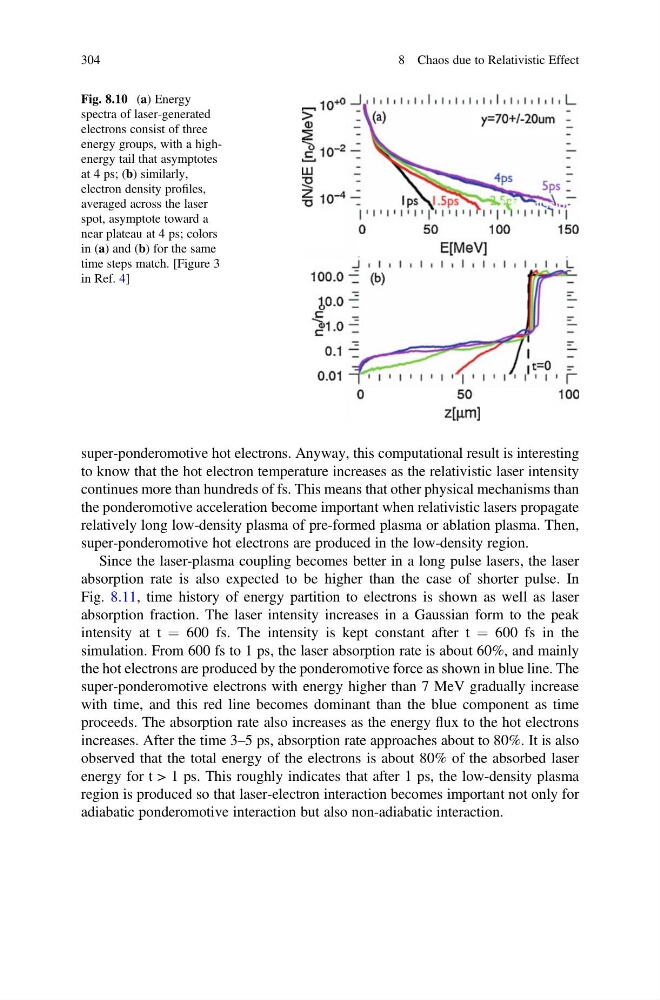
Fig. 8.10 (a) Energy
spectra of laser-generated
electrons consist of three
energy groups, with a highenergy tail that asymptotes
at 4 ps; (b) similarly,
electron density profiles,
averaged across the laser
spot, asymptote toward a
near plateau at 4 ps; colors
in (a) and (b) for the same
time steps match. [Figure 3
in Ref. 4]
304
8 Chaos due to Relativistic Effect
to know that the hot electron temperature increases as the relativistic laser intensity
continues more than hundreds of fs. This means that other physical mechanisms than
the ponderomotive acceleration become important when relativistic lasers propagate
relatively long low-density plasma of pre-formed plasma or ablation plasma. Then,
super-ponderomotive hot electrons are produced in the low-density region.
Since the laser-plasma coupling becomes better in a long pulse lasers, the laser
absorption rate is also expected to be higher than the case of shorter pulse. In
Fig. 8.11, time history of energy partition to electrons is shown as well as laser
absorption fraction. The laser intensity increases in a Gaussian form to the peak
intensity at t ¼ 600 fs. The intensity is kept constant after t ¼ 600 fs in the
simulation. From 600 fs to 1 ps, the laser absorption rate is about 60%, and mainly
the hot electrons are produced by the ponderomotive force as shown in blue line. The
super-ponderomotive electrons with energy higher than 7 MeV gradually increase
with time, and this red line becomes dominant than the blue component as time
proceeds. The absorption rate also increases as the energy flux to the hot electrons
increases. After the time 3–5 ps, absorption rate approaches about to 80%. It is also
observed that the total energy of the electrons is about 80% of the absorbed laser
energy for t > 1 ps. This roughly indicates that after 1 ps, the low-density plasma
region is produced so that laser-electron interaction becomes important not only for
adiabatic ponderomotive interaction but also non-adiabatic interaction.
Fig. 8.10 (a) Energy
spectra of laser-generated
electrons consist of three
energy groups, with a highenergy tail that asymptotes
at 4 ps; (b) similarly,
electron density profiles,
averaged across the laser
spot, asymptote toward a
near plateau at 4 ps; colors
in (a) and (b) for the same
time steps match. [Figure 3
in Ref. 4]
304
8 Chaos due to Relativistic Effect