

accelerated to the x-direction by the electrostatic field. Then, due to the laser direct
acceleration, the electron starts to be accelerated with a lower value of R* after the
time near 877 fs.
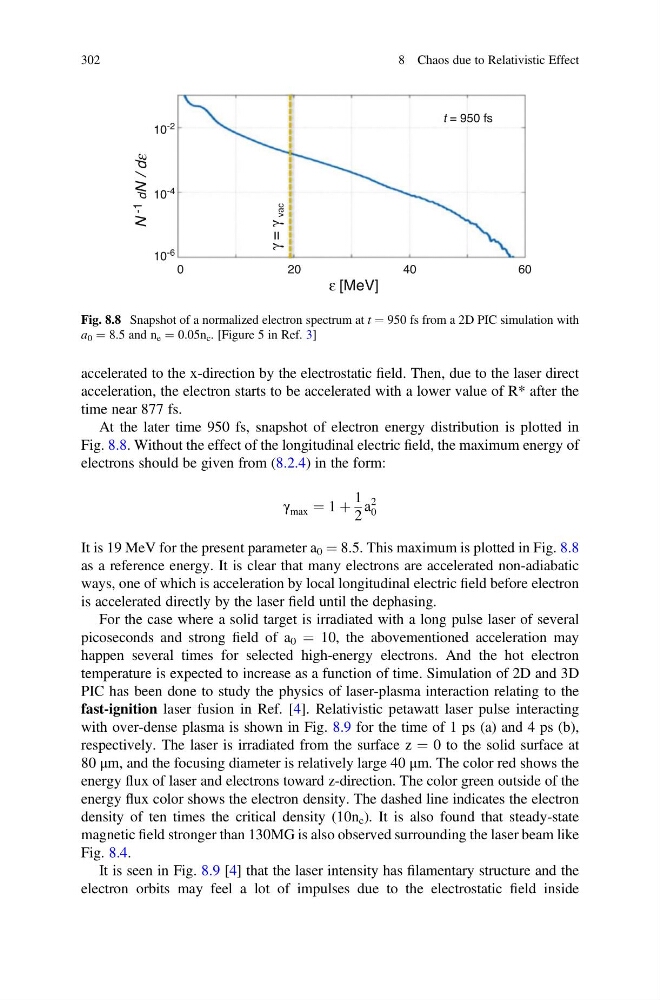
At the later time 950 fs, snapshot of electron energy distribution is plotted in
Fig. 8.8. Without the effect of the longitudinal electric field, the maximum energy of
electrons should be given from (8.2.4) in the form:
γ max ¼ 1 þ
1
2
a
2
0
It is 19 MeV for the present parameter a 0 ¼ 8.5. This maximum is plotted in Fig. 8.8
as a reference energy. It is clear that many electrons are accelerated non-adiabatic
ways, one of which is acceleration by local longitudinal electric field before electron
is accelerated directly by the laser field until the dephasing.
For the case where a solid target is irradiated with a long pulse laser of several
picoseconds and strong field of a 0 ¼ 10, the abovementioned acceleration may
happen several times for selected high-energy electrons. And the hot electron
temperature is expected to increase as a function of time. Simulation of 2D and 3D
PIC has been done to study the physics of laser-plasma interaction relating to the
fast-ignition laser fusion in Ref. [4]. Relativistic petawatt laser pulse interacting
with over-dense plasma is shown in Fig. 8.9 for the time of 1 ps (a) and 4 ps (b),
respectively. The laser is irradiated from the surface z ¼ 0 to the solid surface at
80 μm, and the focusing diameter is relatively large 40 μm. The color red shows the
energy flux of laser and electrons toward z-direction. The color green outside of the
energy flux color shows the electron density. The dashed line indicates the electron
density of ten times the critical density (10n c ). It is also found that steady-state
magnetic field stronger than 130MG is also observed surrounding the laser beam like
Fig. 8.4.
It is seen in Fig. 8.9 [4] that the laser intensity has filamentary structure and the
electron orbits may feel a lot of impulses due to the electrostatic field inside
10
-2
10
-4
10
-6
0
2 0
ε [MeV]
γ =
γ vac
N -1
dN
/ dε
40
60
t = 950 fs
Fig. 8.8 Snapshot of a normalized electron spectrum at t ¼ 950 fs from a 2D PIC simulation with
a 0 ¼ 8.5 and n e ¼ 0.05n c . [Figure 5 in Ref. 3]
302
8 Chaos due to Relativistic Effect
acceleration, the electron starts to be accelerated with a lower value of R* after the
time near 877 fs.
At the later time 950 fs, snapshot of electron energy distribution is plotted in
Fig. 8.8. Without the effect of the longitudinal electric field, the maximum energy of
electrons should be given from (8.2.4) in the form:
γ max ¼ 1 þ
1
2
a
2
0
It is 19 MeV for the present parameter a 0 ¼ 8.5. This maximum is plotted in Fig. 8.8
as a reference energy. It is clear that many electrons are accelerated non-adiabatic
ways, one of which is acceleration by local longitudinal electric field before electron
is accelerated directly by the laser field until the dephasing.
For the case where a solid target is irradiated with a long pulse laser of several
picoseconds and strong field of a 0 ¼ 10, the abovementioned acceleration may
happen several times for selected high-energy electrons. And the hot electron
temperature is expected to increase as a function of time. Simulation of 2D and 3D
PIC has been done to study the physics of laser-plasma interaction relating to the
fast-ignition laser fusion in Ref. [4]. Relativistic petawatt laser pulse interacting
with over-dense plasma is shown in Fig. 8.9 for the time of 1 ps (a) and 4 ps (b),
respectively. The laser is irradiated from the surface z ¼ 0 to the solid surface at
80 μm, and the focusing diameter is relatively large 40 μm. The color red shows the
energy flux of laser and electrons toward z-direction. The color green outside of the
energy flux color shows the electron density. The dashed line indicates the electron
density of ten times the critical density (10n c ). It is also found that steady-state
magnetic field stronger than 130MG is also observed surrounding the laser beam like
Fig. 8.4.
It is seen in Fig. 8.9 [4] that the laser intensity has filamentary structure and the
electron orbits may feel a lot of impulses due to the electrostatic field inside
10
-2
10
-4
10
-6
0
2 0
ε [MeV]
γ =
γ vac
N -1
dN
/ dε
40
60
t = 950 fs
Fig. 8.8 Snapshot of a normalized electron spectrum at t ¼ 950 fs from a 2D PIC simulation with
a 0 ¼ 8.5 and n e ¼ 0.05n c . [Figure 5 in Ref. 3]
302
8 Chaos due to Relativistic Effect