

8.3.1 PIC Simulation
The physical mechanism mentioned above is demonstrated in 2D PIC simulation
[3]. The laser with a 0 ¼ 8.5 propagates in the density channel produced by laser
irradiation in the plasma with the electron density of 0.05 the critical density. As seen
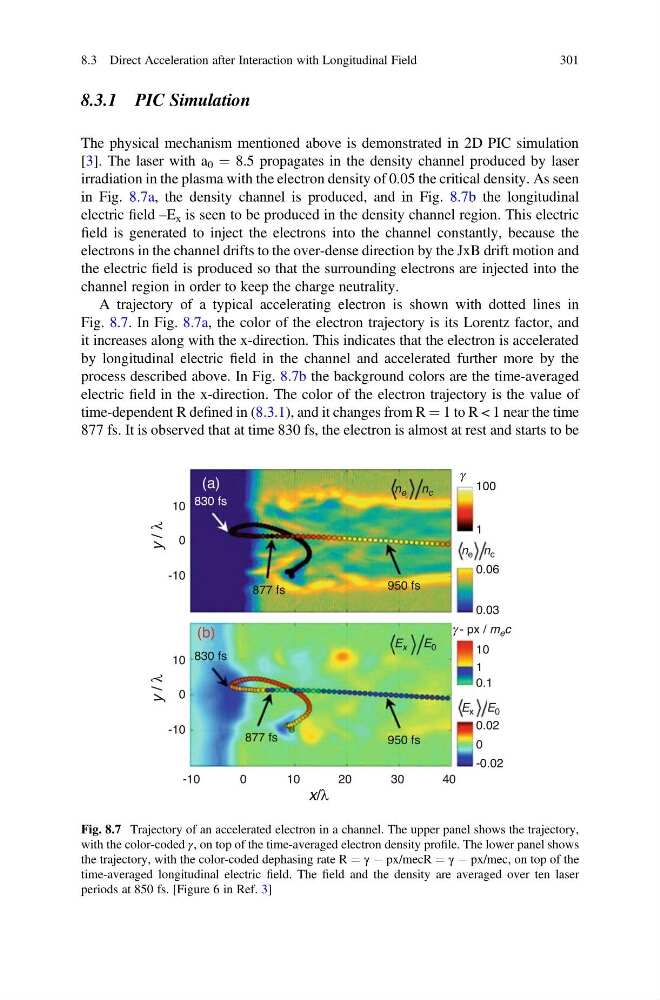
in Fig. 8.7a, the density channel is produced, and in Fig. 8.7b the longitudinal
electric field –E x is seen to be produced in the density channel region. This electric
field is generated to inject the electrons into the channel constantly, because the
electrons in the channel drifts to the over-dense direction by the JxB drift motion and
the electric field is produced so that the surrounding electrons are injected into the
channel region in order to keep the charge neutrality.
A trajectory of a typical accelerating electron is shown with dotted lines in
Fig. 8.7. In Fig. 8.7a, the color of the electron trajectory is its Lorentz factor, and
it increases along with the x-direction. This indicates that the electron is accelerated
by longitudinal electric field in the channel and accelerated further more by the
process described above. In Fig. 8.7b the background colors are the time-averaged
electric field in the x-direction. The color of the electron trajectory is the value of
time-dependent R defined in (8.3.1), and it changes from R ¼ 1 to R < 1 near the time
877 fs. It is observed that at time 830 fs, the electron is almost at rest and starts to be
10
100
n e n c
γ
0.03
0.06
γ - px / m e c
10
1
0.1
0.02
E x E 0
0
-0.02
1
y /
λ
y /
λ
x/λ
0
-10
10 830 fs
830 fs
(b)
(a)
877 fs
877 fs
950 fs
950 fs
E x
n e n c
E 0
10
20
30
40
0
0
-10
-10
Fig. 8.7 Trajectory of an accelerated electron in a channel. The upper panel shows the trajectory,
with the color-coded γ, on top of the time-averaged electron density profile. The lower panel shows
the trajectory, with the color-coded dephasing rate R ¼ γ À px/mecR ¼ γ À px/mec, on top of the
time-averaged longitudinal electric field. The field and the density are averaged over ten laser
periods at 850 fs. [Figure 6 in Ref. 3]
8.3 Direct Acceleration after Interaction with Longitudinal Field
301
The physical mechanism mentioned above is demonstrated in 2D PIC simulation
[3]. The laser with a 0 ¼ 8.5 propagates in the density channel produced by laser
irradiation in the plasma with the electron density of 0.05 the critical density. As seen
in Fig. 8.7a, the density channel is produced, and in Fig. 8.7b the longitudinal
electric field –E x is seen to be produced in the density channel region. This electric
field is generated to inject the electrons into the channel constantly, because the
electrons in the channel drifts to the over-dense direction by the JxB drift motion and
the electric field is produced so that the surrounding electrons are injected into the
channel region in order to keep the charge neutrality.
A trajectory of a typical accelerating electron is shown with dotted lines in
Fig. 8.7. In Fig. 8.7a, the color of the electron trajectory is its Lorentz factor, and
it increases along with the x-direction. This indicates that the electron is accelerated
by longitudinal electric field in the channel and accelerated further more by the
process described above. In Fig. 8.7b the background colors are the time-averaged
electric field in the x-direction. The color of the electron trajectory is the value of
time-dependent R defined in (8.3.1), and it changes from R ¼ 1 to R < 1 near the time
877 fs. It is observed that at time 830 fs, the electron is almost at rest and starts to be
10
100
n e n c
γ
0.03
0.06
γ - px / m e c
10
1
0.1
0.02
E x E 0
0
-0.02
1
y /
λ
y /
λ
x/λ
0
-10
10 830 fs
830 fs
(b)
(a)
877 fs
877 fs
950 fs
950 fs
E x
n e n c
E 0
10
20
30
40
0
0
-10
-10
Fig. 8.7 Trajectory of an accelerated electron in a channel. The upper panel shows the trajectory,
with the color-coded γ, on top of the time-averaged electron density profile. The lower panel shows
the trajectory, with the color-coded dephasing rate R ¼ γ À px/mecR ¼ γ À px/mec, on top of the
time-averaged longitudinal electric field. The field and the density are averaged over ten laser
periods at 850 fs. [Figure 6 in Ref. 3]
8.3 Direct Acceleration after Interaction with Longitudinal Field
301