

If such electron is injected into the laser channel with the x-momentum of
~5 MeV, it is principally possible for the electron is accelerated to the maximum
energy given in (8.2.15), namely,
E=mc
2 ~
a 2
0 Â
ffiffiffiffiffiffiffiffiffiffiffiffiffiffiffi ffi
1
2
a 2
0 þ 1
r
% 270
ð8:2:16Þ
The maximum energy of LIDA electron becomes about 135 MeV. This value can
explain the final energy of three electrons in Fig. 8.3a. In Fig. 8.3d, the green and red
particle’s orbits show strong bending near x ¼ À40 μm. Since this is the surface of
the boundary between the vacuum and the plasma, electrons are reflected by the
sheath field, which helps the loop injection of the electrons.
It is well-known that the above-threshold ionization produces free electrons with
almost the same energy as (8.2.5) dominantly in the x-direction as shown in (8.2.6)
for a large a 0 lasers. However, it is different from the case of a free electron from the
beginning, because the electron interacts with the core of ions via Coulomb force and
is ejected with an additional momentum. So, it is expected at the time of just after the
ionization that the freed electrons have roughly the initial condition (8.2.14) for
strong laser case with a 0 > > 1 like the present simulation. The initial condition is
given by the ponderomotive scattering, and the acceleration physics after the initial
condition near the vacuum boundary is the same as LIDA as seen in Figs. 8.3b, e. It
is noted that for LIDA to act in the system, the laser pulse length should be longer
than the traveling time of the looping electrons. Since the interaction region is about
20 μm, the laser pulse should be longer than the time 66 fs (~20 μm/c).
The other electrons cannot synchronize the laser field as shown in Figs. 8.3c, f. In
Fig. 8.5, final electron energy spectrum is plotted with the black solid line, showing
almost Boltzmann distribution. The fractions of the electron components generated
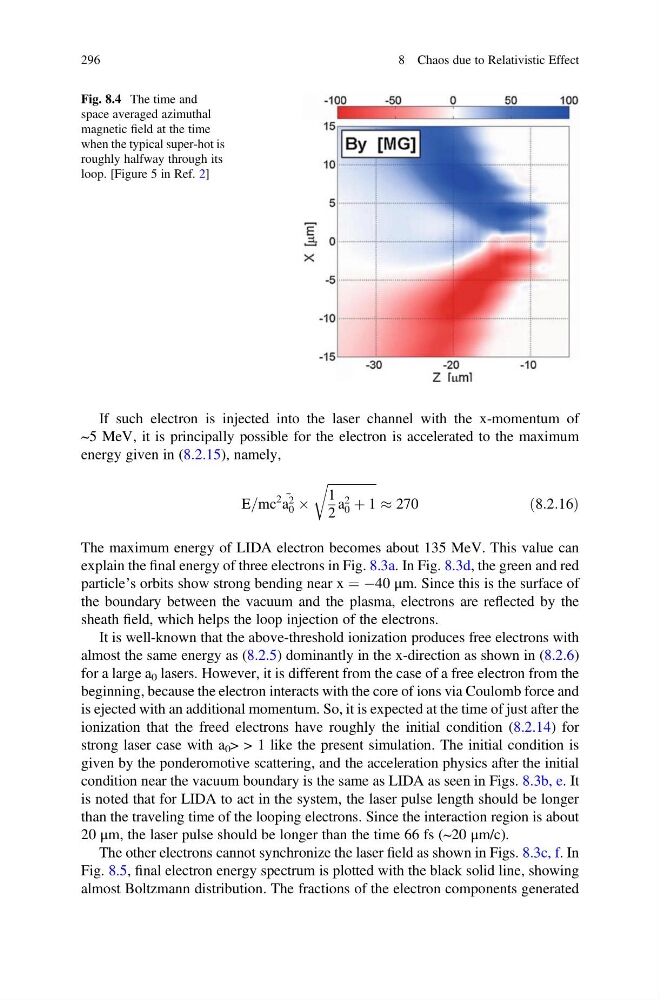
Fig. 8.4 The time and
space averaged azimuthal
magnetic field at the time
when the typical super-hot is
roughly halfway through its
loop. [Figure 5 in Ref. 2]
296
8 Chaos due to Relativistic Effect
~5 MeV, it is principally possible for the electron is accelerated to the maximum
energy given in (8.2.15), namely,
E=mc
2 ~
a 2
0 Â
ffiffiffiffiffiffiffiffiffiffiffiffiffiffiffi ffi
1
2
a 2
0 þ 1
r
% 270
ð8:2:16Þ
The maximum energy of LIDA electron becomes about 135 MeV. This value can
explain the final energy of three electrons in Fig. 8.3a. In Fig. 8.3d, the green and red
particle’s orbits show strong bending near x ¼ À40 μm. Since this is the surface of
the boundary between the vacuum and the plasma, electrons are reflected by the
sheath field, which helps the loop injection of the electrons.
It is well-known that the above-threshold ionization produces free electrons with
almost the same energy as (8.2.5) dominantly in the x-direction as shown in (8.2.6)
for a large a 0 lasers. However, it is different from the case of a free electron from the
beginning, because the electron interacts with the core of ions via Coulomb force and
is ejected with an additional momentum. So, it is expected at the time of just after the
ionization that the freed electrons have roughly the initial condition (8.2.14) for
strong laser case with a 0 > > 1 like the present simulation. The initial condition is
given by the ponderomotive scattering, and the acceleration physics after the initial
condition near the vacuum boundary is the same as LIDA as seen in Figs. 8.3b, e. It
is noted that for LIDA to act in the system, the laser pulse length should be longer
than the traveling time of the looping electrons. Since the interaction region is about
20 μm, the laser pulse should be longer than the time 66 fs (~20 μm/c).
The other electrons cannot synchronize the laser field as shown in Figs. 8.3c, f. In
Fig. 8.5, final electron energy spectrum is plotted with the black solid line, showing
almost Boltzmann distribution. The fractions of the electron components generated
Fig. 8.4 The time and
space averaged azimuthal
magnetic field at the time
when the typical super-hot is
roughly halfway through its
loop. [Figure 5 in Ref. 2]
296
8 Chaos due to Relativistic Effect