

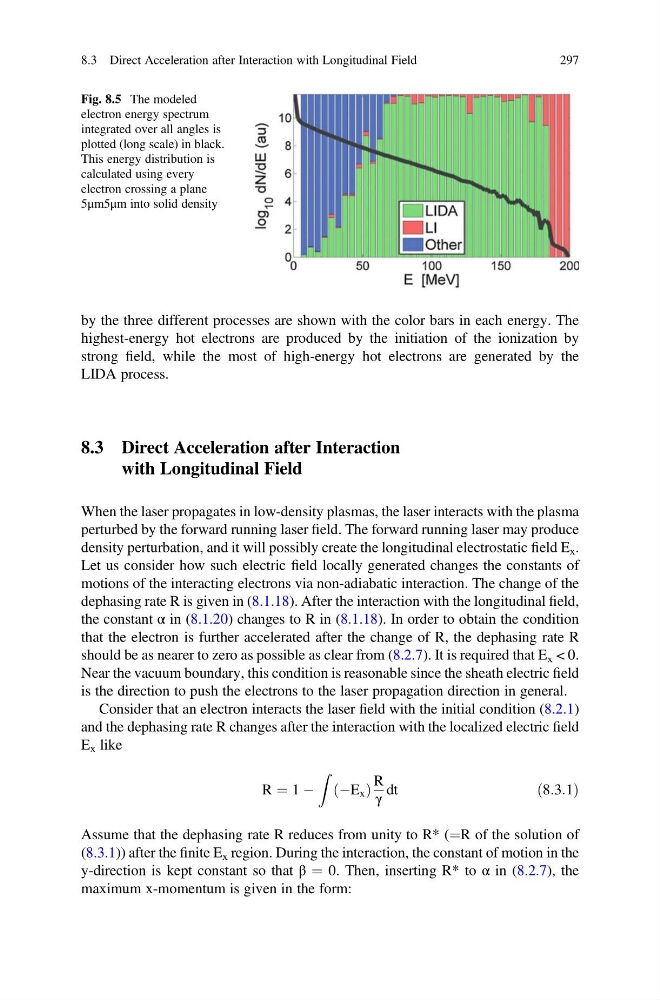
by the three different processes are shown with the color bars in each energy. The
highest-energy hot electrons are produced by the initiation of the ionization by
strong field, while the most of high-energy hot electrons are generated by the
LIDA process.
8.3 Direct Acceleration after Interaction
with Longitudinal Field
When the laser propagates in low-density plasmas, the laser interacts with the plasma
perturbed by the forward running laser field. The forward running laser may produce
density perturbation, and it will possibly create the longitudinal electrostatic field E x .
Let us consider how such electric field locally generated changes the constants of
motions of the interacting electrons via non-adiabatic interaction. The change of the
dephasing rate R is given in (8.1.18). After the interaction with the longitudinal field,
the constant α in (8.1.20) changes to R in (8.1.18). In order to obtain the condition
that the electron is further accelerated after the change of R, the dephasing rate R
should be as nearer to zero as possible as clear from (8.2.7). It is required that E x < 0.
Near the vacuum boundary, this condition is reasonable since the sheath electric field
is the direction to push the electrons to the laser propagation direction in general.
Consider that an electron interacts the laser field with the initial condition (8.2.1)
and the dephasing rate R changes after the interaction with the localized electric field
E x like
R ¼ 1 À
Z
ÀE x
ð
Þ
R
γ
dt
ð8:3:1Þ
Assume that the dephasing rate R reduces from unity to R* (¼R of the solution of
(8.3.1)) after the finite E x region. During the interaction, the constant of motion in the
y-direction is kept constant so that β ¼ 0. Then, inserting R* to α in (8.2.7), the
maximum x-momentum is given in the form:
Fig. 8.5 The modeled
electron energy spectrum
integrated over all angles is
plotted (long scale) in black.
This energy distribution is
calculated using every
electron crossing a plane
5μm5μm into solid density
8.3 Direct Acceleration after Interaction with Longitudinal Field
297
highest-energy hot electrons are produced by the initiation of the ionization by
strong field, while the most of high-energy hot electrons are generated by the
LIDA process.
8.3 Direct Acceleration after Interaction
with Longitudinal Field
When the laser propagates in low-density plasmas, the laser interacts with the plasma
perturbed by the forward running laser field. The forward running laser may produce
density perturbation, and it will possibly create the longitudinal electrostatic field E x .
Let us consider how such electric field locally generated changes the constants of
motions of the interacting electrons via non-adiabatic interaction. The change of the
dephasing rate R is given in (8.1.18). After the interaction with the longitudinal field,
the constant α in (8.1.20) changes to R in (8.1.18). In order to obtain the condition
that the electron is further accelerated after the change of R, the dephasing rate R
should be as nearer to zero as possible as clear from (8.2.7). It is required that E x < 0.
Near the vacuum boundary, this condition is reasonable since the sheath electric field
is the direction to push the electrons to the laser propagation direction in general.
Consider that an electron interacts the laser field with the initial condition (8.2.1)
and the dephasing rate R changes after the interaction with the localized electric field
E x like
R ¼ 1 À
Z
ÀE x
ð
Þ
R
γ
dt
ð8:3:1Þ
Assume that the dephasing rate R reduces from unity to R* (¼R of the solution of
(8.3.1)) after the finite E x region. During the interaction, the constant of motion in the
y-direction is kept constant so that β ¼ 0. Then, inserting R* to α in (8.2.7), the
maximum x-momentum is given in the form:
Fig. 8.5 The modeled
electron energy spectrum
integrated over all angles is
plotted (long scale) in black.
This energy distribution is
calculated using every
electron crossing a plane
5μm5μm into solid density
8.3 Direct Acceleration after Interaction with Longitudinal Field
297