

8.2.2 Acceleration (2)
The second simple case is to start the electron motion with large initial momentum in
the x-direction. From the general relation (8.2.7), higher maximum energy is
obtained if the initial value α is small enough:
0 < α << 1
ð8:2:13Þ
The condition (8.2.13) can be satisfied with the following initial conditions:
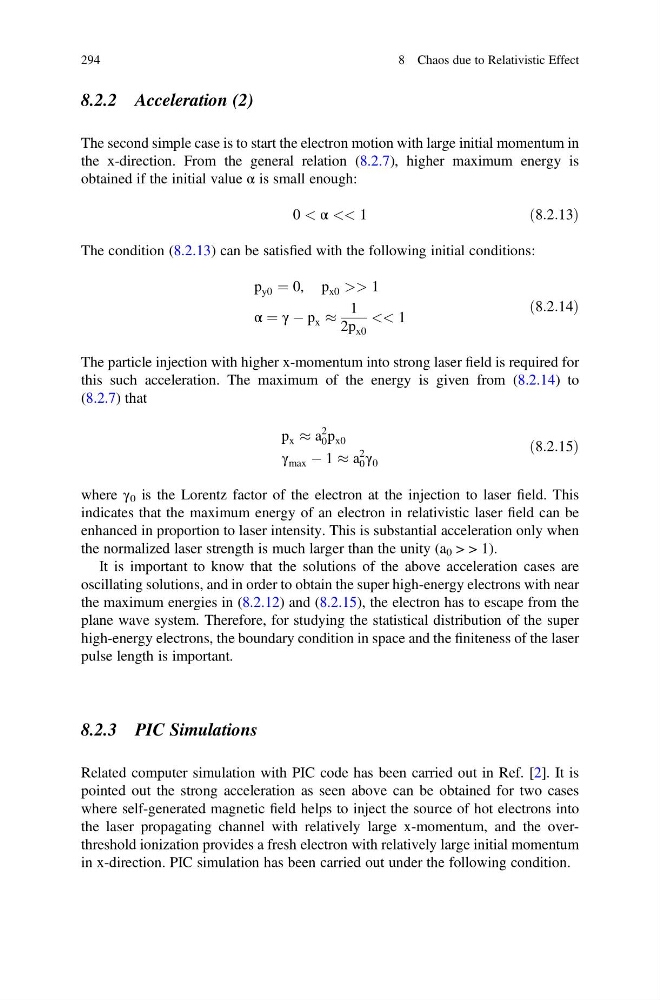
p y0 ¼ 0, p x0 >> 1
α ¼ γ À p x %
1
2p x0
<< 1
ð8:2:14Þ
The particle injection with higher x-momentum into strong laser field is required for
this such acceleration. The maximum of the energy is given from (8.2.14) to
(8.2.7) that
p x % a
2
0 p x0
γ max À 1 % a
2
0 γ 0
ð8:2:15Þ
where γ 0 is the Lorentz factor of the electron at the injection to laser field. This
indicates that the maximum energy of an electron in relativistic laser field can be
enhanced in proportion to laser intensity. This is substantial acceleration only when
the normalized laser strength is much larger than the unity (a 0 > > 1).
It is important to know that the solutions of the above acceleration cases are
oscillating solutions, and in order to obtain the super high-energy electrons with near
the maximum energies in (8.2.12) and (8.2.15), the electron has to escape from the
plane wave system. Therefore, for studying the statistical distribution of the super
high-energy electrons, the boundary condition in space and the finiteness of the laser
pulse length is important.
8.2.3 PIC Simulations
Related computer simulation with PIC code has been carried out in Ref. [2]. It is
pointed out the strong acceleration as seen above can be obtained for two cases
where self-generated magnetic field helps to inject the source of hot electrons into
the laser propagating channel with relatively large x-momentum, and the overthreshold ionization provides a fresh electron with relatively large initial momentum
in x-direction. PIC simulation has been carried out under the following condition.
294
8 Chaos due to Relativistic Effect
The second simple case is to start the electron motion with large initial momentum in
the x-direction. From the general relation (8.2.7), higher maximum energy is
obtained if the initial value α is small enough:
0 < α << 1
ð8:2:13Þ
The condition (8.2.13) can be satisfied with the following initial conditions:
p y0 ¼ 0, p x0 >> 1
α ¼ γ À p x %
1
2p x0
<< 1
ð8:2:14Þ
The particle injection with higher x-momentum into strong laser field is required for
this such acceleration. The maximum of the energy is given from (8.2.14) to
(8.2.7) that
p x % a
2
0 p x0
γ max À 1 % a
2
0 γ 0
ð8:2:15Þ
where γ 0 is the Lorentz factor of the electron at the injection to laser field. This
indicates that the maximum energy of an electron in relativistic laser field can be
enhanced in proportion to laser intensity. This is substantial acceleration only when
the normalized laser strength is much larger than the unity (a 0 > > 1).
It is important to know that the solutions of the above acceleration cases are
oscillating solutions, and in order to obtain the super high-energy electrons with near
the maximum energies in (8.2.12) and (8.2.15), the electron has to escape from the
plane wave system. Therefore, for studying the statistical distribution of the super
high-energy electrons, the boundary condition in space and the finiteness of the laser
pulse length is important.
8.2.3 PIC Simulations
Related computer simulation with PIC code has been carried out in Ref. [2]. It is
pointed out the strong acceleration as seen above can be obtained for two cases
where self-generated magnetic field helps to inject the source of hot electrons into
the laser propagating channel with relatively large x-momentum, and the overthreshold ionization provides a fresh electron with relatively large initial momentum
in x-direction. PIC simulation has been carried out under the following condition.
294
8 Chaos due to Relativistic Effect