

8.2.1 Acceleration (1)
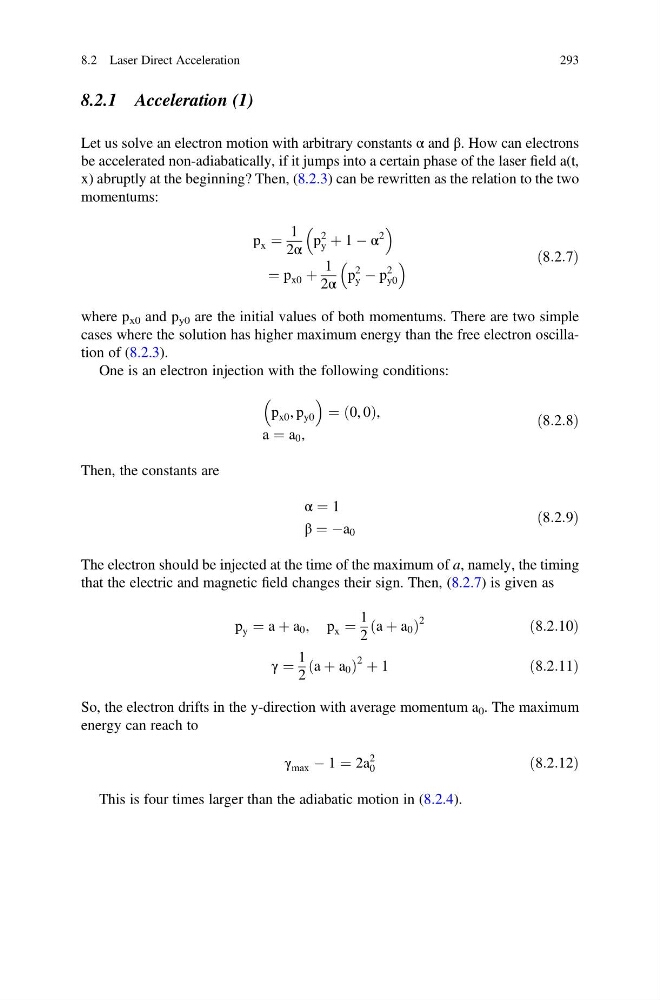
Let us solve an electron motion with arbitrary constants α and β. How can electrons
be accelerated non-adiabatically, if it jumps into a certain phase of the laser field a(t,
x) abruptly at the beginning? Then, (8.2.3) can be rewritten as the relation to the two
momentums:
p x ¼
1
2α
p
2
y þ 1 À α
2
¼ p x0 þ
1
2α
p
2
y À p
2
y0
ð8:2:7Þ
where p x0 and p y0 are the initial values of both momentums. There are two simple
cases where the solution has higher maximum energy than the free electron oscillation of (8.2.3).
One is an electron injection with the following conditions:
p x0 , p y0
¼ 0, 0
ð Þ,
a ¼ a 0 ,
ð8:2:8Þ
Then, the constants are
α ¼ 1
β ¼ Àa 0
ð8:2:9Þ
The electron should be injected at the time of the maximum of a, namely, the timing
that the electric and magnetic field changes their sign. Then, (8.2.7) is given as
p y ¼ a þ a 0 , p x ¼
1
2
a þ a 0
ð
Þ
2
ð8:2:10Þ
γ ¼
1
2
a þ a 0
ð
Þ
2 þ 1
ð8:2:11Þ
So, the electron drifts in the y-direction with average momentum a 0 . The maximum
energy can reach to
γ max À 1 ¼ 2a
2
0
ð8:2:12Þ
This is four times larger than the adiabatic motion in (8.2.4).
8.2 Laser Direct Acceleration
293
Let us solve an electron motion with arbitrary constants α and β. How can electrons
be accelerated non-adiabatically, if it jumps into a certain phase of the laser field a(t,
x) abruptly at the beginning? Then, (8.2.3) can be rewritten as the relation to the two
momentums:
p x ¼
1
2α
p
2
y þ 1 À α
2
¼ p x0 þ
1
2α
p
2
y À p
2
y0
ð8:2:7Þ
where p x0 and p y0 are the initial values of both momentums. There are two simple
cases where the solution has higher maximum energy than the free electron oscillation of (8.2.3).
One is an electron injection with the following conditions:
p x0 , p y0
¼ 0, 0
ð Þ,
a ¼ a 0 ,
ð8:2:8Þ
Then, the constants are
α ¼ 1
β ¼ Àa 0
ð8:2:9Þ
The electron should be injected at the time of the maximum of a, namely, the timing
that the electric and magnetic field changes their sign. Then, (8.2.7) is given as
p y ¼ a þ a 0 , p x ¼
1
2
a þ a 0
ð
Þ
2
ð8:2:10Þ
γ ¼
1
2
a þ a 0
ð
Þ
2 þ 1
ð8:2:11Þ
So, the electron drifts in the y-direction with average momentum a 0 . The maximum
energy can reach to
γ max À 1 ¼ 2a
2
0
ð8:2:12Þ
This is four times larger than the adiabatic motion in (8.2.4).
8.2 Laser Direct Acceleration
293