

p x ¼
1
2α
p
2
y þ 1 À α
2
ð8:1:21Þ
The constant α is determined by the initial condition, p x ¼ p x0 and p y ¼ p y0 at t ¼ 0.
Then, (8.1.21) can be rewritten as
p x ¼
1
2α
p
2
y þ p x0 À
1
2α
p
2
y0
ð8:1:22Þ
In what follows, consider the property of the solution of (8.1.22) in the case with
p y0 ¼ 0, namely, β ¼ 0 for a ¼ 0 at t ¼ 0.
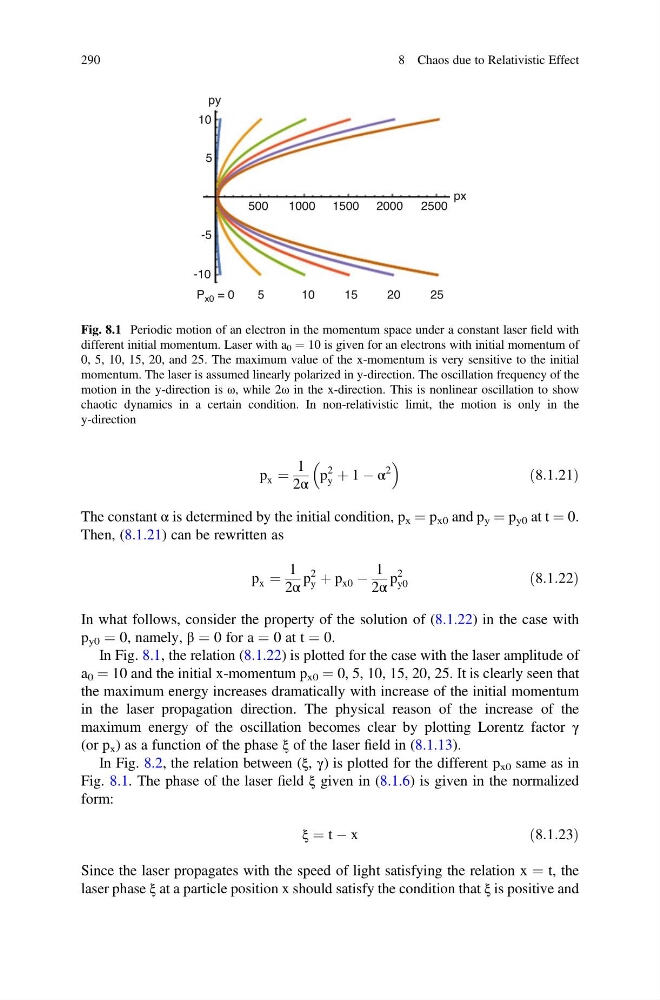
In Fig. 8.1, the relation (8.1.22) is plotted for the case with the laser amplitude of
a 0 ¼ 10 and the initial x-momentum p x0 ¼ 0, 5, 10, 15, 20, 25. It is clearly seen that
the maximum energy increases dramatically with increase of the initial momentum
in the laser propagation direction. The physical reason of the increase of the
maximum energy of the oscillation becomes clear by plotting Lorentz factor γ
(or p x ) as a function of the phase ξ of the laser field in (8.1.13).
In Fig. 8.2, the relation between (ξ, γ) is plotted for the different p x0 same as in
Fig. 8.1. The phase of the laser field ξ given in (8.1.6) is given in the normalized
form:
ξ ¼ t À x
ð8:1:23Þ
Since the laser propagates with the speed of light satisfying the relation x ¼ t, the
laser phase ξ at a particle position x should satisfy the condition that ξ is positive and
py
px
P x0 = 0
500
1000 1500 2000 2500
5
1 0
1 5
2 0
2 5
10
5
-5
-10
Fig. 8.1 Periodic motion of an electron in the momentum space under a constant laser field with
different initial momentum. Laser with a 0 ¼ 10 is given for an electrons with initial momentum of
0, 5, 10, 15, 20, and 25. The maximum value of the x-momentum is very sensitive to the initial
momentum. The laser is assumed linearly polarized in y-direction. The oscillation frequency of the
motion in the y-direction is ω, while 2ω in the x-direction. This is nonlinear oscillation to show
chaotic dynamics in a certain condition. In non-relativistic limit, the motion is only in the
y-direction
290
8 Chaos due to Relativistic Effect
1
2α
p
2
y þ 1 À α
2
ð8:1:21Þ
The constant α is determined by the initial condition, p x ¼ p x0 and p y ¼ p y0 at t ¼ 0.
Then, (8.1.21) can be rewritten as
p x ¼
1
2α
p
2
y þ p x0 À
1
2α
p
2
y0
ð8:1:22Þ
In what follows, consider the property of the solution of (8.1.22) in the case with
p y0 ¼ 0, namely, β ¼ 0 for a ¼ 0 at t ¼ 0.
In Fig. 8.1, the relation (8.1.22) is plotted for the case with the laser amplitude of
a 0 ¼ 10 and the initial x-momentum p x0 ¼ 0, 5, 10, 15, 20, 25. It is clearly seen that
the maximum energy increases dramatically with increase of the initial momentum
in the laser propagation direction. The physical reason of the increase of the
maximum energy of the oscillation becomes clear by plotting Lorentz factor γ
(or p x ) as a function of the phase ξ of the laser field in (8.1.13).
In Fig. 8.2, the relation between (ξ, γ) is plotted for the different p x0 same as in
Fig. 8.1. The phase of the laser field ξ given in (8.1.6) is given in the normalized
form:
ξ ¼ t À x
ð8:1:23Þ
Since the laser propagates with the speed of light satisfying the relation x ¼ t, the
laser phase ξ at a particle position x should satisfy the condition that ξ is positive and
py
px
P x0 = 0
500
1000 1500 2000 2500
5
1 0
1 5
2 0
2 5
10
5
-5
-10
Fig. 8.1 Periodic motion of an electron in the momentum space under a constant laser field with
different initial momentum. Laser with a 0 ¼ 10 is given for an electrons with initial momentum of
0, 5, 10, 15, 20, and 25. The maximum value of the x-momentum is very sensitive to the initial
momentum. The laser is assumed linearly polarized in y-direction. The oscillation frequency of the
motion in the y-direction is ω, while 2ω in the x-direction. This is nonlinear oscillation to show
chaotic dynamics in a certain condition. In non-relativistic limit, the motion is only in the
y-direction
290
8 Chaos due to Relativistic Effect