

∂a
∂t
þ
∂a
∂x
¼ 0
ð8:1:14Þ
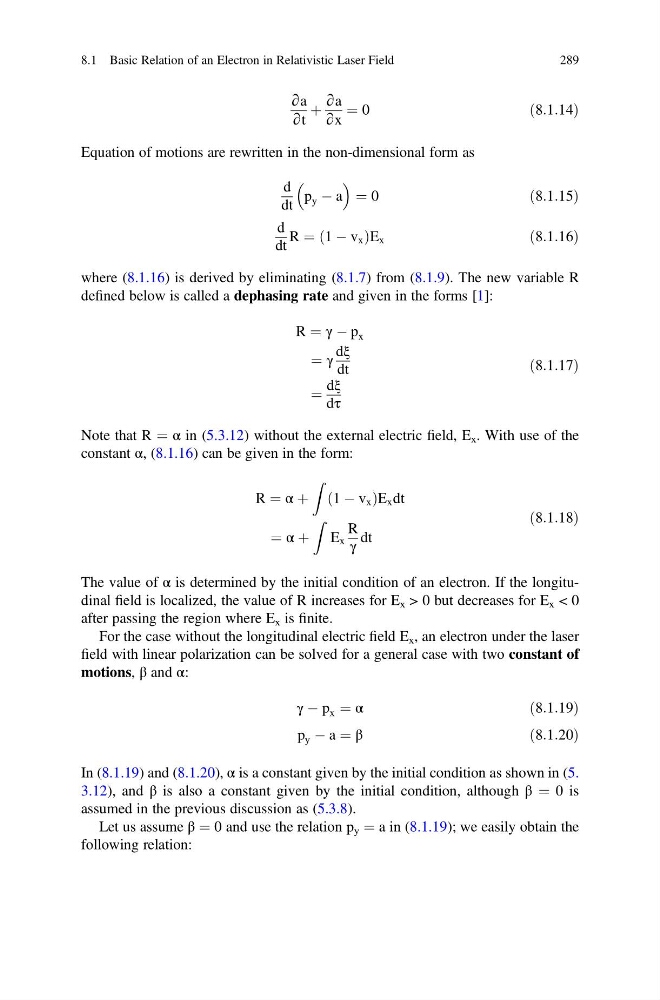
Equation of motions are rewritten in the non-dimensional form as
d
dt
p y À a
¼ 0
ð8:1:15Þ
d
dt
R ¼ 1 À v x
ð
ÞE x
ð8:1:16Þ
where (8.1.16) is derived by eliminating (8.1.7) from (8.1.9). The new variable R
defined below is called a dephasing rate and given in the forms [1]:
R ¼ γ À p x
¼ γ
dξ
dt
¼
dξ
dτ
ð8:1:17Þ
Note that R ¼ α in (5.3.12) without the external electric field, E x . With use of the
constant α, (8.1.16) can be given in the form:
R ¼ α þ
Z
1 À v x
ð
ÞE x dt
¼ α þ
Z
E x
R
γ
dt
ð8:1:18Þ
The value of α is determined by the initial condition of an electron. If the longitudinal field is localized, the value of R increases for E x > 0 but decreases for E x < 0
after passing the region where E x is finite.
For the case without the longitudinal electric field E x , an electron under the laser
field with linear polarization can be solved for a general case with two constant of
motions, β and α:
γ À p x ¼ α
ð8:1:19Þ
p y À a ¼ β
ð8:1:20Þ
In (8.1.19) and (8.1.20), α is a constant given by the initial condition as shown in (5.
3.12), and β is also a constant given by the initial condition, although β ¼ 0 is
assumed in the previous discussion as (5.3.8).
Let us assume β ¼ 0 and use the relation p y ¼ a in (8.1.19); we easily obtain the
following relation:
8.1 Basic Relation of an Electron in Relativistic Laser Field
289
∂t
þ
∂a
∂x
¼ 0
ð8:1:14Þ
Equation of motions are rewritten in the non-dimensional form as
d
dt
p y À a
¼ 0
ð8:1:15Þ
d
dt
R ¼ 1 À v x
ð
ÞE x
ð8:1:16Þ
where (8.1.16) is derived by eliminating (8.1.7) from (8.1.9). The new variable R
defined below is called a dephasing rate and given in the forms [1]:
R ¼ γ À p x
¼ γ
dξ
dt
¼
dξ
dτ
ð8:1:17Þ
Note that R ¼ α in (5.3.12) without the external electric field, E x . With use of the
constant α, (8.1.16) can be given in the form:
R ¼ α þ
Z
1 À v x
ð
ÞE x dt
¼ α þ
Z
E x
R
γ
dt
ð8:1:18Þ
The value of α is determined by the initial condition of an electron. If the longitudinal field is localized, the value of R increases for E x > 0 but decreases for E x < 0
after passing the region where E x is finite.
For the case without the longitudinal electric field E x , an electron under the laser
field with linear polarization can be solved for a general case with two constant of
motions, β and α:
γ À p x ¼ α
ð8:1:19Þ
p y À a ¼ β
ð8:1:20Þ
In (8.1.19) and (8.1.20), α is a constant given by the initial condition as shown in (5.
3.12), and β is also a constant given by the initial condition, although β ¼ 0 is
assumed in the previous discussion as (5.3.8).
Let us assume β ¼ 0 and use the relation p y ¼ a in (8.1.19); we easily obtain the
following relation:
8.1 Basic Relation of an Electron in Relativistic Laser Field
289