

ξ ¼ ω t À x=c
ð
Þþξ 0
ð8:1:6Þ
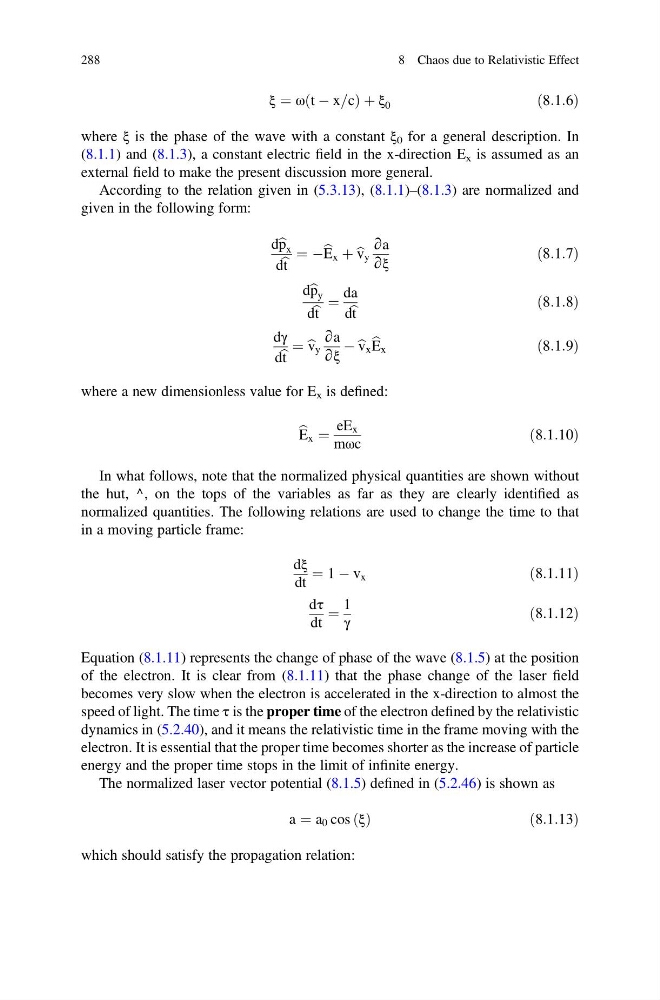
where ξ is the phase of the wave with a constant ξ 0 for a general description. In
(8.1.1) and (8.1.3), a constant electric field in the x-direction E x is assumed as an
external field to make the present discussion more general.
According to the relation given in (5.3.13), (8.1.1)–(8.1.3) are normalized and
given in the following form:
db p x
d b t
¼ À b
E x þ b v y
∂a
∂ξ
ð8:1:7Þ
db p y
d b t
¼
da
d b t
ð8:1:8Þ
dγ
d b t
¼ b v y
∂a
∂ξ
À b v x b
E x
ð8:1:9Þ
where a new dimensionless value for E x is defined:
b
E x ¼
eE x
mωc
ð8:1:10Þ
In what follows, note that the normalized physical quantities are shown without
the hut, ^, on the tops of the variables as far as they are clearly identified as
normalized quantities. The following relations are used to change the time to that
in a moving particle frame:
dξ
dt
¼ 1 À v x
ð8:1:11Þ
dτ
dt
¼
1
γ
ð8:1:12Þ
Equation (8.1.11) represents the change of phase of the wave (8.1.5) at the position
of the electron. It is clear from (8.1.11) that the phase change of the laser field
becomes very slow when the electron is accelerated in the x-direction to almost the
speed of light. The time τ is the proper time of the electron defined by the relativistic
dynamics in (5.2.40), and it means the relativistic time in the frame moving with the
electron. It is essential that the proper time becomes shorter as the increase of particle
energy and the proper time stops in the limit of infinite energy.
The normalized laser vector potential (8.1.5) defined in (5.2.46) is shown as
a ¼ a 0 cos ξ
ð Þ
ð8:1:13Þ
which should satisfy the propagation relation:
288
8 Chaos due to Relativistic Effect
ð
Þþξ 0
ð8:1:6Þ
where ξ is the phase of the wave with a constant ξ 0 for a general description. In
(8.1.1) and (8.1.3), a constant electric field in the x-direction E x is assumed as an
external field to make the present discussion more general.
According to the relation given in (5.3.13), (8.1.1)–(8.1.3) are normalized and
given in the following form:
db p x
d b t
¼ À b
E x þ b v y
∂a
∂ξ
ð8:1:7Þ
db p y
d b t
¼
da
d b t
ð8:1:8Þ
dγ
d b t
¼ b v y
∂a
∂ξ
À b v x b
E x
ð8:1:9Þ
where a new dimensionless value for E x is defined:
b
E x ¼
eE x
mωc
ð8:1:10Þ
In what follows, note that the normalized physical quantities are shown without
the hut, ^, on the tops of the variables as far as they are clearly identified as
normalized quantities. The following relations are used to change the time to that
in a moving particle frame:
dξ
dt
¼ 1 À v x
ð8:1:11Þ
dτ
dt
¼
1
γ
ð8:1:12Þ
Equation (8.1.11) represents the change of phase of the wave (8.1.5) at the position
of the electron. It is clear from (8.1.11) that the phase change of the laser field
becomes very slow when the electron is accelerated in the x-direction to almost the
speed of light. The time τ is the proper time of the electron defined by the relativistic
dynamics in (5.2.40), and it means the relativistic time in the frame moving with the
electron. It is essential that the proper time becomes shorter as the increase of particle
energy and the proper time stops in the limit of infinite energy.
The normalized laser vector potential (8.1.5) defined in (5.2.46) is shown as
a ¼ a 0 cos ξ
ð Þ
ð8:1:13Þ
which should satisfy the propagation relation:
288
8 Chaos due to Relativistic Effect