

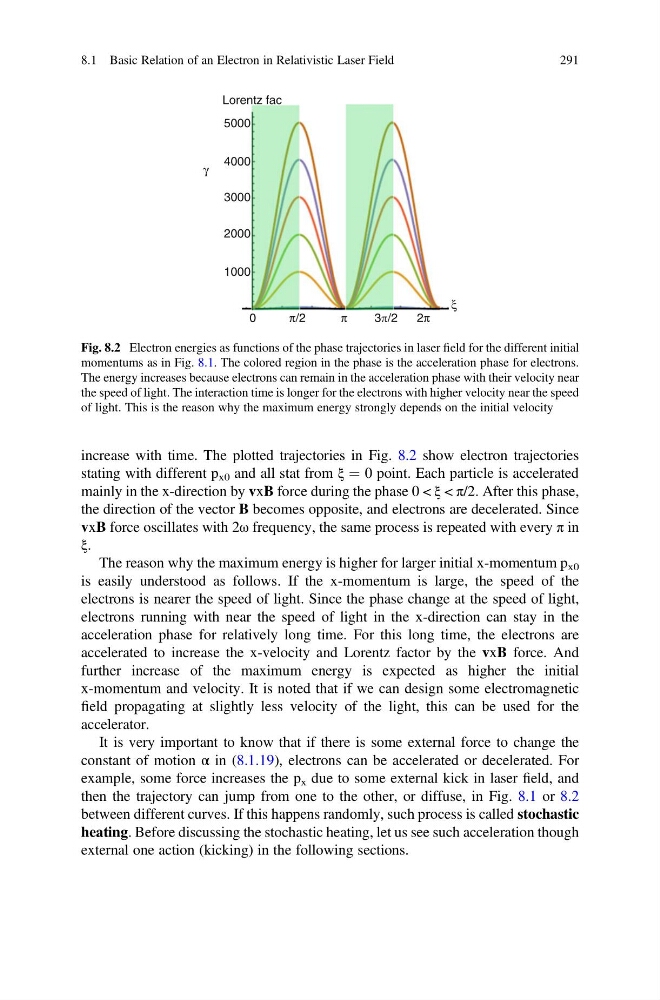
increase with time. The plotted trajectories in Fig. 8.2 show electron trajectories
stating with different p x0 and all stat from ξ ¼ 0 point. Each particle is accelerated
mainly in the x-direction by vxB force during the phase 0 < ξ < π/2. After this phase,
the direction of the vector B becomes opposite, and electrons are decelerated. Since
vxB force oscillates with 2ω frequency, the same process is repeated with every π in
ξ.
The reason why the maximum energy is higher for larger initial x-momentum p x0
is easily understood as follows. If the x-momentum is large, the speed of the
electrons is nearer the speed of light. Since the phase change at the speed of light,
electrons running with near the speed of light in the x-direction can stay in the
acceleration phase for relatively long time. For this long time, the electrons are
accelerated to increase the x-velocity and Lorentz factor by the vxB force. And
further increase of the maximum energy is expected as higher the initial
x-momentum and velocity. It is noted that if we can design some electromagnetic
field propagating at slightly less velocity of the light, this can be used for the
accelerator.
It is very important to know that if there is some external force to change the
constant of motion α in (8.1.19), electrons can be accelerated or decelerated. For
example, some force increases the p x due to some external kick in laser field, and
then the trajectory can jump from one to the other, or diffuse, in Fig. 8.1 or 8.2
between different curves. If this happens randomly, such process is called stochastic
heating. Before discussing the stochastic heating, let us see such acceleration though
external one action (kicking) in the following sections.
5000
4000
3000
2000
1000
Lorentz fac
0
γ
π/2
π
3p/2
2π
ξ
Fig. 8.2 Electron energies as functions of the phase trajectories in laser field for the different initial
momentums as in Fig. 8.1. The colored region in the phase is the acceleration phase for electrons.
The energy increases because electrons can remain in the acceleration phase with their velocity near
the speed of light. The interaction time is longer for the electrons with higher velocity near the speed
of light. This is the reason why the maximum energy strongly depends on the initial velocity
8.1 Basic Relation of an Electron in Relativistic Laser Field
291
stating with different p x0 and all stat from ξ ¼ 0 point. Each particle is accelerated
mainly in the x-direction by vxB force during the phase 0 < ξ < π/2. After this phase,
the direction of the vector B becomes opposite, and electrons are decelerated. Since
vxB force oscillates with 2ω frequency, the same process is repeated with every π in
ξ.
The reason why the maximum energy is higher for larger initial x-momentum p x0
is easily understood as follows. If the x-momentum is large, the speed of the
electrons is nearer the speed of light. Since the phase change at the speed of light,
electrons running with near the speed of light in the x-direction can stay in the
acceleration phase for relatively long time. For this long time, the electrons are
accelerated to increase the x-velocity and Lorentz factor by the vxB force. And
further increase of the maximum energy is expected as higher the initial
x-momentum and velocity. It is noted that if we can design some electromagnetic
field propagating at slightly less velocity of the light, this can be used for the
accelerator.
It is very important to know that if there is some external force to change the
constant of motion α in (8.1.19), electrons can be accelerated or decelerated. For
example, some force increases the p x due to some external kick in laser field, and
then the trajectory can jump from one to the other, or diffuse, in Fig. 8.1 or 8.2
between different curves. If this happens randomly, such process is called stochastic
heating. Before discussing the stochastic heating, let us see such acceleration though
external one action (kicking) in the following sections.
5000
4000
3000
2000
1000
Lorentz fac
0
γ
π/2
π
3p/2
2π
ξ
Fig. 8.2 Electron energies as functions of the phase trajectories in laser field for the different initial
momentums as in Fig. 8.1. The colored region in the phase is the acceleration phase for electrons.
The energy increases because electrons can remain in the acceleration phase with their velocity near
the speed of light. The interaction time is longer for the electrons with higher velocity near the speed
of light. This is the reason why the maximum energy strongly depends on the initial velocity
8.1 Basic Relation of an Electron in Relativistic Laser Field
291