

fundamental question laser can laser propagate in the space much shorter than the
laser wavelength? The nickel target with pillars made of 55 nm and spacing 100 nm
and height 15 μm is irradiated by laser of 5 Â 10
18 W/cm
2 , 400 nm wavelength, and
60 fs pulse duration. It is demonstrated experimentally that He-like Ni line emission
is observed about 100 times stronger than the case of flat nickel foil experiment. It is
inferred that the enhanced number of hot electrons and enhanced laser absorption are
demonstrated in this experiment.
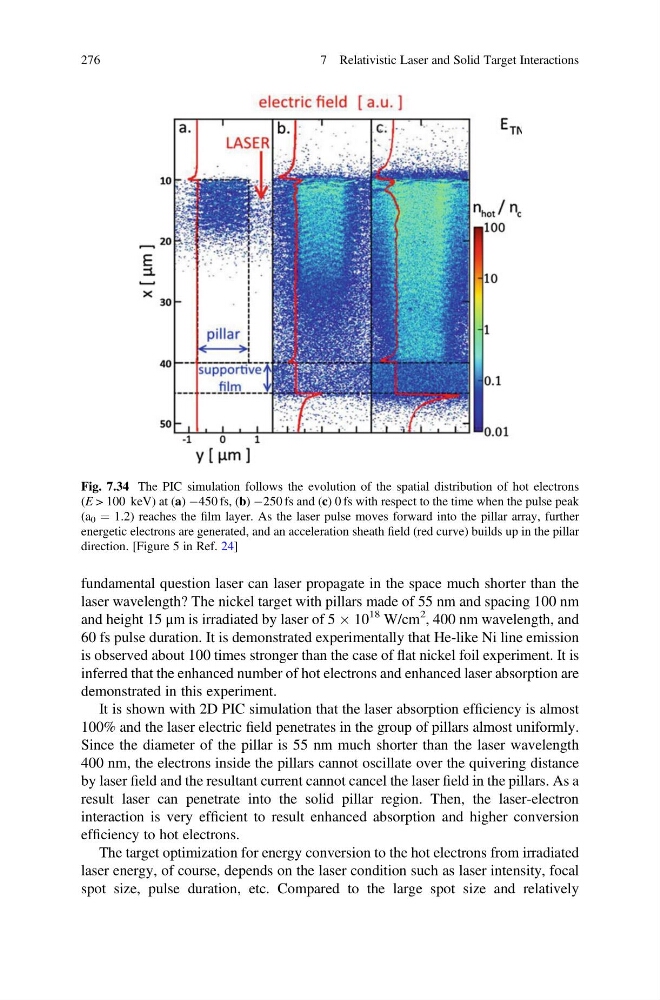
It is shown with 2D PIC simulation that the laser absorption efficiency is almost
100% and the laser electric field penetrates in the group of pillars almost uniformly.
Since the diameter of the pillar is 55 nm much shorter than the laser wavelength
400 nm, the electrons inside the pillars cannot oscillate over the quivering distance
by laser field and the resultant current cannot cancel the laser field in the pillars. As a
result laser can penetrate into the solid pillar region. Then, the laser-electron
interaction is very efficient to result enhanced absorption and higher conversion
efficiency to hot electrons.
The target optimization for energy conversion to the hot electrons from irradiated
laser energy, of course, depends on the laser condition such as laser intensity, focal
spot size, pulse duration, etc. Compared to the large spot size and relatively
Fig. 7.34 The PIC simulation follows the evolution of the spatial distribution of hot electrons
(E > 100 keV) at (a) À450 fs, (b) À250 fs and (c) 0 fs with respect to the time when the pulse peak
(a 0 ¼ 1.2) reaches the film layer. As the laser pulse moves forward into the pillar array, further
energetic electrons are generated, and an acceleration sheath field (red curve) builds up in the pillar
direction. [Figure 5 in Ref. 24]
276
7 Relativistic Laser and Solid Target Interactions
laser wavelength? The nickel target with pillars made of 55 nm and spacing 100 nm
and height 15 μm is irradiated by laser of 5 Â 10
18 W/cm
2 , 400 nm wavelength, and
60 fs pulse duration. It is demonstrated experimentally that He-like Ni line emission
is observed about 100 times stronger than the case of flat nickel foil experiment. It is
inferred that the enhanced number of hot electrons and enhanced laser absorption are
demonstrated in this experiment.
It is shown with 2D PIC simulation that the laser absorption efficiency is almost
100% and the laser electric field penetrates in the group of pillars almost uniformly.
Since the diameter of the pillar is 55 nm much shorter than the laser wavelength
400 nm, the electrons inside the pillars cannot oscillate over the quivering distance
by laser field and the resultant current cannot cancel the laser field in the pillars. As a
result laser can penetrate into the solid pillar region. Then, the laser-electron
interaction is very efficient to result enhanced absorption and higher conversion
efficiency to hot electrons.
The target optimization for energy conversion to the hot electrons from irradiated
laser energy, of course, depends on the laser condition such as laser intensity, focal
spot size, pulse duration, etc. Compared to the large spot size and relatively
Fig. 7.34 The PIC simulation follows the evolution of the spatial distribution of hot electrons
(E > 100 keV) at (a) À450 fs, (b) À250 fs and (c) 0 fs with respect to the time when the pulse peak
(a 0 ¼ 1.2) reaches the film layer. As the laser pulse moves forward into the pillar array, further
energetic electrons are generated, and an acceleration sheath field (red curve) builds up in the pillar
direction. [Figure 5 in Ref. 24]
276
7 Relativistic Laser and Solid Target Interactions