

hot electron acceleration and/or generation in such stochastic system will be
discussed later.
In Fig. 7.26a, expanding electrons are seen in the rear side of the target. The
electrons are expanding hemispherically, accompanying relatively smooth structure
of strong longitudinal electric field. The electric field is clear to be produced by the
charge separation, and sheath potential confines the expanding electrons. Theory of
the plasma sheath shows that the hot electrons are bouncing many times in the
hemisphere and transfers small amount of energy to the ions, roughly a fraction of
mass ratio in each bounce.
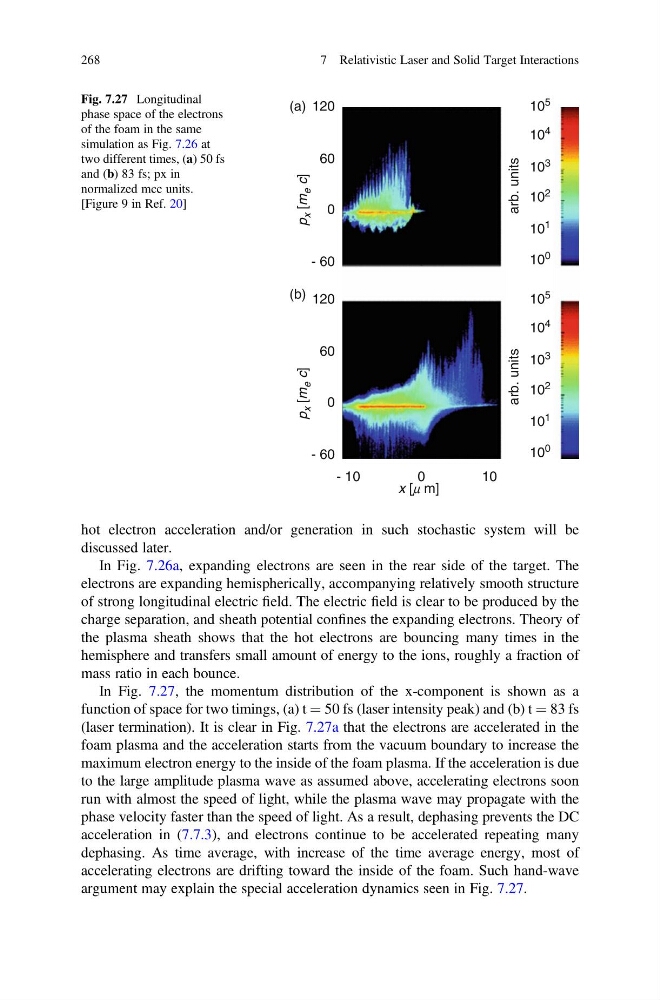
In Fig. 7.27, the momentum distribution of the x-component is shown as a
function of space for two timings, (a) t ¼ 50 fs (laser intensity peak) and (b) t ¼ 83 fs
(laser termination). It is clear in Fig. 7.27a that the electrons are accelerated in the
foam plasma and the acceleration starts from the vacuum boundary to increase the
maximum electron energy to the inside of the foam plasma. If the acceleration is due
to the large amplitude plasma wave as assumed above, accelerating electrons soon
run with almost the speed of light, while the plasma wave may propagate with the
phase velocity faster than the speed of light. As a result, dephasing prevents the DC
acceleration in (7.7.3), and electrons continue to be accelerated repeating many
dephasing. As time average, with increase of the time average energy, most of
accelerating electrons are drifting toward the inside of the foam. Such hand-wave
argument may explain the special acceleration dynamics seen in Fig. 7.27.
120
(a)
(b)
60
0
arb. units
arb. units
10 5
10 4
10 3
10 2
10 1
10
0
10
5
10 4
10
3
10 2
10
1
10
0
- 60
120
x [m m]
60
p
x [m
e c]
p
x [m
e c]
0
- 60
- 10
0
10
Fig. 7.27 Longitudinal
phase space of the electrons
of the foam in the same
simulation as Fig. 7.26 at
two different times, (a) 50 fs
and (b) 83 fs; px in
normalized mcc units.
[Figure 9 in Ref. 20]
268
7 Relativistic Laser and Solid Target Interactions
discussed later.
In Fig. 7.26a, expanding electrons are seen in the rear side of the target. The
electrons are expanding hemispherically, accompanying relatively smooth structure
of strong longitudinal electric field. The electric field is clear to be produced by the
charge separation, and sheath potential confines the expanding electrons. Theory of
the plasma sheath shows that the hot electrons are bouncing many times in the
hemisphere and transfers small amount of energy to the ions, roughly a fraction of
mass ratio in each bounce.
In Fig. 7.27, the momentum distribution of the x-component is shown as a
function of space for two timings, (a) t ¼ 50 fs (laser intensity peak) and (b) t ¼ 83 fs
(laser termination). It is clear in Fig. 7.27a that the electrons are accelerated in the
foam plasma and the acceleration starts from the vacuum boundary to increase the
maximum electron energy to the inside of the foam plasma. If the acceleration is due
to the large amplitude plasma wave as assumed above, accelerating electrons soon
run with almost the speed of light, while the plasma wave may propagate with the
phase velocity faster than the speed of light. As a result, dephasing prevents the DC
acceleration in (7.7.3), and electrons continue to be accelerated repeating many
dephasing. As time average, with increase of the time average energy, most of
accelerating electrons are drifting toward the inside of the foam. Such hand-wave
argument may explain the special acceleration dynamics seen in Fig. 7.27.
120
(a)
(b)
60
0
arb. units
arb. units
10 5
10 4
10 3
10 2
10 1
10
0
10
5
10 4
10
3
10 2
10
1
10
0
- 60
120
x [m m]
60
p
x [m
e c]
p
x [m
e c]
0
- 60
- 10
0
10
Fig. 7.27 Longitudinal
phase space of the electrons
of the foam in the same
simulation as Fig. 7.26 at
two different times, (a) 50 fs
and (b) 83 fs; px in
normalized mcc units.
[Figure 9 in Ref. 20]
268
7 Relativistic Laser and Solid Target Interactions