

E $
e
ε 0
δn e Δx
ð7:7:1Þ
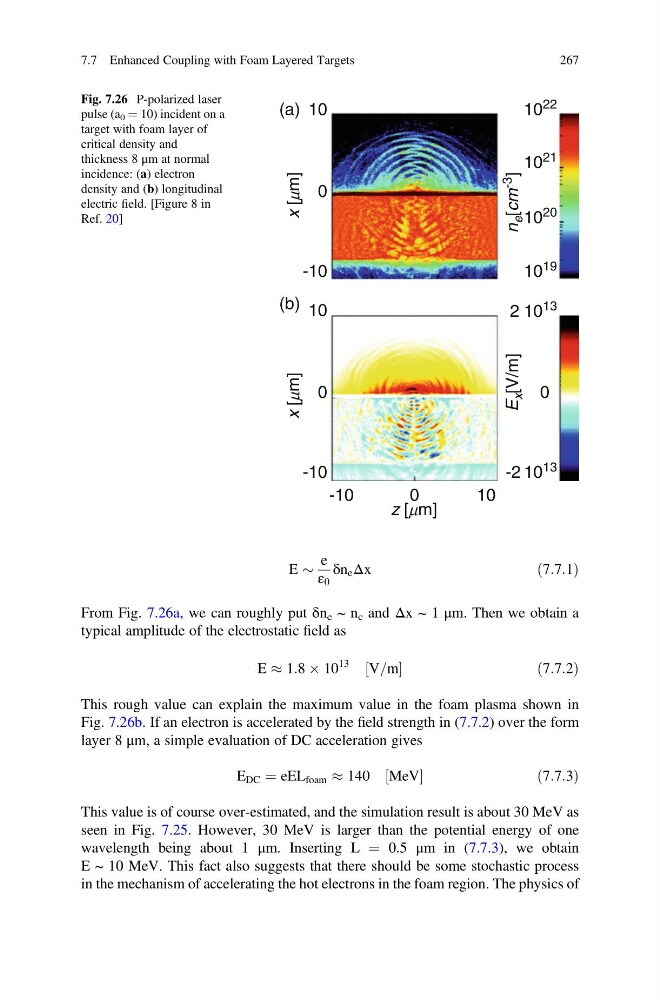
From Fig. 7.26a, we can roughly put δn e ~ n c and Δx ~ 1 μm. Then we obtain a
typical amplitude of the electrostatic field as
E % 1:8 Â 10
13
V=m
½
ð7:7:2Þ
This rough value can explain the maximum value in the foam plasma shown in
Fig. 7.26b. If an electron is accelerated by the field strength in (7.7.2) over the form
layer 8 μm, a simple evaluation of DC acceleration gives
E DC ¼ eEL foam % 140 MeV
½
ð7:7:3Þ
This value is of course over-estimated, and the simulation result is about 30 MeV as
seen in Fig. 7.25. However, 30 MeV is larger than the potential energy of one
wavelength being about 1 μm. Inserting L ¼ 0.5 μm in (7.7.3), we obtain
E ~ 10 MeV. This fact also suggests that there should be some stochastic process
in the mechanism of accelerating the hot electrons in the foam region. The physics of
10
10
22
10
21
10
20
10
19
10
13
10 13
0
(a)
(b)
-10
-10
10
E
x [V/m]
n
e [cm
-3
]
10
0
0
-2
2
z [mm]
x [mm]
x [mm]
0
-10
Fig. 7.26 P-polarized laser
pulse (a 0 ¼ 10) incident on a
target with foam layer of
critical density and
thickness 8 μm at normal
incidence: (a) electron
density and (b) longitudinal
electric field. [Figure 8 in
Ref. 20]
7.7 Enhanced Coupling with Foam Layered Targets
267
e
ε 0
δn e Δx
ð7:7:1Þ
From Fig. 7.26a, we can roughly put δn e ~ n c and Δx ~ 1 μm. Then we obtain a
typical amplitude of the electrostatic field as
E % 1:8 Â 10
13
V=m
½
ð7:7:2Þ
This rough value can explain the maximum value in the foam plasma shown in
Fig. 7.26b. If an electron is accelerated by the field strength in (7.7.2) over the form
layer 8 μm, a simple evaluation of DC acceleration gives
E DC ¼ eEL foam % 140 MeV
½
ð7:7:3Þ
This value is of course over-estimated, and the simulation result is about 30 MeV as
seen in Fig. 7.25. However, 30 MeV is larger than the potential energy of one
wavelength being about 1 μm. Inserting L ¼ 0.5 μm in (7.7.3), we obtain
E ~ 10 MeV. This fact also suggests that there should be some stochastic process
in the mechanism of accelerating the hot electrons in the foam region. The physics of
10
10
22
10
21
10
20
10
19
10
13
10 13
0
(a)
(b)
-10
-10
10
E
x [V/m]
n
e [cm
-3
]
10
0
0
-2
2
z [mm]
x [mm]
x [mm]
0
-10
Fig. 7.26 P-polarized laser
pulse (a 0 ¼ 10) incident on a
target with foam layer of
critical density and
thickness 8 μm at normal
incidence: (a) electron
density and (b) longitudinal
electric field. [Figure 8 in
Ref. 20]
7.7 Enhanced Coupling with Foam Layered Targets
267