

a thin proton contamination layer (H
+
; 0.05 μm). The laser wavelength is 0.8 μm,
pulse duration is 25 fs, and the focusing diameter is 3 μm. Focused laser intensity is
varied as a 0 ¼ 3–20, corresponding to P L ¼ 2.8–128 TW and laser energy
0.075–3.2 J. In the simulations, even for the case where the electron density of the
form is higher than the critical density, n e > n c , the laser can propagate in the foam
layer due to relativistic transparency effect as shown in (3.6.5) and ponderomotive
channeling effect as shown in (3.9.1).
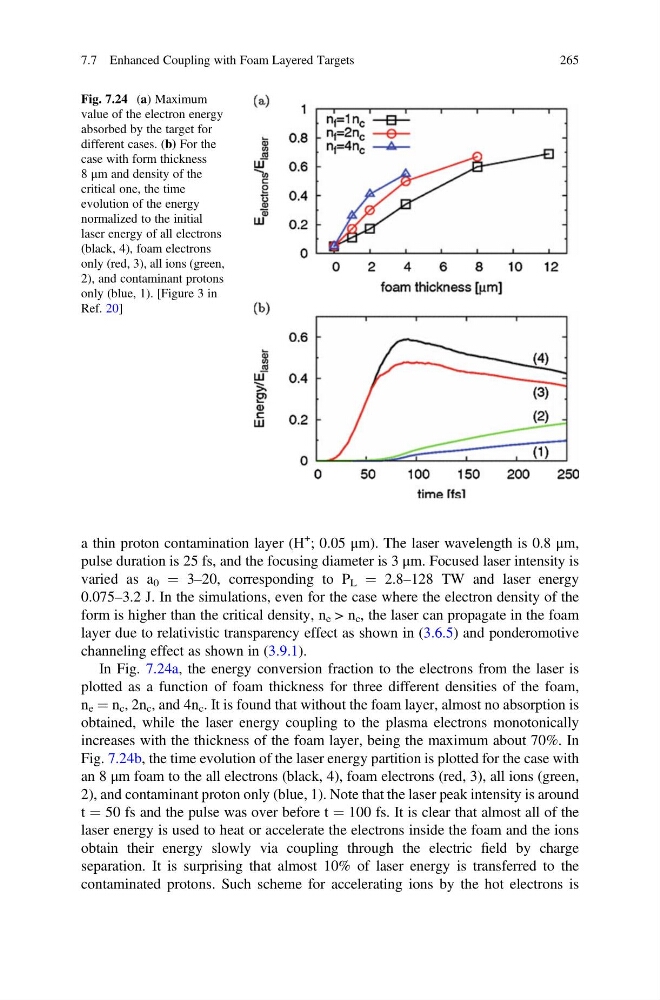
In Fig. 7.24a, the energy conversion fraction to the electrons from the laser is
plotted as a function of foam thickness for three different densities of the foam,
n e ¼ n c , 2n c , and 4n c . It is found that without the foam layer, almost no absorption is
obtained, while the laser energy coupling to the plasma electrons monotonically
increases with the thickness of the foam layer, being the maximum about 70%. In
Fig. 7.24b, the time evolution of the laser energy partition is plotted for the case with
an 8 μm foam to the all electrons (black, 4), foam electrons (red, 3), all ions (green,
2), and contaminant proton only (blue, 1). Note that the laser peak intensity is around
t ¼ 50 fs and the pulse was over before t ¼ 100 fs. It is clear that almost all of the
laser energy is used to heat or accelerate the electrons inside the foam and the ions
obtain their energy slowly via coupling through the electric field by charge
separation. It is surprising that almost 10% of laser energy is transferred to the
contaminated protons. Such scheme for accelerating ions by the hot electrons is
Fig. 7.24 (a) Maximum
value of the electron energy
absorbed by the target for
different cases. (b) For the
case with form thickness
8 μm and density of the
critical one, the time
evolution of the energy
normalized to the initial
laser energy of all electrons
(black, 4), foam electrons
only (red, 3), all ions (green,
2), and contaminant protons
only (blue, 1). [Figure 3 in
Ref. 20]
7.7 Enhanced Coupling with Foam Layered Targets
265
+
; 0.05 μm). The laser wavelength is 0.8 μm,
pulse duration is 25 fs, and the focusing diameter is 3 μm. Focused laser intensity is
varied as a 0 ¼ 3–20, corresponding to P L ¼ 2.8–128 TW and laser energy
0.075–3.2 J. In the simulations, even for the case where the electron density of the
form is higher than the critical density, n e > n c , the laser can propagate in the foam
layer due to relativistic transparency effect as shown in (3.6.5) and ponderomotive
channeling effect as shown in (3.9.1).
In Fig. 7.24a, the energy conversion fraction to the electrons from the laser is
plotted as a function of foam thickness for three different densities of the foam,
n e ¼ n c , 2n c , and 4n c . It is found that without the foam layer, almost no absorption is
obtained, while the laser energy coupling to the plasma electrons monotonically
increases with the thickness of the foam layer, being the maximum about 70%. In
Fig. 7.24b, the time evolution of the laser energy partition is plotted for the case with
an 8 μm foam to the all electrons (black, 4), foam electrons (red, 3), all ions (green,
2), and contaminant proton only (blue, 1). Note that the laser peak intensity is around
t ¼ 50 fs and the pulse was over before t ¼ 100 fs. It is clear that almost all of the
laser energy is used to heat or accelerate the electrons inside the foam and the ions
obtain their energy slowly via coupling through the electric field by charge
separation. It is surprising that almost 10% of laser energy is transferred to the
contaminated protons. Such scheme for accelerating ions by the hot electrons is
Fig. 7.24 (a) Maximum
value of the electron energy
absorbed by the target for
different cases. (b) For the
case with form thickness
8 μm and density of the
critical one, the time
evolution of the energy
normalized to the initial
laser energy of all electrons
(black, 4), foam electrons
only (red, 3), all ions (green,
2), and contaminant protons
only (blue, 1). [Figure 3 in
Ref. 20]
7.7 Enhanced Coupling with Foam Layered Targets
265