

ponderomotive force, propagating to the lower-density region. The plasma waves
accelerate electrons to the vacuum direction, while the electrons return to the right
because of the sheath potential near the vacuum boundary. Such electron has the
energy of about 1–2 MeV, while the ponderomotive scaling gives about 500 keV.
Both accelerated electrons penetrate into the over-dense region, while they do not
return to the interaction region because the laser spot diameter is 2.5 μm, very small.
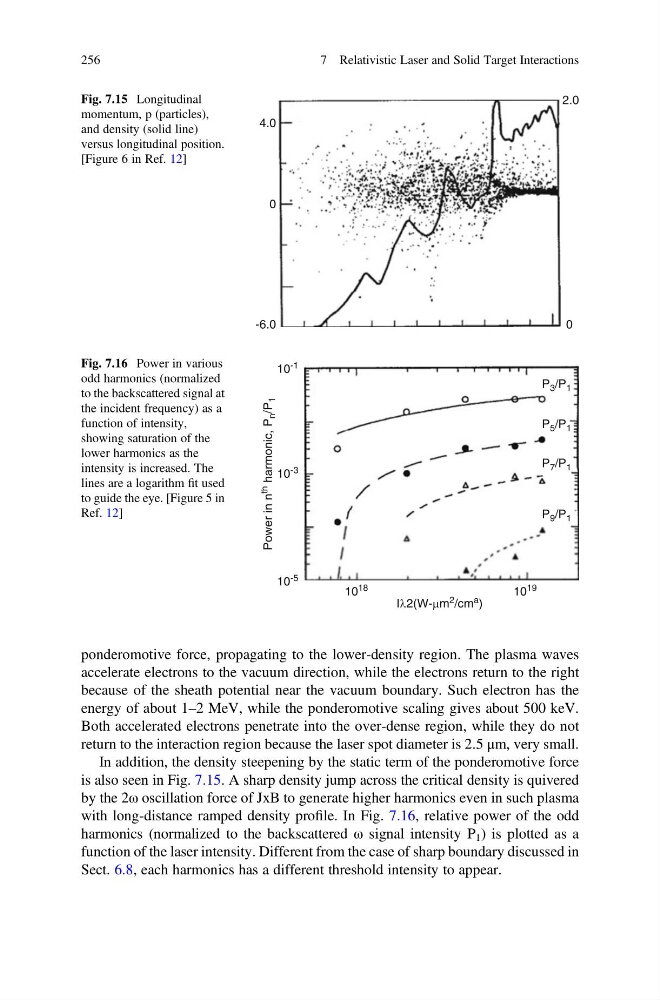
In addition, the density steepening by the static term of the ponderomotive force
is also seen in Fig. 7.15. A sharp density jump across the critical density is quivered
by the 2ω oscillation force of JxB to generate higher harmonics even in such plasma
with long-distance ramped density profile. In Fig. 7.16, relative power of the odd
harmonics (normalized to the backscattered ω signal intensity P 1 ) is plotted as a
function of the laser intensity. Different from the case of sharp boundary discussed in
Sect. 6.8, each harmonics has a different threshold intensity to appear.
4.0
2.0
0
0
-6.0
Fig. 7.15 Longitudinal
momentum, p (particles),
and density (solid line)
versus longitudinal position.
[Figure 6 in Ref. 12]
10 -1
10
-3
Power in n
th
harmonic, P
n /P
1
P 3 /P 1
P 5 /P 1
P 7 /P 1
P 9 /P 1
10
-5
Iλ2(W-μm 2 /cm a )
10 18
10
19
Fig. 7.16 Power in various
odd harmonics (normalized
to the backscattered signal at
the incident frequency) as a
function of intensity,
showing saturation of the
lower harmonics as the
intensity is increased. The
lines are a logarithm fit used
to guide the eye. [Figure 5 in
Ref. 12]
256
7 Relativistic Laser and Solid Target Interactions
accelerate electrons to the vacuum direction, while the electrons return to the right
because of the sheath potential near the vacuum boundary. Such electron has the
energy of about 1–2 MeV, while the ponderomotive scaling gives about 500 keV.
Both accelerated electrons penetrate into the over-dense region, while they do not
return to the interaction region because the laser spot diameter is 2.5 μm, very small.
In addition, the density steepening by the static term of the ponderomotive force
is also seen in Fig. 7.15. A sharp density jump across the critical density is quivered
by the 2ω oscillation force of JxB to generate higher harmonics even in such plasma
with long-distance ramped density profile. In Fig. 7.16, relative power of the odd
harmonics (normalized to the backscattered ω signal intensity P 1 ) is plotted as a
function of the laser intensity. Different from the case of sharp boundary discussed in
Sect. 6.8, each harmonics has a different threshold intensity to appear.
4.0
2.0
0
0
-6.0
Fig. 7.15 Longitudinal
momentum, p (particles),
and density (solid line)
versus longitudinal position.
[Figure 6 in Ref. 12]
10 -1
10
-3
Power in n
th
harmonic, P
n /P
1
P 3 /P 1
P 5 /P 1
P 7 /P 1
P 9 /P 1
10
-5
Iλ2(W-μm 2 /cm a )
10 18
10
19
Fig. 7.16 Power in various
odd harmonics (normalized
to the backscattered signal at
the incident frequency) as a
function of intensity,
showing saturation of the
lower harmonics as the
intensity is increased. The
lines are a logarithm fit used
to guide the eye. [Figure 5 in
Ref. 12]
256
7 Relativistic Laser and Solid Target Interactions