

explained by the fact that static electric and magnetic fields in the laser channel act to
collimate the electrons and therefore the hot electrons emerge from a narrow region
and the electron energy is higher. This reason is speculated because each hot electron
gains higher energy in the low-density case and enhances the speed of hole boring
due to the enhanced charge separation force.
7.5 Laser Interaction in Long Pre-formed Plasmas
So far we have discussed the case where the pre-formed plasma has a scale length of
about the laser wavelength. What different physics is seen when relativistic ultrashort pulse is irradiated, on the other hand, on long-ramped plasmas on purpose or
accidentally? In Fig. 7.15, the density profile (solid line) and electron momentum in
x-direction (particles) are plotted at about 400 fs from 2D PIC simulation, where the
plasma is initially assumed with ramped density from 0 to 4n c , over a distance of 4λ,
with an additional plasmas of density 4n c behind the ramp. The laser intensity is
5 Â 10
18 W/cm
2 at λ ¼ 1 μm. The laser is irradiated with s-polarization normally on
the plasma surface, meaning computation space is x and y, and laser is linearly
polarized in z-direction.
The ponderomotive force is due to JxB and pushes the low-density plasma to
soon deform the plasma density as seen in Fig. 7.15. It is observed that plasma waves
with large amplitude are generated due to the charge separation by the
0
50
(a) 0.9n c
(f) 30n c
(e) 15n c
(d) 4.5n c
(c) 3n c
(b) 1.5n c
100
y (μm)
y (μm)
x (μm)
x (μm)
x (μm)
150
0
1
2
3
0
0
2
4
6
8
1
2 3
4 5
0 2
4 6
8 10
0
0
10
20
30
4
8
12 16
200
250
0
0
50
100
100
150
200
200
0
100
200 0
100
200
250
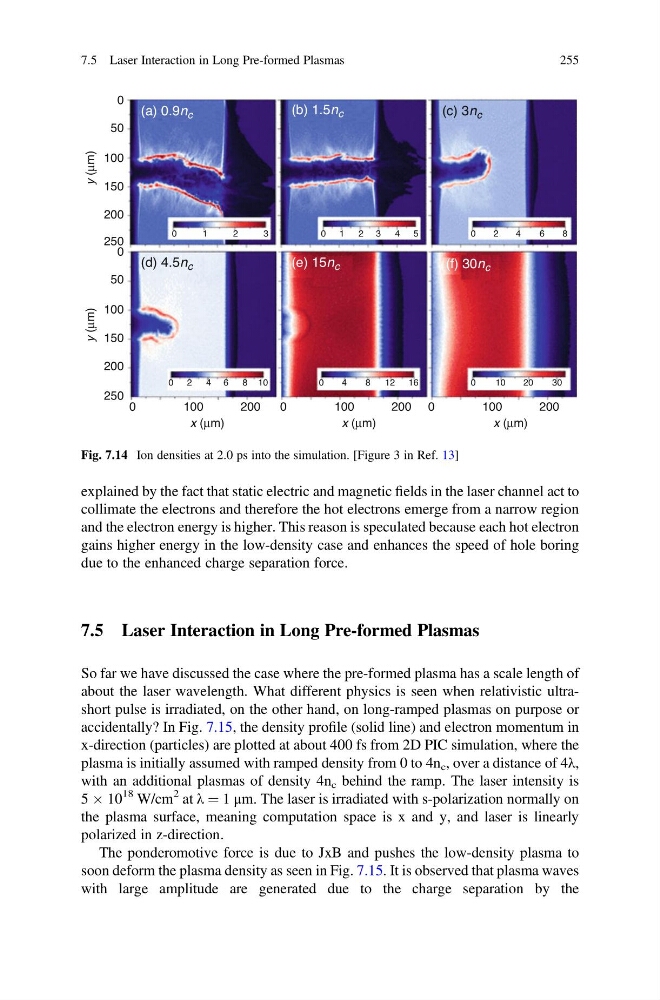
Fig. 7.14 Ion densities at 2.0 ps into the simulation. [Figure 3 in Ref. 13]
7.5 Laser Interaction in Long Pre-formed Plasmas
255
collimate the electrons and therefore the hot electrons emerge from a narrow region
and the electron energy is higher. This reason is speculated because each hot electron
gains higher energy in the low-density case and enhances the speed of hole boring
due to the enhanced charge separation force.
7.5 Laser Interaction in Long Pre-formed Plasmas
So far we have discussed the case where the pre-formed plasma has a scale length of
about the laser wavelength. What different physics is seen when relativistic ultrashort pulse is irradiated, on the other hand, on long-ramped plasmas on purpose or
accidentally? In Fig. 7.15, the density profile (solid line) and electron momentum in
x-direction (particles) are plotted at about 400 fs from 2D PIC simulation, where the
plasma is initially assumed with ramped density from 0 to 4n c , over a distance of 4λ,
with an additional plasmas of density 4n c behind the ramp. The laser intensity is
5 Â 10
18 W/cm
2 at λ ¼ 1 μm. The laser is irradiated with s-polarization normally on
the plasma surface, meaning computation space is x and y, and laser is linearly
polarized in z-direction.
The ponderomotive force is due to JxB and pushes the low-density plasma to
soon deform the plasma density as seen in Fig. 7.15. It is observed that plasma waves
with large amplitude are generated due to the charge separation by the
0
50
(a) 0.9n c
(f) 30n c
(e) 15n c
(d) 4.5n c
(c) 3n c
(b) 1.5n c
100
y (μm)
y (μm)
x (μm)
x (μm)
x (μm)
150
0
1
2
3
0
0
2
4
6
8
1
2 3
4 5
0 2
4 6
8 10
0
0
10
20
30
4
8
12 16
200
250
0
0
50
100
100
150
200
200
0
100
200 0
100
200
250
Fig. 7.14 Ion densities at 2.0 ps into the simulation. [Figure 3 in Ref. 13]
7.5 Laser Interaction in Long Pre-formed Plasmas
255