

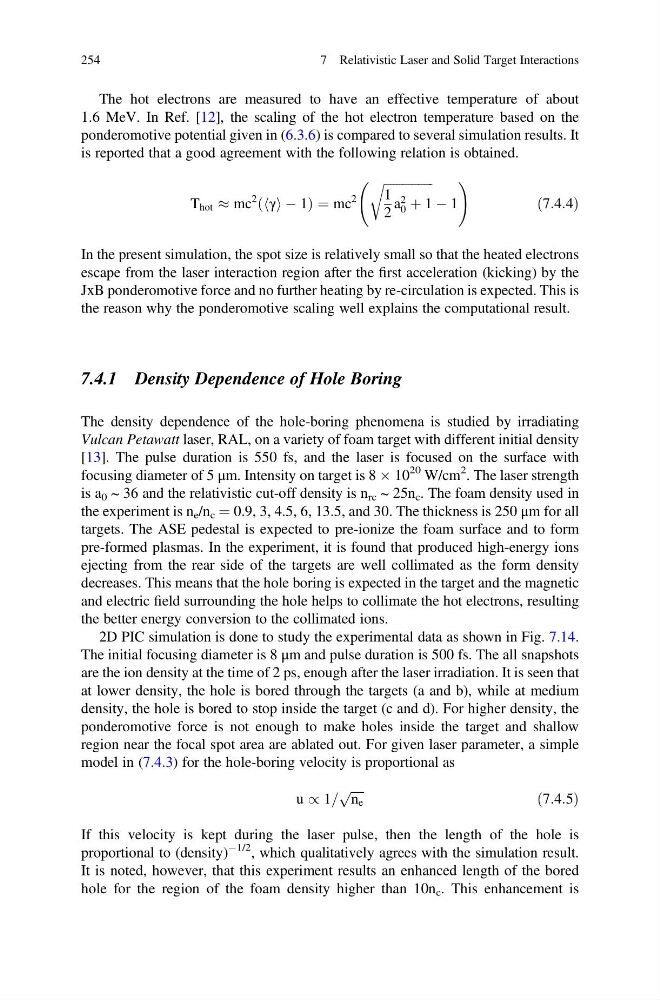
The hot electrons are measured to have an effective temperature of about
1.6 MeV. In Ref. [12], the scaling of the hot electron temperature based on the
ponderomotive potential given in (6.3.6) is compared to several simulation results. It
is reported that a good agreement with the following relation is obtained.
T hot % mc
2
γ
h i À 1
ð
Þ¼mc
2
ffiffiffiffiffiffiffiffiffiffiffiffiffiffiffi ffi
1
2
a 2
0 þ 1
r
À 1
!
ð7:4:4Þ
In the present simulation, the spot size is relatively small so that the heated electrons
escape from the laser interaction region after the first acceleration (kicking) by the
JxB ponderomotive force and no further heating by re-circulation is expected. This is
the reason why the ponderomotive scaling well explains the computational result.
7.4.1 Density Dependence of Hole Boring
The density dependence of the hole-boring phenomena is studied by irradiating
Vulcan Petawatt laser, RAL, on a variety of foam target with different initial density
[13]. The pulse duration is 550 fs, and the laser is focused on the surface with
focusing diameter of 5 μm. Intensity on target is 8 Â 10
20 W/cm
2 . The laser strength
is a 0 ~ 36 and the relativistic cut-off density is n rc ~ 25n c . The foam density used in
the experiment is n e /n c ¼ 0.9, 3, 4.5, 6, 13.5, and 30. The thickness is 250 μm for all
targets. The ASE pedestal is expected to pre-ionize the foam surface and to form
pre-formed plasmas. In the experiment, it is found that produced high-energy ions
ejecting from the rear side of the targets are well collimated as the form density
decreases. This means that the hole boring is expected in the target and the magnetic
and electric field surrounding the hole helps to collimate the hot electrons, resulting
the better energy conversion to the collimated ions.
2D PIC simulation is done to study the experimental data as shown in Fig. 7.14.
The initial focusing diameter is 8 μm and pulse duration is 500 fs. The all snapshots
are the ion density at the time of 2 ps, enough after the laser irradiation. It is seen that
at lower density, the hole is bored through the targets (a and b), while at medium
density, the hole is bored to stop inside the target (c and d). For higher density, the
ponderomotive force is not enough to make holes inside the target and shallow
region near the focal spot area are ablated out. For given laser parameter, a simple
model in (7.4.3) for the hole-boring velocity is proportional as
u / 1=
ffiffiffiffi ffi
n e
p
ð7:4:5Þ
If this velocity is kept during the laser pulse, then the length of the hole is
proportional to (density)
À1/2 , which qualitatively agrees with the simulation result.
It is noted, however, that this experiment results an enhanced length of the bored
hole for the region of the foam density higher than 10n c . This enhancement is
254
7 Relativistic Laser and Solid Target Interactions
1.6 MeV. In Ref. [12], the scaling of the hot electron temperature based on the
ponderomotive potential given in (6.3.6) is compared to several simulation results. It
is reported that a good agreement with the following relation is obtained.
T hot % mc
2
γ
h i À 1
ð
Þ¼mc
2
ffiffiffiffiffiffiffiffiffiffiffiffiffiffiffi ffi
1
2
a 2
0 þ 1
r
À 1
!
ð7:4:4Þ
In the present simulation, the spot size is relatively small so that the heated electrons
escape from the laser interaction region after the first acceleration (kicking) by the
JxB ponderomotive force and no further heating by re-circulation is expected. This is
the reason why the ponderomotive scaling well explains the computational result.
7.4.1 Density Dependence of Hole Boring
The density dependence of the hole-boring phenomena is studied by irradiating
Vulcan Petawatt laser, RAL, on a variety of foam target with different initial density
[13]. The pulse duration is 550 fs, and the laser is focused on the surface with
focusing diameter of 5 μm. Intensity on target is 8 Â 10
20 W/cm
2 . The laser strength
is a 0 ~ 36 and the relativistic cut-off density is n rc ~ 25n c . The foam density used in
the experiment is n e /n c ¼ 0.9, 3, 4.5, 6, 13.5, and 30. The thickness is 250 μm for all
targets. The ASE pedestal is expected to pre-ionize the foam surface and to form
pre-formed plasmas. In the experiment, it is found that produced high-energy ions
ejecting from the rear side of the targets are well collimated as the form density
decreases. This means that the hole boring is expected in the target and the magnetic
and electric field surrounding the hole helps to collimate the hot electrons, resulting
the better energy conversion to the collimated ions.
2D PIC simulation is done to study the experimental data as shown in Fig. 7.14.
The initial focusing diameter is 8 μm and pulse duration is 500 fs. The all snapshots
are the ion density at the time of 2 ps, enough after the laser irradiation. It is seen that
at lower density, the hole is bored through the targets (a and b), while at medium
density, the hole is bored to stop inside the target (c and d). For higher density, the
ponderomotive force is not enough to make holes inside the target and shallow
region near the focal spot area are ablated out. For given laser parameter, a simple
model in (7.4.3) for the hole-boring velocity is proportional as
u / 1=
ffiffiffiffi ffi
n e
p
ð7:4:5Þ
If this velocity is kept during the laser pulse, then the length of the hole is
proportional to (density)
À1/2 , which qualitatively agrees with the simulation result.
It is noted, however, that this experiment results an enhanced length of the bored
hole for the region of the foam density higher than 10n c . This enhancement is
254
7 Relativistic Laser and Solid Target Interactions