

P L ¼ p ph N ph c ¼ I L =c
ð7:4:2Þ
The pressure of perfectly reflecting laser is give to be P L ¼ 2I L /c ~ 6Â10
3 Mbar for,
say, I ¼ 10
19 W/cm
2 . Since the plasma density is low, the ions are easily moved via
ambipolar field toward the slab plasma region in the present density profile.
Assuming that the ion fluid moves with the speed of u, then the increase of the ion
momentum should be supported by the pressure (PdV) work at the contact surface of
laser and plasma. This simple momentum flux conservation law provides the ion
hole boring velocity u as
ρu
2
À Á
u ¼ P L u )
u
c
¼
n c
n e
Zm e
m i
! 1=2 a 0
2
,
ð7:4:3Þ
where n e is the electron density of the plasma in front of the laser piston and Z is the
charge state. In the present simulation, n e ¼ 4n c and u ¼ 0.025c. In the simulation,
the hole depth is about d ¼ 1.5λ (¼1.5 μm) at t ¼ 300 fs, which is reasonable
distance compared to the above evaluation, d ¼ ut ¼ 2.2 μm.
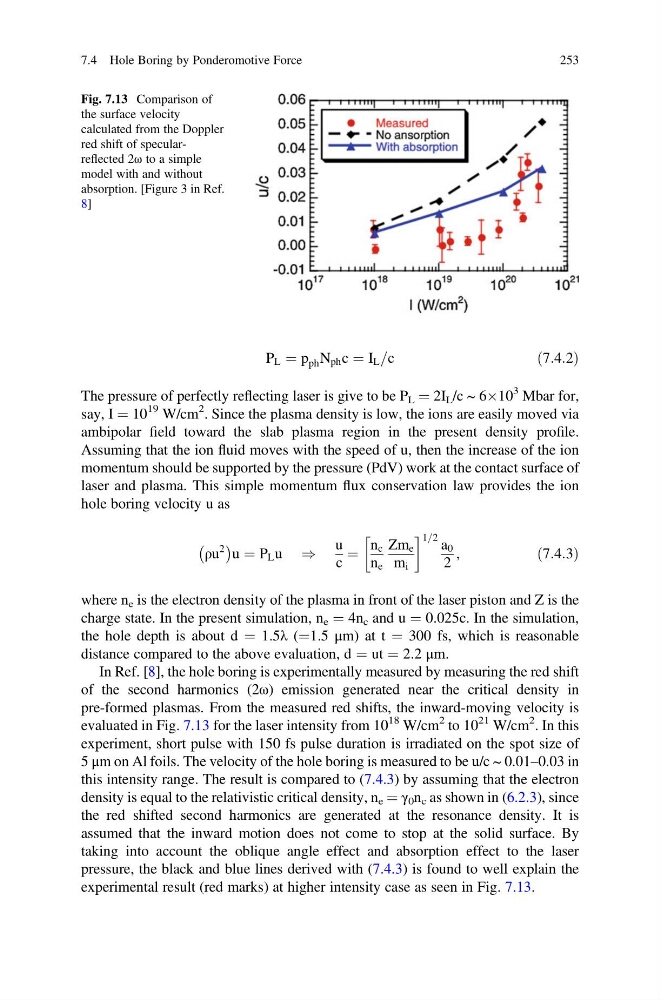
In Ref. [8], the hole boring is experimentally measured by measuring the red shift
of the second harmonics (2ω) emission generated near the critical density in
pre-formed plasmas. From the measured red shifts, the inward-moving velocity is
evaluated in Fig. 7.13 for the laser intensity from 10
18 W/cm
2 to 10
21 W/cm
2 . In this
experiment, short pulse with 150 fs pulse duration is irradiated on the spot size of
5 μm on Al foils. The velocity of the hole boring is measured to be u/c ~ 0.01–0.03 in
this intensity range. The result is compared to (7.4.3) by assuming that the electron
density is equal to the relativistic critical density, n e ¼ γ 0 n c as shown in (6.2.3), since
the red shifted second harmonics are generated at the resonance density. It is
assumed that the inward motion does not come to stop at the solid surface. By
taking into account the oblique angle effect and absorption effect to the laser
pressure, the black and blue lines derived with (7.4.3) is found to well explain the
experimental result (red marks) at higher intensity case as seen in Fig. 7.13.
Fig. 7.13 Comparison of
the surface velocity
calculated from the Doppler
red shift of specularreflected 2ω to a simple
model with and without
absorption. [Figure 3 in Ref.
8]
7.4 Hole Boring by Ponderomotive Force
253
ð7:4:2Þ
The pressure of perfectly reflecting laser is give to be P L ¼ 2I L /c ~ 6Â10
3 Mbar for,
say, I ¼ 10
19 W/cm
2 . Since the plasma density is low, the ions are easily moved via
ambipolar field toward the slab plasma region in the present density profile.
Assuming that the ion fluid moves with the speed of u, then the increase of the ion
momentum should be supported by the pressure (PdV) work at the contact surface of
laser and plasma. This simple momentum flux conservation law provides the ion
hole boring velocity u as
ρu
2
À Á
u ¼ P L u )
u
c
¼
n c
n e
Zm e
m i
! 1=2 a 0
2
,
ð7:4:3Þ
where n e is the electron density of the plasma in front of the laser piston and Z is the
charge state. In the present simulation, n e ¼ 4n c and u ¼ 0.025c. In the simulation,
the hole depth is about d ¼ 1.5λ (¼1.5 μm) at t ¼ 300 fs, which is reasonable
distance compared to the above evaluation, d ¼ ut ¼ 2.2 μm.
In Ref. [8], the hole boring is experimentally measured by measuring the red shift
of the second harmonics (2ω) emission generated near the critical density in
pre-formed plasmas. From the measured red shifts, the inward-moving velocity is
evaluated in Fig. 7.13 for the laser intensity from 10
18 W/cm
2 to 10
21 W/cm
2 . In this
experiment, short pulse with 150 fs pulse duration is irradiated on the spot size of
5 μm on Al foils. The velocity of the hole boring is measured to be u/c ~ 0.01–0.03 in
this intensity range. The result is compared to (7.4.3) by assuming that the electron
density is equal to the relativistic critical density, n e ¼ γ 0 n c as shown in (6.2.3), since
the red shifted second harmonics are generated at the resonance density. It is
assumed that the inward motion does not come to stop at the solid surface. By
taking into account the oblique angle effect and absorption effect to the laser
pressure, the black and blue lines derived with (7.4.3) is found to well explain the
experimental result (red marks) at higher intensity case as seen in Fig. 7.13.
Fig. 7.13 Comparison of
the surface velocity
calculated from the Doppler
red shift of specularreflected 2ω to a simple
model with and without
absorption. [Figure 3 in Ref.
8]
7.4 Hole Boring by Ponderomotive Force
253