

It is also shown that the critical surface with sharp density jump seen in Fig. 7.15
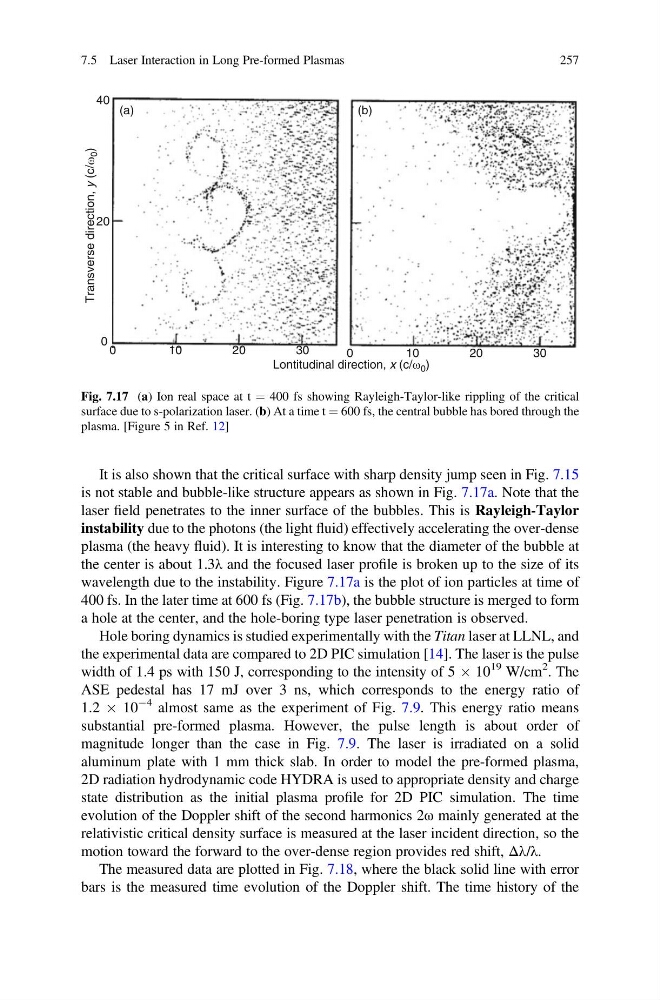
is not stable and bubble-like structure appears as shown in Fig. 7.17a. Note that the
laser field penetrates to the inner surface of the bubbles. This is Rayleigh-Taylor
instability due to the photons (the light fluid) effectively accelerating the over-dense
plasma (the heavy fluid). It is interesting to know that the diameter of the bubble at
the center is about 1.3λ and the focused laser profile is broken up to the size of its
wavelength due to the instability. Figure 7.17a is the plot of ion particles at time of
400 fs. In the later time at 600 fs (Fig. 7.17b), the bubble structure is merged to form
a hole at the center, and the hole-boring type laser penetration is observed.
Hole boring dynamics is studied experimentally with the Titan laser at LLNL, and
the experimental data are compared to 2D PIC simulation [14]. The laser is the pulse
width of 1.4 ps with 150 J, corresponding to the intensity of 5 Â 10
19 W/cm
2 . The
ASE pedestal has 17 mJ over 3 ns, which corresponds to the energy ratio of
1.2 Â 10
À4 almost same as the experiment of Fig. 7.9. This energy ratio means
substantial pre-formed plasma. However, the pulse length is about order of
magnitude longer than the case in Fig. 7.9. The laser is irradiated on a solid
aluminum plate with 1 mm thick slab. In order to model the pre-formed plasma,
2D radiation hydrodynamic code HYDRA is used to appropriate density and charge
state distribution as the initial plasma profile for 2D PIC simulation. The time
evolution of the Doppler shift of the second harmonics 2ω mainly generated at the
relativistic critical density surface is measured at the laser incident direction, so the
motion toward the forward to the over-dense region provides red shift, Δλ/λ.
The measured data are plotted in Fig. 7.18, where the black solid line with error
bars is the measured time evolution of the Doppler shift. The time history of the
40
20
(a)
(b)
20
30
Lontitudinal direction, x (c/ω 0 )
Transverse direction,
y (c/ω
0 )
0
0
1 0
20
30
0
1 0
Fig. 7.17 (a) Ion real space at t ¼ 400 fs showing Rayleigh-Taylor-like rippling of the critical
surface due to s-polarization laser. (b) At a time t ¼ 600 fs, the central bubble has bored through the
plasma. [Figure 5 in Ref. 12]
7.5 Laser Interaction in Long Pre-formed Plasmas
257
is not stable and bubble-like structure appears as shown in Fig. 7.17a. Note that the
laser field penetrates to the inner surface of the bubbles. This is Rayleigh-Taylor
instability due to the photons (the light fluid) effectively accelerating the over-dense
plasma (the heavy fluid). It is interesting to know that the diameter of the bubble at
the center is about 1.3λ and the focused laser profile is broken up to the size of its
wavelength due to the instability. Figure 7.17a is the plot of ion particles at time of
400 fs. In the later time at 600 fs (Fig. 7.17b), the bubble structure is merged to form
a hole at the center, and the hole-boring type laser penetration is observed.
Hole boring dynamics is studied experimentally with the Titan laser at LLNL, and
the experimental data are compared to 2D PIC simulation [14]. The laser is the pulse
width of 1.4 ps with 150 J, corresponding to the intensity of 5 Â 10
19 W/cm
2 . The
ASE pedestal has 17 mJ over 3 ns, which corresponds to the energy ratio of
1.2 Â 10
À4 almost same as the experiment of Fig. 7.9. This energy ratio means
substantial pre-formed plasma. However, the pulse length is about order of
magnitude longer than the case in Fig. 7.9. The laser is irradiated on a solid
aluminum plate with 1 mm thick slab. In order to model the pre-formed plasma,
2D radiation hydrodynamic code HYDRA is used to appropriate density and charge
state distribution as the initial plasma profile for 2D PIC simulation. The time
evolution of the Doppler shift of the second harmonics 2ω mainly generated at the
relativistic critical density surface is measured at the laser incident direction, so the
motion toward the forward to the over-dense region provides red shift, Δλ/λ.
The measured data are plotted in Fig. 7.18, where the black solid line with error
bars is the measured time evolution of the Doppler shift. The time history of the
40
20
(a)
(b)
20
30
Lontitudinal direction, x (c/ω 0 )
Transverse direction,
y (c/ω
0 )
0
0
1 0
20
30
0
1 0
Fig. 7.17 (a) Ion real space at t ¼ 400 fs showing Rayleigh-Taylor-like rippling of the critical
surface due to s-polarization laser. (b) At a time t ¼ 600 fs, the central bubble has bored through the
plasma. [Figure 5 in Ref. 12]
7.5 Laser Interaction in Long Pre-formed Plasmas
257