

pre-formed plasmas with scale length of L ~ 0.1–1 λ. It is found that even if the
pedestal is the same, the pre-formed plasma condition depends on the target
materials. We have to know more about the physics of laser cutting as shown in
Fig. 2.11.
7.1.2 Model Experiments with Controlled Pre-formed
Plasmas
Recently, with advancement of technology, the pedestal is well eliminated. Well
controlled experiment is done and compared to PIC simulation [3]. In the
experiment, optically polished silica foils with the electron density 400 times critical
density for 800 nm light are irradiated obliquely (angle 55 degree from the target
normal) with p-polarization by laser of 20–25 fs pulse duration with its intensity
around 2 Â 10
19 W/cm
2 (a 0 ~ 3.5). The intensity contrast is achieved around 10
À13
for > 100 ps before the main pulse. In order to control the scale length of the
pre-formed plasma, the other laser is irradiated while altering the time interval before
the main laser irradiation. The density scale length of the pre-plasma L is measured
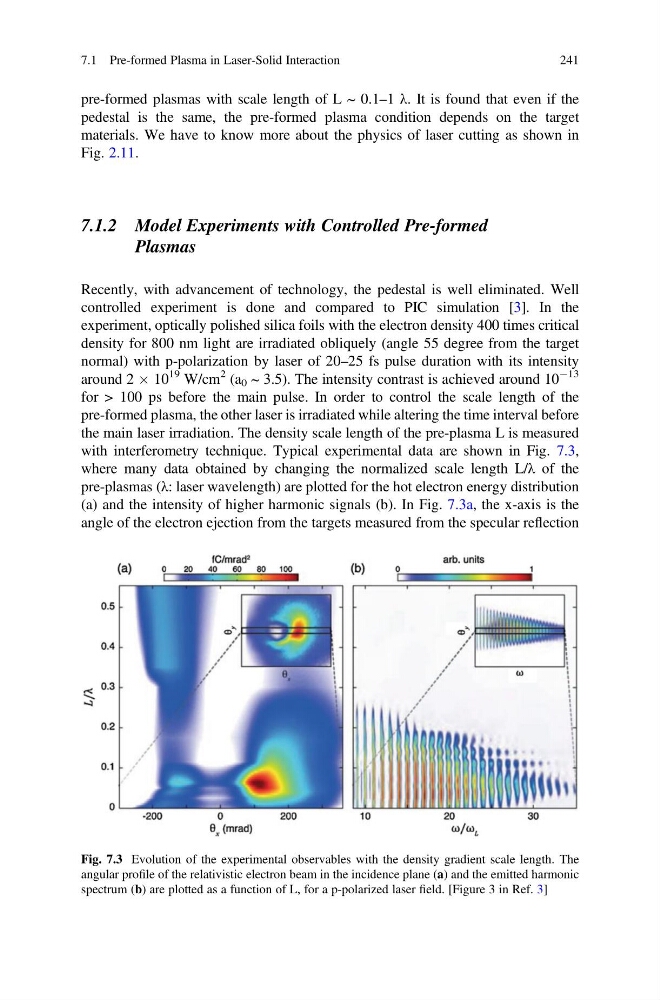
with interferometry technique. Typical experimental data are shown in Fig. 7.3,
where many data obtained by changing the normalized scale length L/λ of the
pre-plasmas (λ: laser wavelength) are plotted for the hot electron energy distribution
(a) and the intensity of higher harmonic signals (b). In Fig. 7.3a, the x-axis is the
angle of the electron ejection from the targets measured from the specular reflection
Fig. 7.3 Evolution of the experimental observables with the density gradient scale length. The
angular profile of the relativistic electron beam in the incidence plane (a) and the emitted harmonic
spectrum (b) are plotted as a function of L, for a p-polarized laser field. [Figure 3 in Ref. 3]
7.1 Pre-formed Plasma in Laser-Solid Interaction
241
pedestal is the same, the pre-formed plasma condition depends on the target
materials. We have to know more about the physics of laser cutting as shown in
Fig. 2.11.
7.1.2 Model Experiments with Controlled Pre-formed
Plasmas
Recently, with advancement of technology, the pedestal is well eliminated. Well
controlled experiment is done and compared to PIC simulation [3]. In the
experiment, optically polished silica foils with the electron density 400 times critical
density for 800 nm light are irradiated obliquely (angle 55 degree from the target
normal) with p-polarization by laser of 20–25 fs pulse duration with its intensity
around 2 Â 10
19 W/cm
2 (a 0 ~ 3.5). The intensity contrast is achieved around 10
À13
for > 100 ps before the main pulse. In order to control the scale length of the
pre-formed plasma, the other laser is irradiated while altering the time interval before
the main laser irradiation. The density scale length of the pre-plasma L is measured
with interferometry technique. Typical experimental data are shown in Fig. 7.3,
where many data obtained by changing the normalized scale length L/λ of the
pre-plasmas (λ: laser wavelength) are plotted for the hot electron energy distribution
(a) and the intensity of higher harmonic signals (b). In Fig. 7.3a, the x-axis is the
angle of the electron ejection from the targets measured from the specular reflection
Fig. 7.3 Evolution of the experimental observables with the density gradient scale length. The
angular profile of the relativistic electron beam in the incidence plane (a) and the emitted harmonic
spectrum (b) are plotted as a function of L, for a p-polarized laser field. [Figure 3 in Ref. 3]
7.1 Pre-formed Plasma in Laser-Solid Interaction
241