

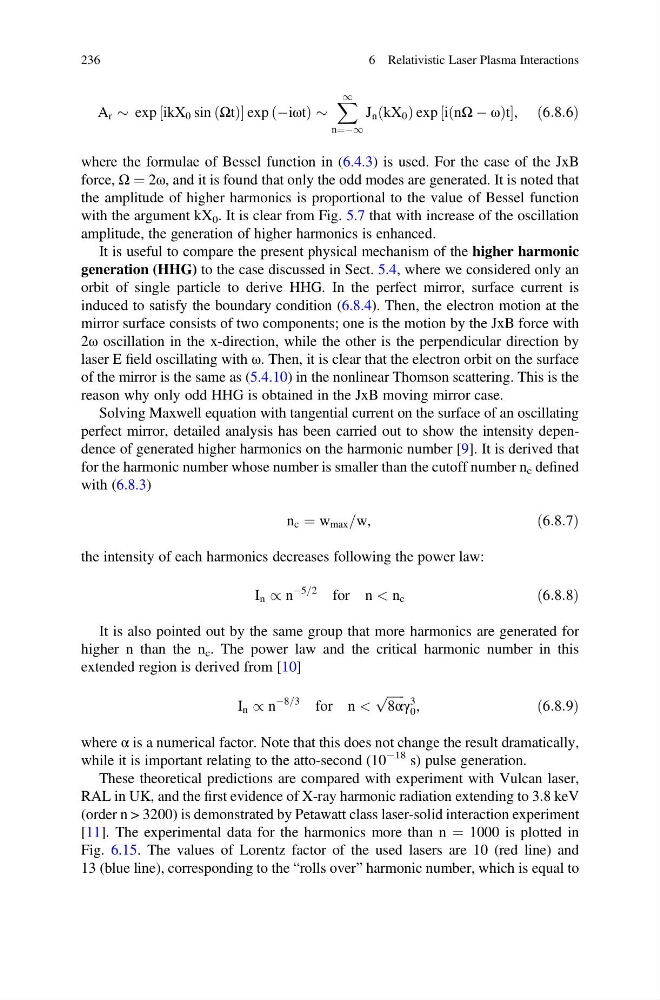
A r $ exp ikX 0 sin Ωt
ð Þ
½
exp Àiωt
ð
Þ$
X 1
n¼À1
J n kX 0
ð
Þexp i nΩ À ω
ð
Þ t
½
, ð6:8:6Þ
where the formulae of Bessel function in (6.4.3) is used. For the case of the JxB
force, Ω ¼ 2ω, and it is found that only the odd modes are generated. It is noted that
the amplitude of higher harmonics is proportional to the value of Bessel function
with the argument kX 0 . It is clear from Fig. 5.7 that with increase of the oscillation
amplitude, the generation of higher harmonics is enhanced.
It is useful to compare the present physical mechanism of the higher harmonic
generation (HHG) to the case discussed in Sect. 5.4, where we considered only an
orbit of single particle to derive HHG. In the perfect mirror, surface current is
induced to satisfy the boundary condition (6.8.4). Then, the electron motion at the
mirror surface consists of two components; one is the motion by the JxB force with
2ω oscillation in the x-direction, while the other is the perpendicular direction by
laser E field oscillating with ω. Then, it is clear that the electron orbit on the surface
of the mirror is the same as (5.4.10) in the nonlinear Thomson scattering. This is the
reason why only odd HHG is obtained in the JxB moving mirror case.
Solving Maxwell equation with tangential current on the surface of an oscillating
perfect mirror, detailed analysis has been carried out to show the intensity dependence of generated higher harmonics on the harmonic number [9]. It is derived that
for the harmonic number whose number is smaller than the cutoff number n c defined
with (6.8.3)
n c ¼ w max =w,
ð6:8:7Þ
the intensity of each harmonics decreases following the power law:
I n / n
À5=2 for n < n c
ð6:8:8Þ
It is also pointed out by the same group that more harmonics are generated for
higher n than the n c . The power law and the critical harmonic number in this
extended region is derived from [10]
I n / n
À8=3 for n <
ffiffiffiffiffi ffi
8α
p γ
3
0 ,
ð6:8:9Þ
where α is a numerical factor. Note that this does not change the result dramatically,
while it is important relating to the atto-second (10
À18 s) pulse generation.
These theoretical predictions are compared with experiment with Vulcan laser,
RAL in UK, and the first evidence of X-ray harmonic radiation extending to 3.8 keV
(order n > 3200) is demonstrated by Petawatt class laser-solid interaction experiment
[11]. The experimental data for the harmonics more than n ¼ 1000 is plotted in
Fig. 6.15. The values of Lorentz factor of the used lasers are 10 (red line) and
13 (blue line), corresponding to the “rolls over” harmonic number, which is equal to
236
6 Relativistic Laser Plasma Interactions
ð Þ
½
exp Àiωt
ð
Þ$
X 1
n¼À1
J n kX 0
ð
Þexp i nΩ À ω
ð
Þ t
½
, ð6:8:6Þ
where the formulae of Bessel function in (6.4.3) is used. For the case of the JxB
force, Ω ¼ 2ω, and it is found that only the odd modes are generated. It is noted that
the amplitude of higher harmonics is proportional to the value of Bessel function
with the argument kX 0 . It is clear from Fig. 5.7 that with increase of the oscillation
amplitude, the generation of higher harmonics is enhanced.
It is useful to compare the present physical mechanism of the higher harmonic
generation (HHG) to the case discussed in Sect. 5.4, where we considered only an
orbit of single particle to derive HHG. In the perfect mirror, surface current is
induced to satisfy the boundary condition (6.8.4). Then, the electron motion at the
mirror surface consists of two components; one is the motion by the JxB force with
2ω oscillation in the x-direction, while the other is the perpendicular direction by
laser E field oscillating with ω. Then, it is clear that the electron orbit on the surface
of the mirror is the same as (5.4.10) in the nonlinear Thomson scattering. This is the
reason why only odd HHG is obtained in the JxB moving mirror case.
Solving Maxwell equation with tangential current on the surface of an oscillating
perfect mirror, detailed analysis has been carried out to show the intensity dependence of generated higher harmonics on the harmonic number [9]. It is derived that
for the harmonic number whose number is smaller than the cutoff number n c defined
with (6.8.3)
n c ¼ w max =w,
ð6:8:7Þ
the intensity of each harmonics decreases following the power law:
I n / n
À5=2 for n < n c
ð6:8:8Þ
It is also pointed out by the same group that more harmonics are generated for
higher n than the n c . The power law and the critical harmonic number in this
extended region is derived from [10]
I n / n
À8=3 for n <
ffiffiffiffiffi ffi
8α
p γ
3
0 ,
ð6:8:9Þ
where α is a numerical factor. Note that this does not change the result dramatically,
while it is important relating to the atto-second (10
À18 s) pulse generation.
These theoretical predictions are compared with experiment with Vulcan laser,
RAL in UK, and the first evidence of X-ray harmonic radiation extending to 3.8 keV
(order n > 3200) is demonstrated by Petawatt class laser-solid interaction experiment
[11]. The experimental data for the harmonics more than n ¼ 1000 is plotted in
Fig. 6.15. The values of Lorentz factor of the used lasers are 10 (red line) and
13 (blue line), corresponding to the “rolls over” harmonic number, which is equal to
236
6 Relativistic Laser Plasma Interactions