

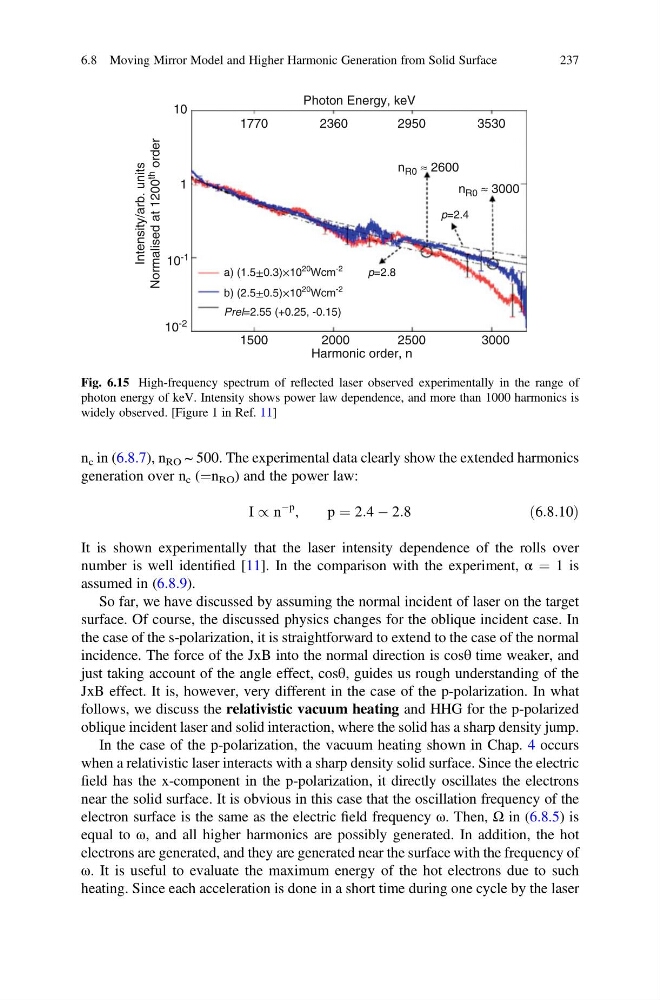
n c in (6.8.7), n RO ~ 500. The experimental data clearly show the extended harmonics
generation over n c (¼n RO ) and the power law:
I / n
Àp ,
p¼ 2:4 À 2:8
ð6:8:10Þ
It is shown experimentally that the laser intensity dependence of the rolls over
number is well identified [11]. In the comparison with the experiment, α ¼ 1 is
assumed in (6.8.9).
So far, we have discussed by assuming the normal incident of laser on the target
surface. Of course, the discussed physics changes for the oblique incident case. In
the case of the s-polarization, it is straightforward to extend to the case of the normal
incidence. The force of the JxB into the normal direction is cosθ time weaker, and
just taking account of the angle effect, cosθ, guides us rough understanding of the
JxB effect. It is, however, very different in the case of the p-polarization. In what
follows, we discuss the relativistic vacuum heating and HHG for the p-polarized
oblique incident laser and solid interaction, where the solid has a sharp density jump.
In the case of the p-polarization, the vacuum heating shown in Chap. 4 occurs
when a relativistic laser interacts with a sharp density solid surface. Since the electric
field has the x-component in the p-polarization, it directly oscillates the electrons
near the solid surface. It is obvious in this case that the oscillation frequency of the
electron surface is the same as the electric field frequency ω. Then, Ω in (6.8.5) is
equal to ω, and all higher harmonics are possibly generated. In addition, the hot
electrons are generated, and they are generated near the surface with the frequency of
ω. It is useful to evaluate the maximum energy of the hot electrons due to such
heating. Since each acceleration is done in a short time during one cycle by the laser
10
1
1500
a) (1.5±0.3)×10
20
Wcm
-2
b) (2.5±0.5)×10
20
Wcm
-2
Prel=2.55 (+0.25, -0.15)
1770
2360
Photon Energy, keV
Intensity/arb. units
Normalised at 1200 th
order
2950
n R0 ≈ 2600
n R0 ≈ 3000
3530
2000
Harmonic order, n
2500
p=2.8
p=2.4
3000
10 -1
10 -2
Fig. 6.15 High-frequency spectrum of reflected laser observed experimentally in the range of
photon energy of keV. Intensity shows power law dependence, and more than 1000 harmonics is
widely observed. [Figure 1 in Ref. 11]
6.8 Moving Mirror Model and Higher Harmonic Generation from Solid Surface
237
generation over n c (¼n RO ) and the power law:
I / n
Àp ,
p¼ 2:4 À 2:8
ð6:8:10Þ
It is shown experimentally that the laser intensity dependence of the rolls over
number is well identified [11]. In the comparison with the experiment, α ¼ 1 is
assumed in (6.8.9).
So far, we have discussed by assuming the normal incident of laser on the target
surface. Of course, the discussed physics changes for the oblique incident case. In
the case of the s-polarization, it is straightforward to extend to the case of the normal
incidence. The force of the JxB into the normal direction is cosθ time weaker, and
just taking account of the angle effect, cosθ, guides us rough understanding of the
JxB effect. It is, however, very different in the case of the p-polarization. In what
follows, we discuss the relativistic vacuum heating and HHG for the p-polarized
oblique incident laser and solid interaction, where the solid has a sharp density jump.
In the case of the p-polarization, the vacuum heating shown in Chap. 4 occurs
when a relativistic laser interacts with a sharp density solid surface. Since the electric
field has the x-component in the p-polarization, it directly oscillates the electrons
near the solid surface. It is obvious in this case that the oscillation frequency of the
electron surface is the same as the electric field frequency ω. Then, Ω in (6.8.5) is
equal to ω, and all higher harmonics are possibly generated. In addition, the hot
electrons are generated, and they are generated near the surface with the frequency of
ω. It is useful to evaluate the maximum energy of the hot electrons due to such
heating. Since each acceleration is done in a short time during one cycle by the laser
10
1
1500
a) (1.5±0.3)×10
20
Wcm
-2
b) (2.5±0.5)×10
20
Wcm
-2
Prel=2.55 (+0.25, -0.15)
1770
2360
Photon Energy, keV
Intensity/arb. units
Normalised at 1200 th
order
2950
n R0 ≈ 2600
n R0 ≈ 3000
3530
2000
Harmonic order, n
2500
p=2.8
p=2.4
3000
10 -1
10 -2
Fig. 6.15 High-frequency spectrum of reflected laser observed experimentally in the range of
photon energy of keV. Intensity shows power law dependence, and more than 1000 harmonics is
widely observed. [Figure 1 in Ref. 11]
6.8 Moving Mirror Model and Higher Harmonic Generation from Solid Surface
237