

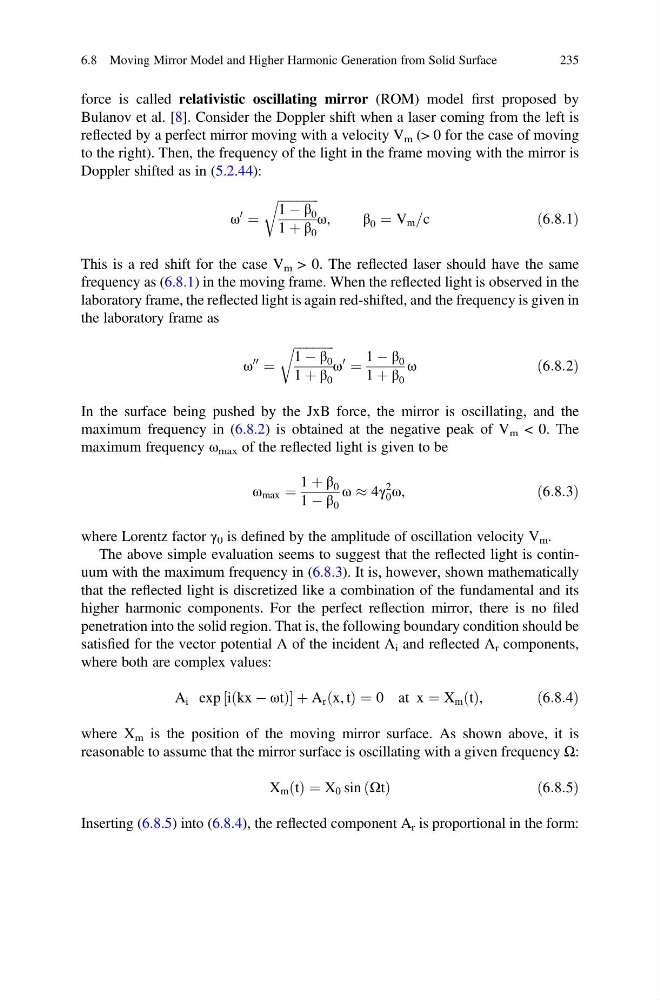
force is called relativistic oscillating mirror (ROM) model first proposed by
Bulanov et al. [8]. Consider the Doppler shift when a laser coming from the left is
reflected by a perfect mirror moving with a velocity V m (> 0 for the case of moving
to the right). Then, the frequency of the light in the frame moving with the mirror is
Doppler shifted as in (5.2.44):
ω
0
¼
ffiffiffiffiffiffiffiffiffiffiffiffiffi
1 À β 0
1 þ β 0
r
ω,
β 0 ¼ V m =c
ð6:8:1Þ
This is a red shift for the case V m > 0. The reflected laser should have the same
frequency as (6.8.1) in the moving frame. When the reflected light is observed in the
laboratory frame, the reflected light is again red-shifted, and the frequency is given in
the laboratory frame as
ω
00
¼
ffiffiffiffiffiffiffiffiffiffiffiffiffi
1 À β 0
1 þ β 0
r
ω
0
¼
1 À β 0
1 þ β 0
ω
ð6:8:2Þ
In the surface being pushed by the JxB force, the mirror is oscillating, and the
maximum frequency in (6.8.2) is obtained at the negative peak of V m < 0. The
maximum frequency ω max of the reflected light is given to be
ω max ¼
1 þ β 0
1 À β 0
ω % 4γ
2
0 ω,
ð6:8:3Þ
where Lorentz factor γ 0 is defined by the amplitude of oscillation velocity V m .
The above simple evaluation seems to suggest that the reflected light is continuum with the maximum frequency in (6.8.3). It is, however, shown mathematically
that the reflected light is discretized like a combination of the fundamental and its
higher harmonic components. For the perfect reflection mirror, there is no filed
penetration into the solid region. That is, the following boundary condition should be
satisfied for the vector potential A of the incident A i and reflected A r components,
where both are complex values:
A i exp i kx À ωt
ð
Þ
½
þA r x, t
ð Þ ¼ 0 at x ¼ X m t
ð Þ,
ð6:8:4Þ
where X m is the position of the moving mirror surface. As shown above, it is
reasonable to assume that the mirror surface is oscillating with a given frequency Ω:
X m t
ð Þ ¼ X 0 sin Ωt
ð Þ
ð6:8:5Þ
Inserting (6.8.5) into (6.8.4), the reflected component A r is proportional in the form:
6.8 Moving Mirror Model and Higher Harmonic Generation from Solid Surface
235
Bulanov et al. [8]. Consider the Doppler shift when a laser coming from the left is
reflected by a perfect mirror moving with a velocity V m (> 0 for the case of moving
to the right). Then, the frequency of the light in the frame moving with the mirror is
Doppler shifted as in (5.2.44):
ω
0
¼
ffiffiffiffiffiffiffiffiffiffiffiffiffi
1 À β 0
1 þ β 0
r
ω,
β 0 ¼ V m =c
ð6:8:1Þ
This is a red shift for the case V m > 0. The reflected laser should have the same
frequency as (6.8.1) in the moving frame. When the reflected light is observed in the
laboratory frame, the reflected light is again red-shifted, and the frequency is given in
the laboratory frame as
ω
00
¼
ffiffiffiffiffiffiffiffiffiffiffiffiffi
1 À β 0
1 þ β 0
r
ω
0
¼
1 À β 0
1 þ β 0
ω
ð6:8:2Þ
In the surface being pushed by the JxB force, the mirror is oscillating, and the
maximum frequency in (6.8.2) is obtained at the negative peak of V m < 0. The
maximum frequency ω max of the reflected light is given to be
ω max ¼
1 þ β 0
1 À β 0
ω % 4γ
2
0 ω,
ð6:8:3Þ
where Lorentz factor γ 0 is defined by the amplitude of oscillation velocity V m .
The above simple evaluation seems to suggest that the reflected light is continuum with the maximum frequency in (6.8.3). It is, however, shown mathematically
that the reflected light is discretized like a combination of the fundamental and its
higher harmonic components. For the perfect reflection mirror, there is no filed
penetration into the solid region. That is, the following boundary condition should be
satisfied for the vector potential A of the incident A i and reflected A r components,
where both are complex values:
A i exp i kx À ωt
ð
Þ
½
þA r x, t
ð Þ ¼ 0 at x ¼ X m t
ð Þ,
ð6:8:4Þ
where X m is the position of the moving mirror surface. As shown above, it is
reasonable to assume that the mirror surface is oscillating with a given frequency Ω:
X m t
ð Þ ¼ X 0 sin Ωt
ð Þ
ð6:8:5Þ
Inserting (6.8.5) into (6.8.4), the reflected component A r is proportional in the form:
6.8 Moving Mirror Model and Higher Harmonic Generation from Solid Surface
235