

P JxB $ mc γ
ð Þ 2ω $
mc
ffiffi ffi
2
p a 0 ,
ð6:7:9Þ
where we took the potential difference over 2ω oscillation of the force, that is, γ.
Since a 0 ¼ 6.8, the accelerated momentum may have p x ~ 4.8 mc, roughly in
agreement with the value in Fig. 6.13. Such scaling law for the hot electron
temperature
T h % ΔE ¼ mc
2
γ À 1
ð
Þ,
γ ¼
1
2
a
2
0 þ 1
1=2
ð6:7:10Þ
is called Ponderomotive scaling of hot electron temperature. It is noted that such
simple scaling provides a rough estimate of the temperature of hot electrons. As will
be discussed below, however, this simple scaling is applicable only to limited cases.
Another electron acceleration physics becomes important in the other cases.
Especially in the case of longer pulse, large spot size, and targets with pre-formed
plasmas, the further interaction of re-circulating hot electrons with laser fields and
longitudinal plasma fields heats again and again the hotel electrons to increase the
hot electron temperature even for the same laser intensity.
6.8 Moving Mirror Model and Higher Harmonic
Generation from Solid Surface
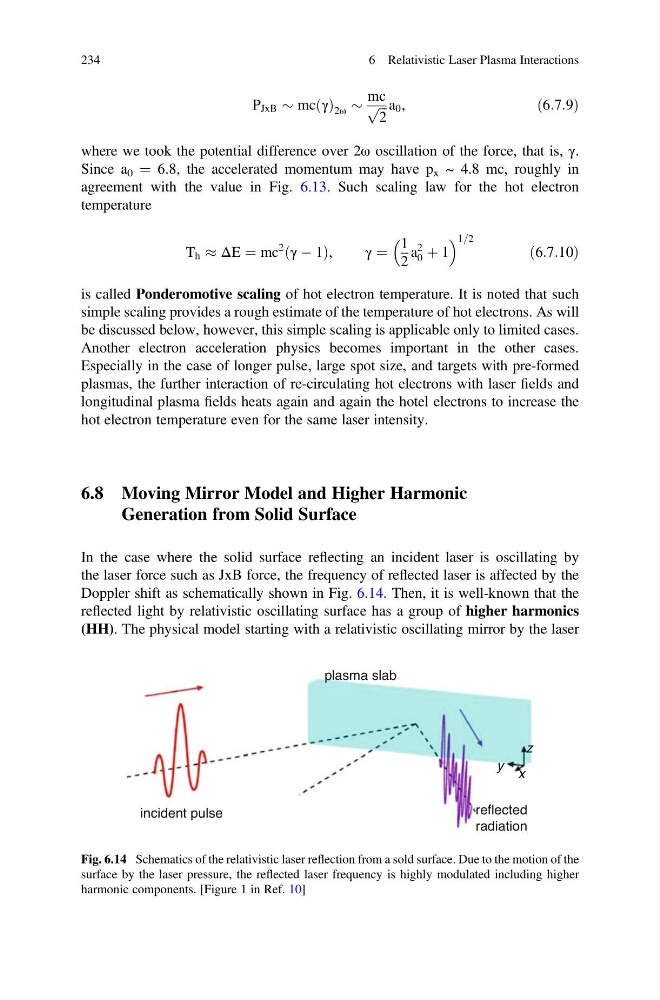
In the case where the solid surface reflecting an incident laser is oscillating by
the laser force such as JxB force, the frequency of reflected laser is affected by the
Doppler shift as schematically shown in Fig. 6.14. Then, it is well-known that the
reflected light by relativistic oscillating surface has a group of higher harmonics
(HH). The physical model starting with a relativistic oscillating mirror by the laser
plasma slab
incident pulse
reflected
radiation
y x
z
Fig. 6.14 Schematics of the relativistic laser reflection from a sold surface. Due to the motion of the
surface by the laser pressure, the reflected laser frequency is highly modulated including higher
harmonic components. [Figure 1 in Ref. 10]
234
6 Relativistic Laser Plasma Interactions
ð Þ 2ω $
mc
ffiffi ffi
2
p a 0 ,
ð6:7:9Þ
where we took the potential difference over 2ω oscillation of the force, that is, γ.
Since a 0 ¼ 6.8, the accelerated momentum may have p x ~ 4.8 mc, roughly in
agreement with the value in Fig. 6.13. Such scaling law for the hot electron
temperature
T h % ΔE ¼ mc
2
γ À 1
ð
Þ,
γ ¼
1
2
a
2
0 þ 1
1=2
ð6:7:10Þ
is called Ponderomotive scaling of hot electron temperature. It is noted that such
simple scaling provides a rough estimate of the temperature of hot electrons. As will
be discussed below, however, this simple scaling is applicable only to limited cases.
Another electron acceleration physics becomes important in the other cases.
Especially in the case of longer pulse, large spot size, and targets with pre-formed
plasmas, the further interaction of re-circulating hot electrons with laser fields and
longitudinal plasma fields heats again and again the hotel electrons to increase the
hot electron temperature even for the same laser intensity.
6.8 Moving Mirror Model and Higher Harmonic
Generation from Solid Surface
In the case where the solid surface reflecting an incident laser is oscillating by
the laser force such as JxB force, the frequency of reflected laser is affected by the
Doppler shift as schematically shown in Fig. 6.14. Then, it is well-known that the
reflected light by relativistic oscillating surface has a group of higher harmonics
(HH). The physical model starting with a relativistic oscillating mirror by the laser
plasma slab
incident pulse
reflected
radiation
y x
z
Fig. 6.14 Schematics of the relativistic laser reflection from a sold surface. Due to the motion of the
surface by the laser pressure, the reflected laser frequency is highly modulated including higher
harmonic components. [Figure 1 in Ref. 10]
234
6 Relativistic Laser Plasma Interactions