

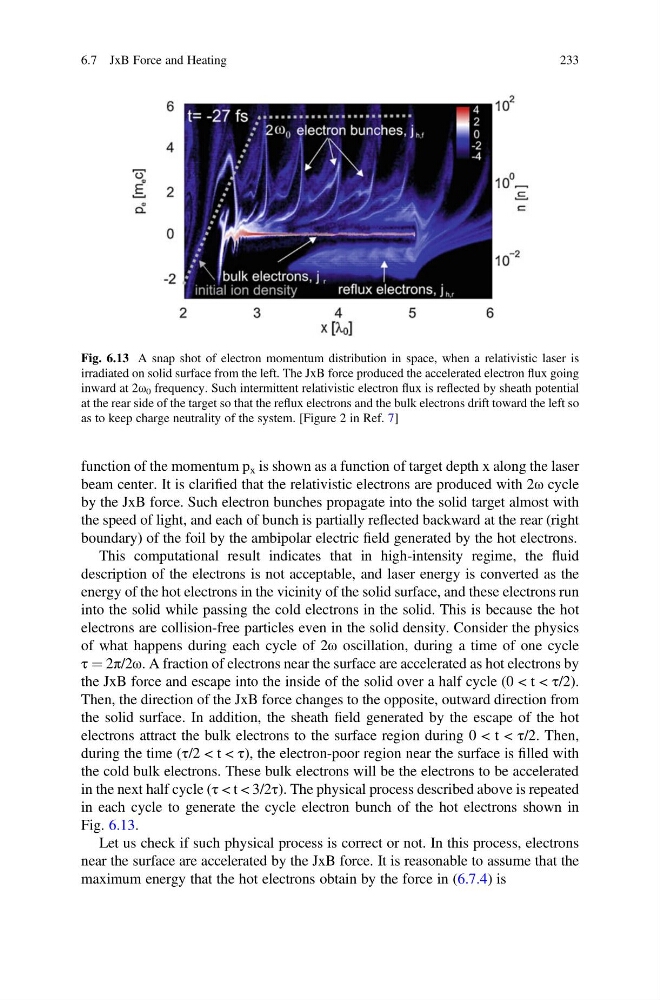
function of the momentum p x is shown as a function of target depth x along the laser
beam center. It is clarified that the relativistic electrons are produced with 2ω cycle
by the JxB force. Such electron bunches propagate into the solid target almost with
the speed of light, and each of bunch is partially reflected backward at the rear (right
boundary) of the foil by the ambipolar electric field generated by the hot electrons.
This computational result indicates that in high-intensity regime, the fluid
description of the electrons is not acceptable, and laser energy is converted as the
energy of the hot electrons in the vicinity of the solid surface, and these electrons run
into the solid while passing the cold electrons in the solid. This is because the hot
electrons are collision-free particles even in the solid density. Consider the physics
of what happens during each cycle of 2ω oscillation, during a time of one cycle
τ ¼ 2π/2ω. A fraction of electrons near the surface are accelerated as hot electrons by
the JxB force and escape into the inside of the solid over a half cycle (0 < t < τ/2).
Then, the direction of the JxB force changes to the opposite, outward direction from
the solid surface. In addition, the sheath field generated by the escape of the hot
electrons attract the bulk electrons to the surface region during 0 < t < τ/2. Then,
during the time (τ/2 < t < τ), the electron-poor region near the surface is filled with
the cold bulk electrons. These bulk electrons will be the electrons to be accelerated
in the next half cycle (τ < t < 3/2τ). The physical process described above is repeated
in each cycle to generate the cycle electron bunch of the hot electrons shown in
Fig. 6.13.
Let us check if such physical process is correct or not. In this process, electrons
near the surface are accelerated by the JxB force. It is reasonable to assume that the
maximum energy that the hot electrons obtain by the force in (6.7.4) is
Fig. 6.13 A snap shot of electron momentum distribution in space, when a relativistic laser is
irradiated on solid surface from the left. The JxB force produced the accelerated electron flux going
inward at 2ω 0 frequency. Such intermittent relativistic electron flux is reflected by sheath potential
at the rear side of the target so that the reflux electrons and the bulk electrons drift toward the left so
as to keep charge neutrality of the system. [Figure 2 in Ref. 7]
6.7 JxB Force and Heating
233
beam center. It is clarified that the relativistic electrons are produced with 2ω cycle
by the JxB force. Such electron bunches propagate into the solid target almost with
the speed of light, and each of bunch is partially reflected backward at the rear (right
boundary) of the foil by the ambipolar electric field generated by the hot electrons.
This computational result indicates that in high-intensity regime, the fluid
description of the electrons is not acceptable, and laser energy is converted as the
energy of the hot electrons in the vicinity of the solid surface, and these electrons run
into the solid while passing the cold electrons in the solid. This is because the hot
electrons are collision-free particles even in the solid density. Consider the physics
of what happens during each cycle of 2ω oscillation, during a time of one cycle
τ ¼ 2π/2ω. A fraction of electrons near the surface are accelerated as hot electrons by
the JxB force and escape into the inside of the solid over a half cycle (0 < t < τ/2).
Then, the direction of the JxB force changes to the opposite, outward direction from
the solid surface. In addition, the sheath field generated by the escape of the hot
electrons attract the bulk electrons to the surface region during 0 < t < τ/2. Then,
during the time (τ/2 < t < τ), the electron-poor region near the surface is filled with
the cold bulk electrons. These bulk electrons will be the electrons to be accelerated
in the next half cycle (τ < t < 3/2τ). The physical process described above is repeated
in each cycle to generate the cycle electron bunch of the hot electrons shown in
Fig. 6.13.
Let us check if such physical process is correct or not. In this process, electrons
near the surface are accelerated by the JxB force. It is reasonable to assume that the
maximum energy that the hot electrons obtain by the force in (6.7.4) is
Fig. 6.13 A snap shot of electron momentum distribution in space, when a relativistic laser is
irradiated on solid surface from the left. The JxB force produced the accelerated electron flux going
inward at 2ω 0 frequency. Such intermittent relativistic electron flux is reflected by sheath potential
at the rear side of the target so that the reflux electrons and the bulk electrons drift toward the left so
as to keep charge neutrality of the system. [Figure 2 in Ref. 7]
6.7 JxB Force and Heating
233