

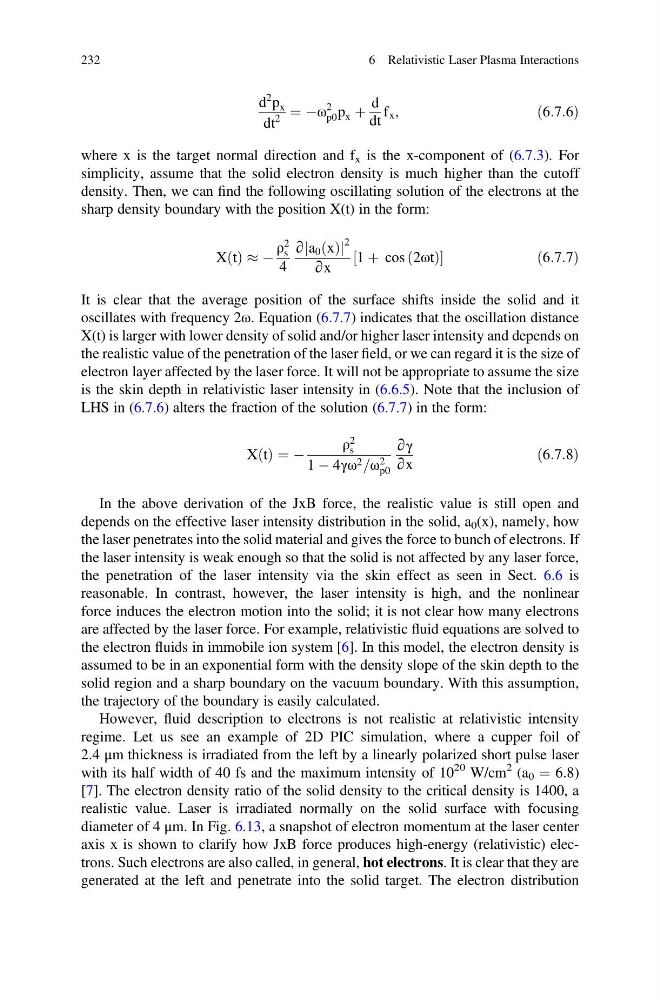
d
2 p x
dt
2
¼ Àω
2
p0 p x þ
d
dt
f x ,
ð6:7:6Þ
where x is the target normal direction and f x is the x-component of (6.7.3). For
simplicity, assume that the solid electron density is much higher than the cutoff
density. Then, we can find the following oscillating solution of the electrons at the
sharp density boundary with the position X(t) in the form:
X t
ð Þ % À
ρ
2
s
4
∂ a 0 x
ð Þ
j
j
2
∂x
1 þ cos 2ωt
ð Þ
½
ð 6:7:7Þ
It is clear that the average position of the surface shifts inside the solid and it
oscillates with frequency 2ω. Equation (6.7.7) indicates that the oscillation distance
X(t) is larger with lower density of solid and/or higher laser intensity and depends on
the realistic value of the penetration of the laser field, or we can regard it is the size of
electron layer affected by the laser force. It will not be appropriate to assume the size
is the skin depth in relativistic laser intensity in (6.6.5). Note that the inclusion of
LHS in (6.7.6) alters the fraction of the solution (6.7.7) in the form:
X t
ð Þ ¼ À
ρ
2
s
1 À 4γω 2 =ω 2
p0
∂γ
∂x
ð6:7:8Þ
In the above derivation of the JxB force, the realistic value is still open and
depends on the effective laser intensity distribution in the solid, a 0 (x), namely, how
the laser penetrates into the solid material and gives the force to bunch of electrons. If
the laser intensity is weak enough so that the solid is not affected by any laser force,
the penetration of the laser intensity via the skin effect as seen in Sect. 6.6 is
reasonable. In contrast, however, the laser intensity is high, and the nonlinear
force induces the electron motion into the solid; it is not clear how many electrons
are affected by the laser force. For example, relativistic fluid equations are solved to
the electron fluids in immobile ion system [6]. In this model, the electron density is
assumed to be in an exponential form with the density slope of the skin depth to the
solid region and a sharp boundary on the vacuum boundary. With this assumption,
the trajectory of the boundary is easily calculated.
However, fluid description to electrons is not realistic at relativistic intensity
regime. Let us see an example of 2D PIC simulation, where a cupper foil of
2.4 μm thickness is irradiated from the left by a linearly polarized short pulse laser
with its half width of 40 fs and the maximum intensity of 10
20 W/cm
2 (a 0 ¼ 6.8)
[7]. The electron density ratio of the solid density to the critical density is 1400, a
realistic value. Laser is irradiated normally on the solid surface with focusing
diameter of 4 μm. In Fig. 6.13, a snapshot of electron momentum at the laser center
axis x is shown to clarify how JxB force produces high-energy (relativistic) electrons. Such electrons are also called, in general, hot electrons. It is clear that they are
generated at the left and penetrate into the solid target. The electron distribution
232
6 Relativistic Laser Plasma Interactions
2 p x
dt
2
¼ Àω
2
p0 p x þ
d
dt
f x ,
ð6:7:6Þ
where x is the target normal direction and f x is the x-component of (6.7.3). For
simplicity, assume that the solid electron density is much higher than the cutoff
density. Then, we can find the following oscillating solution of the electrons at the
sharp density boundary with the position X(t) in the form:
X t
ð Þ % À
ρ
2
s
4
∂ a 0 x
ð Þ
j
j
2
∂x
1 þ cos 2ωt
ð Þ
½
ð 6:7:7Þ
It is clear that the average position of the surface shifts inside the solid and it
oscillates with frequency 2ω. Equation (6.7.7) indicates that the oscillation distance
X(t) is larger with lower density of solid and/or higher laser intensity and depends on
the realistic value of the penetration of the laser field, or we can regard it is the size of
electron layer affected by the laser force. It will not be appropriate to assume the size
is the skin depth in relativistic laser intensity in (6.6.5). Note that the inclusion of
LHS in (6.7.6) alters the fraction of the solution (6.7.7) in the form:
X t
ð Þ ¼ À
ρ
2
s
1 À 4γω 2 =ω 2
p0
∂γ
∂x
ð6:7:8Þ
In the above derivation of the JxB force, the realistic value is still open and
depends on the effective laser intensity distribution in the solid, a 0 (x), namely, how
the laser penetrates into the solid material and gives the force to bunch of electrons. If
the laser intensity is weak enough so that the solid is not affected by any laser force,
the penetration of the laser intensity via the skin effect as seen in Sect. 6.6 is
reasonable. In contrast, however, the laser intensity is high, and the nonlinear
force induces the electron motion into the solid; it is not clear how many electrons
are affected by the laser force. For example, relativistic fluid equations are solved to
the electron fluids in immobile ion system [6]. In this model, the electron density is
assumed to be in an exponential form with the density slope of the skin depth to the
solid region and a sharp boundary on the vacuum boundary. With this assumption,
the trajectory of the boundary is easily calculated.
However, fluid description to electrons is not realistic at relativistic intensity
regime. Let us see an example of 2D PIC simulation, where a cupper foil of
2.4 μm thickness is irradiated from the left by a linearly polarized short pulse laser
with its half width of 40 fs and the maximum intensity of 10
20 W/cm
2 (a 0 ¼ 6.8)
[7]. The electron density ratio of the solid density to the critical density is 1400, a
realistic value. Laser is irradiated normally on the solid surface with focusing
diameter of 4 μm. In Fig. 6.13, a snapshot of electron momentum at the laser center
axis x is shown to clarify how JxB force produces high-energy (relativistic) electrons. Such electrons are also called, in general, hot electrons. It is clear that they are
generated at the left and penetrate into the solid target. The electron distribution
232
6 Relativistic Laser Plasma Interactions