

6.5.4 Frequency Shifts
It is noticed that the self-focusing and nonlinear frequency shift happen simultaneously, and the evaluation by paying attention only to the self-focusing shown
above is difficult to apply to the analysis of the frequency shift of the laser in the
traveling channel made by the nonlinearity of laser itself.
For the infinite plasma R ! 1 in (6.5.4), the nonlinear terms seem to provide
only the change of wavenumber k and phase velocity of the laser propagation.
ω
2
À c
2 k
2
¼ ω
2
p0 1 À δ m
ð
Þ¼ω
2
p0
1
γ
h i
ð6:5:17Þ
Equation (6.5.17) is nothing without (6.2.2) showing the relativistic dispersion
relation and transparency. In order to study the self-focusing and nonlinear frequency shift, we have to invoke more basic analysis for a nonlinear coupling of two
weak electromagnetic waves propagating with slightly oblique angle along the laser
beam. Then, we can also obtain the dynamic time scale of the self-focusing
depending on the size of the intensity width of laser beam as see below.
6.5.5 Filamentation Instability
Let us evaluate the stability of the two waves propagating with the angles slightly
oblique to the propagating laser wave due to the nonlinearity via the relativistic mass
correction. Assume the original wave has a ¼ a 0 and these two oblique waves are
given as a 1 and a 2 , namely,
a ¼ a 0 þ a 1 þ a 2
ð6:5:18Þ
The condition |a 0 | > > |a 1 |, |a 2 | is also satisfied.
Inserting a linear polarized plane wave into the 0-th wave a 0 with k ¼ k and
ω ¼ ω 0 . Then, assuming weak nonlinearity such as
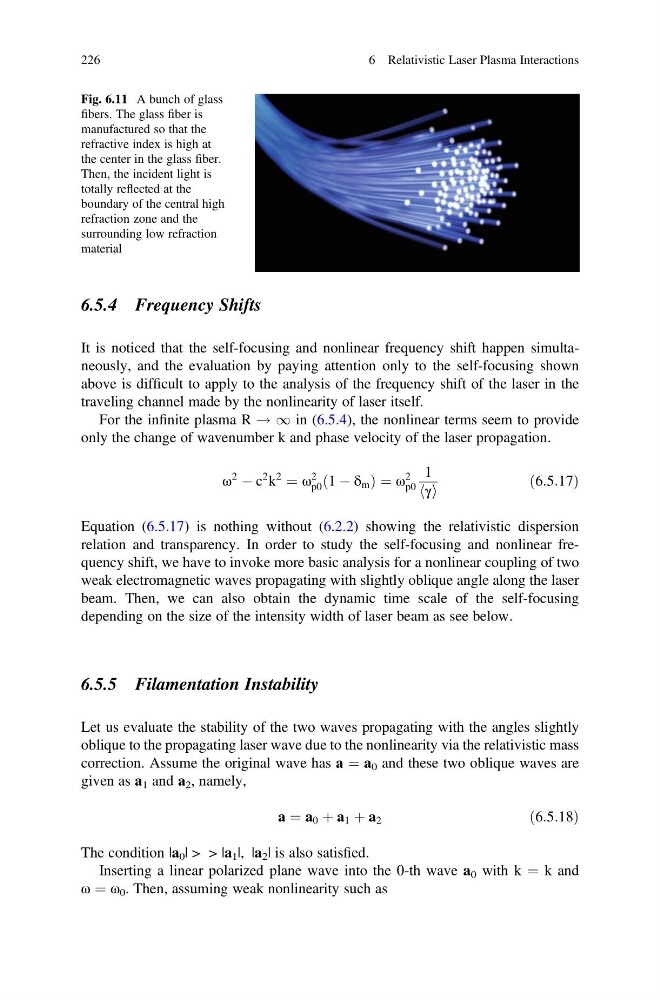
Fig. 6.11 A bunch of glass
fibers. The glass fiber is
manufactured so that the
refractive index is high at
the center in the glass fiber.
Then, the incident light is
totally reflected at the
boundary of the central high
refraction zone and the
surrounding low refraction
material
226
6 Relativistic Laser Plasma Interactions
It is noticed that the self-focusing and nonlinear frequency shift happen simultaneously, and the evaluation by paying attention only to the self-focusing shown
above is difficult to apply to the analysis of the frequency shift of the laser in the
traveling channel made by the nonlinearity of laser itself.
For the infinite plasma R ! 1 in (6.5.4), the nonlinear terms seem to provide
only the change of wavenumber k and phase velocity of the laser propagation.
ω
2
À c
2 k
2
¼ ω
2
p0 1 À δ m
ð
Þ¼ω
2
p0
1
γ
h i
ð6:5:17Þ
Equation (6.5.17) is nothing without (6.2.2) showing the relativistic dispersion
relation and transparency. In order to study the self-focusing and nonlinear frequency shift, we have to invoke more basic analysis for a nonlinear coupling of two
weak electromagnetic waves propagating with slightly oblique angle along the laser
beam. Then, we can also obtain the dynamic time scale of the self-focusing
depending on the size of the intensity width of laser beam as see below.
6.5.5 Filamentation Instability
Let us evaluate the stability of the two waves propagating with the angles slightly
oblique to the propagating laser wave due to the nonlinearity via the relativistic mass
correction. Assume the original wave has a ¼ a 0 and these two oblique waves are
given as a 1 and a 2 , namely,
a ¼ a 0 þ a 1 þ a 2
ð6:5:18Þ
The condition |a 0 | > > |a 1 |, |a 2 | is also satisfied.
Inserting a linear polarized plane wave into the 0-th wave a 0 with k ¼ k and
ω ¼ ω 0 . Then, assuming weak nonlinearity such as
Fig. 6.11 A bunch of glass
fibers. The glass fiber is
manufactured so that the
refractive index is high at
the center in the glass fiber.
Then, the incident light is
totally reflected at the
boundary of the central high
refraction zone and the
surrounding low refraction
material
226
6 Relativistic Laser Plasma Interactions