

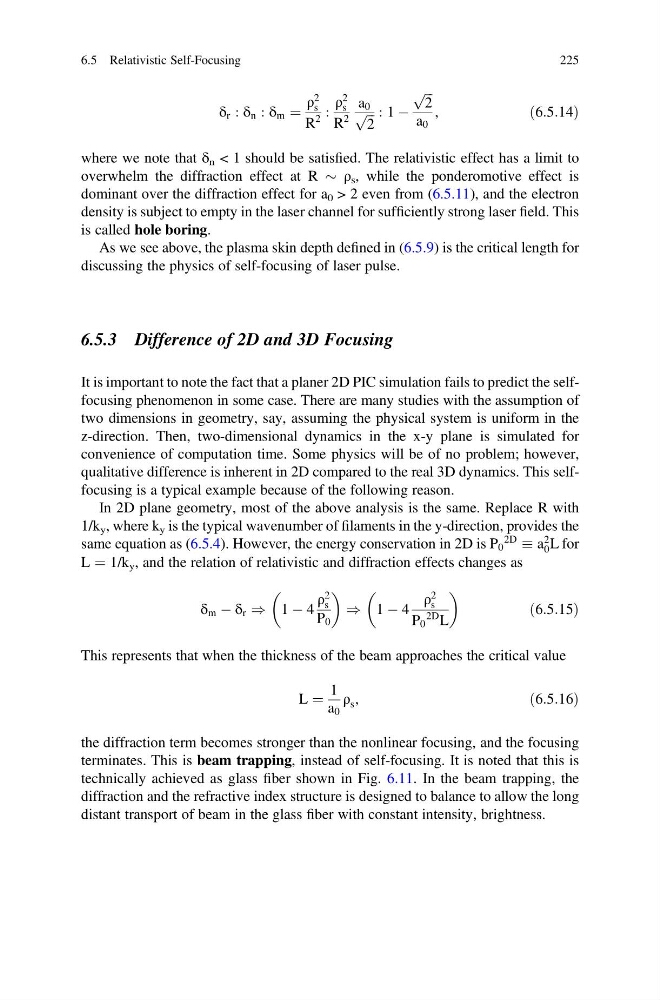
δ r : δ n : δ m ¼
ρ
2
s
R
2
:
ρ
2
s
R
2
a 0 ffiffi ffi
2
p : 1 À
ffiffi ffi
2
p
a 0
,
ð6:5:14Þ
where we note that δ n < 1 should be satisfied. The relativistic effect has a limit to
overwhelm the diffraction effect at R $ ρ s , while the ponderomotive effect is
dominant over the diffraction effect for a 0 > 2 even from (6.5.11), and the electron
density is subject to empty in the laser channel for sufficiently strong laser field. This
is called hole boring.
As we see above, the plasma skin depth defined in (6.5.9) is the critical length for
discussing the physics of self-focusing of laser pulse.
6.5.3 Difference of 2D and 3D Focusing
It is important to note the fact that a planer 2D PIC simulation fails to predict the selffocusing phenomenon in some case. There are many studies with the assumption of
two dimensions in geometry, say, assuming the physical system is uniform in the
z-direction. Then, two-dimensional dynamics in the x-y plane is simulated for
convenience of computation time. Some physics will be of no problem; however,
qualitative difference is inherent in 2D compared to the real 3D dynamics. This selffocusing is a typical example because of the following reason.
In 2D plane geometry, most of the above analysis is the same. Replace R with
1/k y , where k y is the typical wavenumber of filaments in the y-direction, provides the
same equation as (6.5.4). However, the energy conservation in 2D is P 0
2D
a
2
0 L for
L ¼ 1/k y , and the relation of relativistic and diffraction effects changes as
δ m À δ r ) 1 À 4
ρ
2
s
P 0
) 1 À 4
ρ
2
s
P 0
2D L
ð6:5:15Þ
This represents that when the thickness of the beam approaches the critical value
L ¼
1
a 0
ρ s ,
ð6:5:16Þ
the diffraction term becomes stronger than the nonlinear focusing, and the focusing
terminates. This is beam trapping, instead of self-focusing. It is noted that this is
technically achieved as glass fiber shown in Fig. 6.11. In the beam trapping, the
diffraction and the refractive index structure is designed to balance to allow the long
distant transport of beam in the glass fiber with constant intensity, brightness.
6.5 Relativistic Self-Focusing
225
ρ
2
s
R
2
:
ρ
2
s
R
2
a 0 ffiffi ffi
2
p : 1 À
ffiffi ffi
2
p
a 0
,
ð6:5:14Þ
where we note that δ n < 1 should be satisfied. The relativistic effect has a limit to
overwhelm the diffraction effect at R $ ρ s , while the ponderomotive effect is
dominant over the diffraction effect for a 0 > 2 even from (6.5.11), and the electron
density is subject to empty in the laser channel for sufficiently strong laser field. This
is called hole boring.
As we see above, the plasma skin depth defined in (6.5.9) is the critical length for
discussing the physics of self-focusing of laser pulse.
6.5.3 Difference of 2D and 3D Focusing
It is important to note the fact that a planer 2D PIC simulation fails to predict the selffocusing phenomenon in some case. There are many studies with the assumption of
two dimensions in geometry, say, assuming the physical system is uniform in the
z-direction. Then, two-dimensional dynamics in the x-y plane is simulated for
convenience of computation time. Some physics will be of no problem; however,
qualitative difference is inherent in 2D compared to the real 3D dynamics. This selffocusing is a typical example because of the following reason.
In 2D plane geometry, most of the above analysis is the same. Replace R with
1/k y , where k y is the typical wavenumber of filaments in the y-direction, provides the
same equation as (6.5.4). However, the energy conservation in 2D is P 0
2D
a
2
0 L for
L ¼ 1/k y , and the relation of relativistic and diffraction effects changes as
δ m À δ r ) 1 À 4
ρ
2
s
P 0
) 1 À 4
ρ
2
s
P 0
2D L
ð6:5:15Þ
This represents that when the thickness of the beam approaches the critical value
L ¼
1
a 0
ρ s ,
ð6:5:16Þ
the diffraction term becomes stronger than the nonlinear focusing, and the focusing
terminates. This is beam trapping, instead of self-focusing. It is noted that this is
technically achieved as glass fiber shown in Fig. 6.11. In the beam trapping, the
diffraction and the refractive index structure is designed to balance to allow the long
distant transport of beam in the glass fiber with constant intensity, brightness.
6.5 Relativistic Self-Focusing
225