

1
γ
% 1 À
1
2
a
2 ,
ð6:5:19Þ
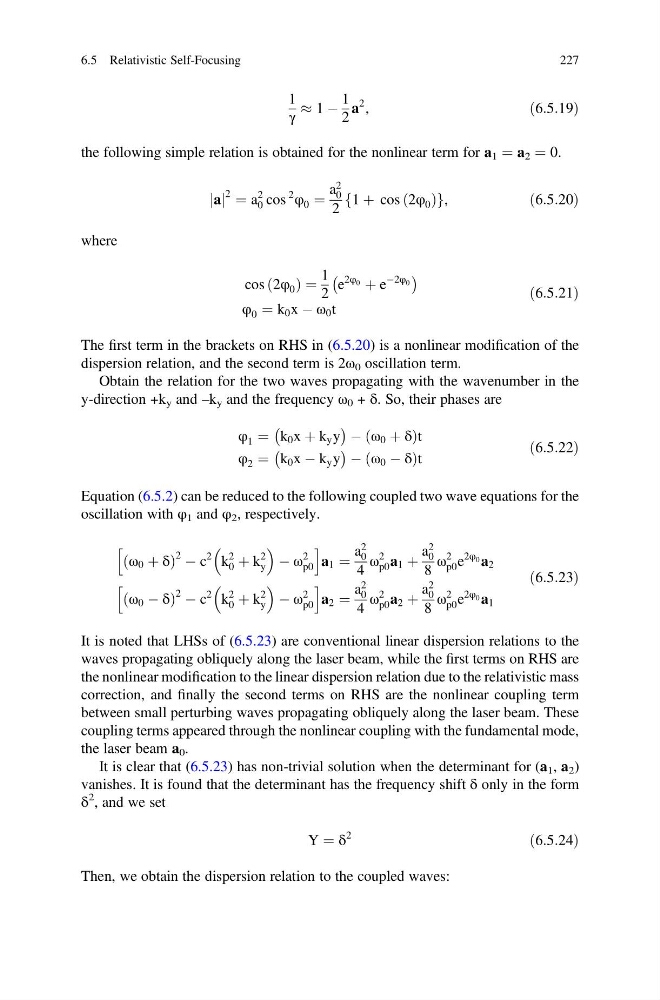
the following simple relation is obtained for the nonlinear term for a 1 ¼ a 2 ¼ 0.
a
j j
2 ¼ a
2
0 cos
2
φ 0 ¼
a
2
0
2
1 þ cos 2φ 0
ð
Þ
f
g ,
ð6:5:20Þ
where
cos 2φ 0
ð
Þ ¼
1
2
e
2φ 0 þ e
À2φ 0
À
Á
φ 0 ¼ k 0 x À ω 0 t
ð6:5:21Þ
The first term in the brackets on RHS in (6.5.20) is a nonlinear modification of the
dispersion relation, and the second term is 2ω 0 oscillation term.
Obtain the relation for the two waves propagating with the wavenumber in the
y-direction +k y and –k y and the frequency ω 0 + δ. So, their phases are
φ 1 ¼ k 0 x þ k y y
À
Á À ω 0 þ δ
ð
Þt
φ 2 ¼ k 0 x À k y y
À
Á À ω 0 À δ
ð
Þt
ð6:5:22Þ
Equation (6.5.2) can be reduced to the following coupled two wave equations for the
oscillation with φ 1 and φ 2 , respectively.
ω 0 þ δ
ð
Þ
2 À c
2 k
2
0 þ k
2
y
À ω
2
p0
h
i
a 1 ¼
a
2
0
4
ω
2
p0 a 1 þ
a
2
0
8
ω
2
p0 e
2φ 0 a 2
ω 0 À δ
ð
Þ
2 À c
2 k
2
0 þ k
2
y
À ω
2
p0
h
i
a 2 ¼
a
2
0
4
ω
2
p0 a 2 þ
a
2
0
8
ω
2
p0 e
2φ 0 a 1
ð6:5:23Þ
It is noted that LHSs of (6.5.23) are conventional linear dispersion relations to the
waves propagating obliquely along the laser beam, while the first terms on RHS are
the nonlinear modification to the linear dispersion relation due to the relativistic mass
correction, and finally the second terms on RHS are the nonlinear coupling term
between small perturbing waves propagating obliquely along the laser beam. These
coupling terms appeared through the nonlinear coupling with the fundamental mode,
the laser beam a 0 .
It is clear that (6.5.23) has non-trivial solution when the determinant for (a 1 , a 2 )
vanishes. It is found that the determinant has the frequency shift δ only in the form
δ
2 , and we set
Y ¼ δ
2
ð6:5:24Þ
Then, we obtain the dispersion relation to the coupled waves:
6.5 Relativistic Self-Focusing
227
γ
% 1 À
1
2
a
2 ,
ð6:5:19Þ
the following simple relation is obtained for the nonlinear term for a 1 ¼ a 2 ¼ 0.
a
j j
2 ¼ a
2
0 cos
2
φ 0 ¼
a
2
0
2
1 þ cos 2φ 0
ð
Þ
f
g ,
ð6:5:20Þ
where
cos 2φ 0
ð
Þ ¼
1
2
e
2φ 0 þ e
À2φ 0
À
Á
φ 0 ¼ k 0 x À ω 0 t
ð6:5:21Þ
The first term in the brackets on RHS in (6.5.20) is a nonlinear modification of the
dispersion relation, and the second term is 2ω 0 oscillation term.
Obtain the relation for the two waves propagating with the wavenumber in the
y-direction +k y and –k y and the frequency ω 0 + δ. So, their phases are
φ 1 ¼ k 0 x þ k y y
À
Á À ω 0 þ δ
ð
Þt
φ 2 ¼ k 0 x À k y y
À
Á À ω 0 À δ
ð
Þt
ð6:5:22Þ
Equation (6.5.2) can be reduced to the following coupled two wave equations for the
oscillation with φ 1 and φ 2 , respectively.
ω 0 þ δ
ð
Þ
2 À c
2 k
2
0 þ k
2
y
À ω
2
p0
h
i
a 1 ¼
a
2
0
4
ω
2
p0 a 1 þ
a
2
0
8
ω
2
p0 e
2φ 0 a 2
ω 0 À δ
ð
Þ
2 À c
2 k
2
0 þ k
2
y
À ω
2
p0
h
i
a 2 ¼
a
2
0
4
ω
2
p0 a 2 þ
a
2
0
8
ω
2
p0 e
2φ 0 a 1
ð6:5:23Þ
It is noted that LHSs of (6.5.23) are conventional linear dispersion relations to the
waves propagating obliquely along the laser beam, while the first terms on RHS are
the nonlinear modification to the linear dispersion relation due to the relativistic mass
correction, and finally the second terms on RHS are the nonlinear coupling term
between small perturbing waves propagating obliquely along the laser beam. These
coupling terms appeared through the nonlinear coupling with the fundamental mode,
the laser beam a 0 .
It is clear that (6.5.23) has non-trivial solution when the determinant for (a 1 , a 2 )
vanishes. It is found that the determinant has the frequency shift δ only in the form
δ
2 , and we set
Y ¼ δ
2
ð6:5:24Þ
Then, we obtain the dispersion relation to the coupled waves:
6.5 Relativistic Self-Focusing
227