

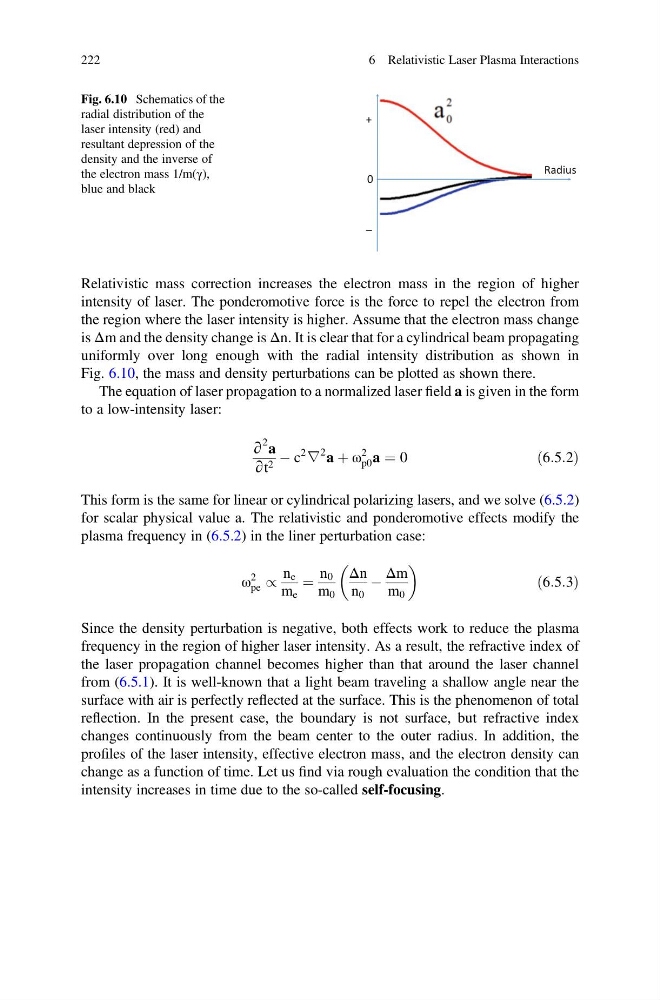
Relativistic mass correction increases the electron mass in the region of higher
intensity of laser. The ponderomotive force is the force to repel the electron from
the region where the laser intensity is higher. Assume that the electron mass change
is Δm and the density change is Δn. It is clear that for a cylindrical beam propagating
uniformly over long enough with the radial intensity distribution as shown in
Fig. 6.10, the mass and density perturbations can be plotted as shown there.
The equation of laser propagation to a normalized laser field a is given in the form
to a low-intensity laser:
∂
2 a
∂t 2 À c
2
∇
2 a þ ω
2
p0 a ¼ 0
ð6:5:2Þ
This form is the same for linear or cylindrical polarizing lasers, and we solve (6.5.2)
for scalar physical value a. The relativistic and ponderomotive effects modify the
plasma frequency in (6.5.2) in the liner perturbation case:
ω
2
pe /
n e
m e
¼
n 0
m 0
Δn
n 0
À
Δm
m 0
ð6:5:3Þ
Since the density perturbation is negative, both effects work to reduce the plasma
frequency in the region of higher laser intensity. As a result, the refractive index of
the laser propagation channel becomes higher than that around the laser channel
from (6.5.1). It is well-known that a light beam traveling a shallow angle near the
surface with air is perfectly reflected at the surface. This is the phenomenon of total
reflection. In the present case, the boundary is not surface, but refractive index
changes continuously from the beam center to the outer radius. In addition, the
profiles of the laser intensity, effective electron mass, and the electron density can
change as a function of time. Let us find via rough evaluation the condition that the
intensity increases in time due to the so-called self-focusing.
Radius
0
+
_
Fig. 6.10 Schematics of the
radial distribution of the
laser intensity (red) and
resultant depression of the
density and the inverse of
the electron mass 1/m(γ),
blue and black
222
6 Relativistic Laser Plasma Interactions
intensity of laser. The ponderomotive force is the force to repel the electron from
the region where the laser intensity is higher. Assume that the electron mass change
is Δm and the density change is Δn. It is clear that for a cylindrical beam propagating
uniformly over long enough with the radial intensity distribution as shown in
Fig. 6.10, the mass and density perturbations can be plotted as shown there.
The equation of laser propagation to a normalized laser field a is given in the form
to a low-intensity laser:
∂
2 a
∂t 2 À c
2
∇
2 a þ ω
2
p0 a ¼ 0
ð6:5:2Þ
This form is the same for linear or cylindrical polarizing lasers, and we solve (6.5.2)
for scalar physical value a. The relativistic and ponderomotive effects modify the
plasma frequency in (6.5.2) in the liner perturbation case:
ω
2
pe /
n e
m e
¼
n 0
m 0
Δn
n 0
À
Δm
m 0
ð6:5:3Þ
Since the density perturbation is negative, both effects work to reduce the plasma
frequency in the region of higher laser intensity. As a result, the refractive index of
the laser propagation channel becomes higher than that around the laser channel
from (6.5.1). It is well-known that a light beam traveling a shallow angle near the
surface with air is perfectly reflected at the surface. This is the phenomenon of total
reflection. In the present case, the boundary is not surface, but refractive index
changes continuously from the beam center to the outer radius. In addition, the
profiles of the laser intensity, effective electron mass, and the electron density can
change as a function of time. Let us find via rough evaluation the condition that the
intensity increases in time due to the so-called self-focusing.
Radius
0
+
_
Fig. 6.10 Schematics of the
radial distribution of the
laser intensity (red) and
resultant depression of the
density and the inverse of
the electron mass 1/m(γ),
blue and black
222
6 Relativistic Laser Plasma Interactions