

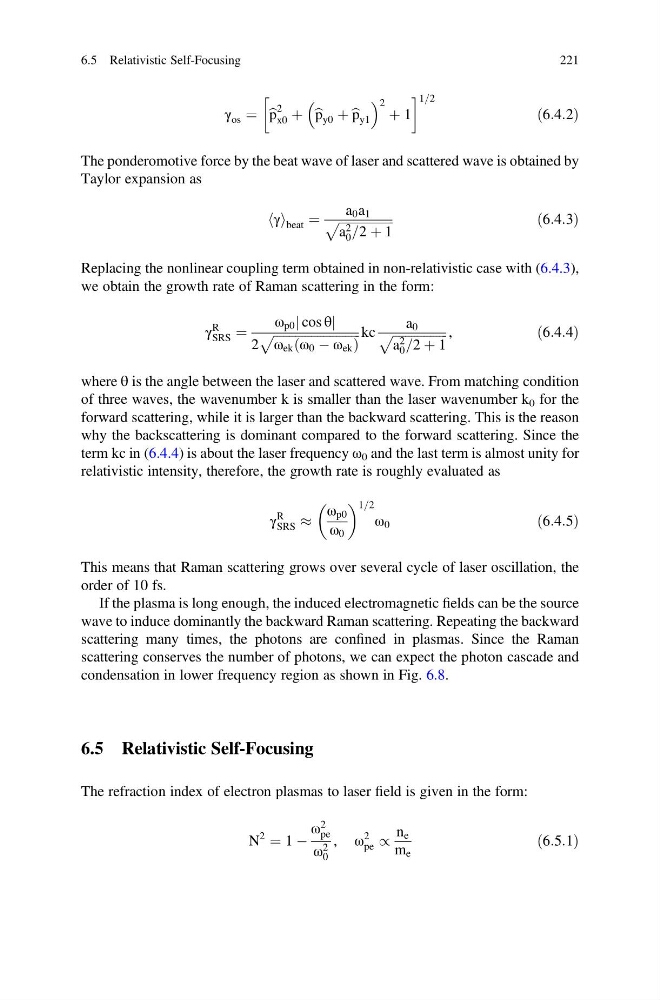
γ os ¼ b p
2
x0 þ b p y0 þ b p y1
2 þ 1
! 1=2
ð6:4:2Þ
The ponderomotive force by the beat wave of laser and scattered wave is obtained by
Taylor expansion as
γ
h i beat ¼
a 0 a 1
ffiffiffiffiffiffiffiffiffiffiffiffiffiffiffiffiffi ffi
a 2
0 =2 þ 1
p
ð6:4:3Þ
Replacing the nonlinear coupling term obtained in non-relativistic case with (6.4.3),
we obtain the growth rate of Raman scattering in the form:
γ
R
SRS ¼
ω p0 cos θ
j
j
2
ffiffiffiffiffiffiffiffiffiffiffiffiffiffiffiffiffiffiffiffiffiffiffiffiffiffiffi ffi
ω ek ω 0 À ω ek
ð
Þ
p
kc
a 0
ffiffiffiffiffiffiffiffiffiffiffiffiffiffiffiffiffi ffi
a 2
0 =2 þ 1
p
,
ð6:4:4Þ
where θ is the angle between the laser and scattered wave. From matching condition
of three waves, the wavenumber k is smaller than the laser wavenumber k 0 for the
forward scattering, while it is larger than the backward scattering. This is the reason
why the backscattering is dominant compared to the forward scattering. Since the
term kc in (6.4.4) is about the laser frequency ω 0 and the last term is almost unity for
relativistic intensity, therefore, the growth rate is roughly evaluated as
γ
R
SRS %
ω p0
ω 0
1=2
ω 0
ð6:4:5Þ
This means that Raman scattering grows over several cycle of laser oscillation, the
order of 10 fs.
If the plasma is long enough, the induced electromagnetic fields can be the source
wave to induce dominantly the backward Raman scattering. Repeating the backward
scattering many times, the photons are confined in plasmas. Since the Raman
scattering conserves the number of photons, we can expect the photon cascade and
condensation in lower frequency region as shown in Fig. 6.8.
6.5 Relativistic Self-Focusing
The refraction index of electron plasmas to laser field is given in the form:
N
2
¼ 1 À
ω
2
pe
ω 2
0
, ω
2
pe /
n e
m e
ð6:5:1Þ
6.5 Relativistic Self-Focusing
221
2
x0 þ b p y0 þ b p y1
2 þ 1
! 1=2
ð6:4:2Þ
The ponderomotive force by the beat wave of laser and scattered wave is obtained by
Taylor expansion as
γ
h i beat ¼
a 0 a 1
ffiffiffiffiffiffiffiffiffiffiffiffiffiffiffiffiffi ffi
a 2
0 =2 þ 1
p
ð6:4:3Þ
Replacing the nonlinear coupling term obtained in non-relativistic case with (6.4.3),
we obtain the growth rate of Raman scattering in the form:
γ
R
SRS ¼
ω p0 cos θ
j
j
2
ffiffiffiffiffiffiffiffiffiffiffiffiffiffiffiffiffiffiffiffiffiffiffiffiffiffiffi ffi
ω ek ω 0 À ω ek
ð
Þ
p
kc
a 0
ffiffiffiffiffiffiffiffiffiffiffiffiffiffiffiffiffi ffi
a 2
0 =2 þ 1
p
,
ð6:4:4Þ
where θ is the angle between the laser and scattered wave. From matching condition
of three waves, the wavenumber k is smaller than the laser wavenumber k 0 for the
forward scattering, while it is larger than the backward scattering. This is the reason
why the backscattering is dominant compared to the forward scattering. Since the
term kc in (6.4.4) is about the laser frequency ω 0 and the last term is almost unity for
relativistic intensity, therefore, the growth rate is roughly evaluated as
γ
R
SRS %
ω p0
ω 0
1=2
ω 0
ð6:4:5Þ
This means that Raman scattering grows over several cycle of laser oscillation, the
order of 10 fs.
If the plasma is long enough, the induced electromagnetic fields can be the source
wave to induce dominantly the backward Raman scattering. Repeating the backward
scattering many times, the photons are confined in plasmas. Since the Raman
scattering conserves the number of photons, we can expect the photon cascade and
condensation in lower frequency region as shown in Fig. 6.8.
6.5 Relativistic Self-Focusing
The refraction index of electron plasmas to laser field is given in the form:
N
2
¼ 1 À
ω
2
pe
ω 2
0
, ω
2
pe /
n e
m e
ð6:5:1Þ
6.5 Relativistic Self-Focusing
221