

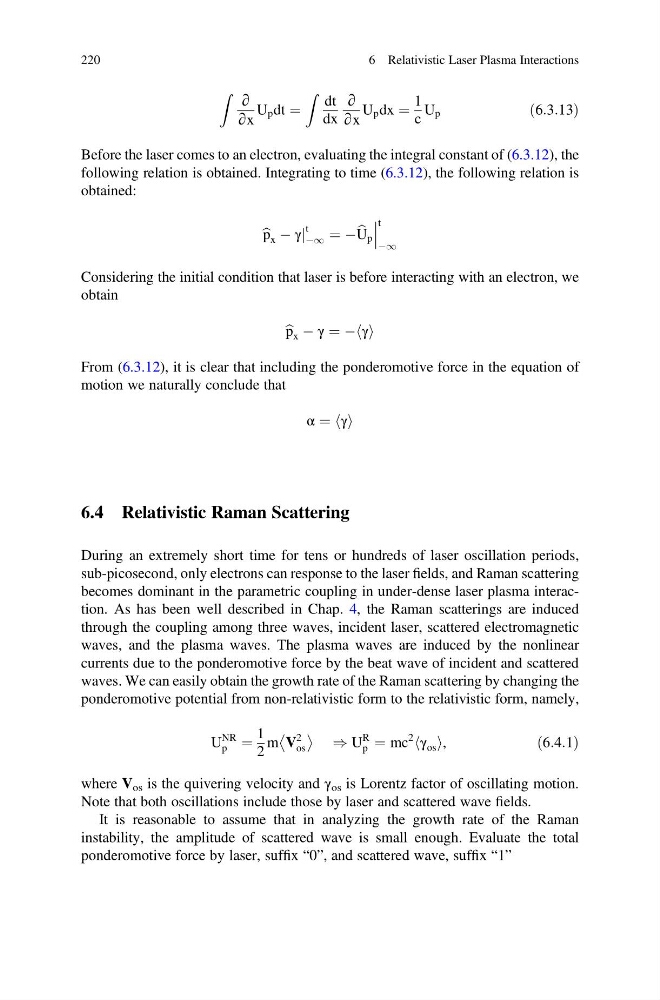
Z ∂
∂x
U p dt ¼
Z
dt
dx
∂
∂x
U p dx ¼
1
c
U p
ð6:3:13Þ
Before the laser comes to an electron, evaluating the integral constant of (6.3.12), the
following relation is obtained. Integrating to time (6.3.12), the following relation is
obtained:
b p x À γj
t
À1 ¼ À b
U p
t
À1
Considering the initial condition that laser is before interacting with an electron, we
obtain
b p x À γ ¼ À γ
h i
From (6.3.12), it is clear that including the ponderomotive force in the equation of
motion we naturally conclude that
α ¼ γ
h i
6.4 Relativistic Raman Scattering
During an extremely short time for tens or hundreds of laser oscillation periods,
sub-picosecond, only electrons can response to the laser fields, and Raman scattering
becomes dominant in the parametric coupling in under-dense laser plasma interaction. As has been well described in Chap. 4, the Raman scatterings are induced
through the coupling among three waves, incident laser, scattered electromagnetic
waves, and the plasma waves. The plasma waves are induced by the nonlinear
currents due to the ponderomotive force by the beat wave of incident and scattered
waves. We can easily obtain the growth rate of the Raman scattering by changing the
ponderomotive potential from non-relativistic form to the relativistic form, namely,
U
NR
p ¼
1
2
m V
2
os
) U
R
p ¼ mc
2
γ os
h i,
ð6:4:1Þ
where V os is the quivering velocity and γ os is Lorentz factor of oscillating motion.
Note that both oscillations include those by laser and scattered wave fields.
It is reasonable to assume that in analyzing the growth rate of the Raman
instability, the amplitude of scattered wave is small enough. Evaluate the total
ponderomotive force by laser, suffix “0”, and scattered wave, suffix “1”
220
6 Relativistic Laser Plasma Interactions
∂x
U p dt ¼
Z
dt
dx
∂
∂x
U p dx ¼
1
c
U p
ð6:3:13Þ
Before the laser comes to an electron, evaluating the integral constant of (6.3.12), the
following relation is obtained. Integrating to time (6.3.12), the following relation is
obtained:
b p x À γj
t
À1 ¼ À b
U p
t
À1
Considering the initial condition that laser is before interacting with an electron, we
obtain
b p x À γ ¼ À γ
h i
From (6.3.12), it is clear that including the ponderomotive force in the equation of
motion we naturally conclude that
α ¼ γ
h i
6.4 Relativistic Raman Scattering
During an extremely short time for tens or hundreds of laser oscillation periods,
sub-picosecond, only electrons can response to the laser fields, and Raman scattering
becomes dominant in the parametric coupling in under-dense laser plasma interaction. As has been well described in Chap. 4, the Raman scatterings are induced
through the coupling among three waves, incident laser, scattered electromagnetic
waves, and the plasma waves. The plasma waves are induced by the nonlinear
currents due to the ponderomotive force by the beat wave of incident and scattered
waves. We can easily obtain the growth rate of the Raman scattering by changing the
ponderomotive potential from non-relativistic form to the relativistic form, namely,
U
NR
p ¼
1
2
m V
2
os
) U
R
p ¼ mc
2
γ os
h i,
ð6:4:1Þ
where V os is the quivering velocity and γ os is Lorentz factor of oscillating motion.
Note that both oscillations include those by laser and scattered wave fields.
It is reasonable to assume that in analyzing the growth rate of the Raman
instability, the amplitude of scattered wave is small enough. Evaluate the total
ponderomotive force by laser, suffix “0”, and scattered wave, suffix “1”
220
6 Relativistic Laser Plasma Interactions