

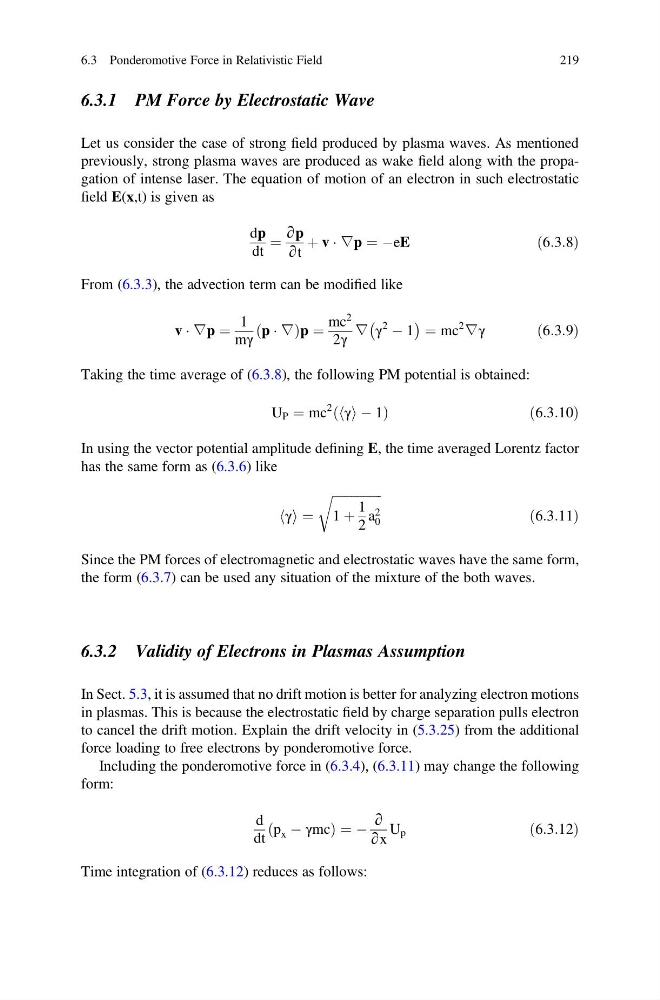
6.3.1 PM Force by Electrostatic Wave
Let us consider the case of strong field produced by plasma waves. As mentioned
previously, strong plasma waves are produced as wake field along with the propagation of intense laser. The equation of motion of an electron in such electrostatic
field E(x,t) is given as
dp
dt
¼
∂p
∂t
þ v Á ∇p ¼ ÀeE
ð6:3:8Þ
From (6.3.3), the advection term can be modified like
v Á ∇p ¼
1
mγ
p Á ∇
ð
Þp ¼
mc
2
2γ
∇ γ
2
À 1
À
Á ¼ mc
2
∇γ
ð6:3:9Þ
Taking the time average of (6.3.8), the following PM potential is obtained:
U P ¼ mc
2
γ
h i À 1
ð
Þ
ð6:3:10Þ
In using the vector potential amplitude defining E, the time averaged Lorentz factor
has the same form as (6.3.6) like
γ
h i ¼
ffiffiffiffiffiffiffiffiffiffiffiffiffiffiffi ffi
1 þ
1
2
a 2
0
r
ð6:3:11Þ
Since the PM forces of electromagnetic and electrostatic waves have the same form,
the form (6.3.7) can be used any situation of the mixture of the both waves.
6.3.2 Validity of Electrons in Plasmas Assumption
In Sect. 5.3, it is assumed that no drift motion is better for analyzing electron motions
in plasmas. This is because the electrostatic field by charge separation pulls electron
to cancel the drift motion. Explain the drift velocity in (5.3.25) from the additional
force loading to free electrons by ponderomotive force.
Including the ponderomotive force in (6.3.4), (6.3.11) may change the following
form:
d
dt
p x À γmc
ð
޼∂
∂x
U p
ð6:3:12Þ
Time integration of (6.3.12) reduces as follows:
6.3 Ponderomotive Force in Relativistic Field
219
Let us consider the case of strong field produced by plasma waves. As mentioned
previously, strong plasma waves are produced as wake field along with the propagation of intense laser. The equation of motion of an electron in such electrostatic
field E(x,t) is given as
dp
dt
¼
∂p
∂t
þ v Á ∇p ¼ ÀeE
ð6:3:8Þ
From (6.3.3), the advection term can be modified like
v Á ∇p ¼
1
mγ
p Á ∇
ð
Þp ¼
mc
2
2γ
∇ γ
2
À 1
À
Á ¼ mc
2
∇γ
ð6:3:9Þ
Taking the time average of (6.3.8), the following PM potential is obtained:
U P ¼ mc
2
γ
h i À 1
ð
Þ
ð6:3:10Þ
In using the vector potential amplitude defining E, the time averaged Lorentz factor
has the same form as (6.3.6) like
γ
h i ¼
ffiffiffiffiffiffiffiffiffiffiffiffiffiffiffi ffi
1 þ
1
2
a 2
0
r
ð6:3:11Þ
Since the PM forces of electromagnetic and electrostatic waves have the same form,
the form (6.3.7) can be used any situation of the mixture of the both waves.
6.3.2 Validity of Electrons in Plasmas Assumption
In Sect. 5.3, it is assumed that no drift motion is better for analyzing electron motions
in plasmas. This is because the electrostatic field by charge separation pulls electron
to cancel the drift motion. Explain the drift velocity in (5.3.25) from the additional
force loading to free electrons by ponderomotive force.
Including the ponderomotive force in (6.3.4), (6.3.11) may change the following
form:
d
dt
p x À γmc
ð
޼∂
∂x
U p
ð6:3:12Þ
Time integration of (6.3.12) reduces as follows:
6.3 Ponderomotive Force in Relativistic Field
219