

∂ p
h i
∂t
¼ À
1
2m
γ
À1
∇ p
j j
2
D
E
¼ À
mc
2
2γ
∇ γ
2
À 1
À
Á
(
)
¼ Àmc
2
∇ γ
h i
ð6:3:4Þ
Since ∇hγi is defined at each fixed position and is now the physical quantity of a new
field. Therefore, a local force acting to an electron much slower than laser oscillation
time is given in the following form of potential already shown in (1.3.20):
f PM ¼ À∇U P , U P ¼ mc
2
γ
h i À 1
ð
Þ
ð6:3:5Þ
This force is called ponderomotive force and U p is called ponderomotive potential. It is clear that the ponderomotive potential is the time averaged kinetic energy of
an oscillating electron. If the amplitude of the vector potential change slowly
compared to the oscillation period and give as a 0 ¼ a 0 (x, t), the Lorentz factor can
be replaced with a 0 by assuming the plasma case (5.3.30) as
γ
h i ¼
ffiffiffiffiffiffiffiffiffiffiffiffiffiffiffi ffi
1 þ
1
2
a 2
0
r
ð6:3:6Þ
More simply the PM force is expressed in the form:
f PM ¼ Àmc
2
∇ γ
h i
ð6:3:7Þ
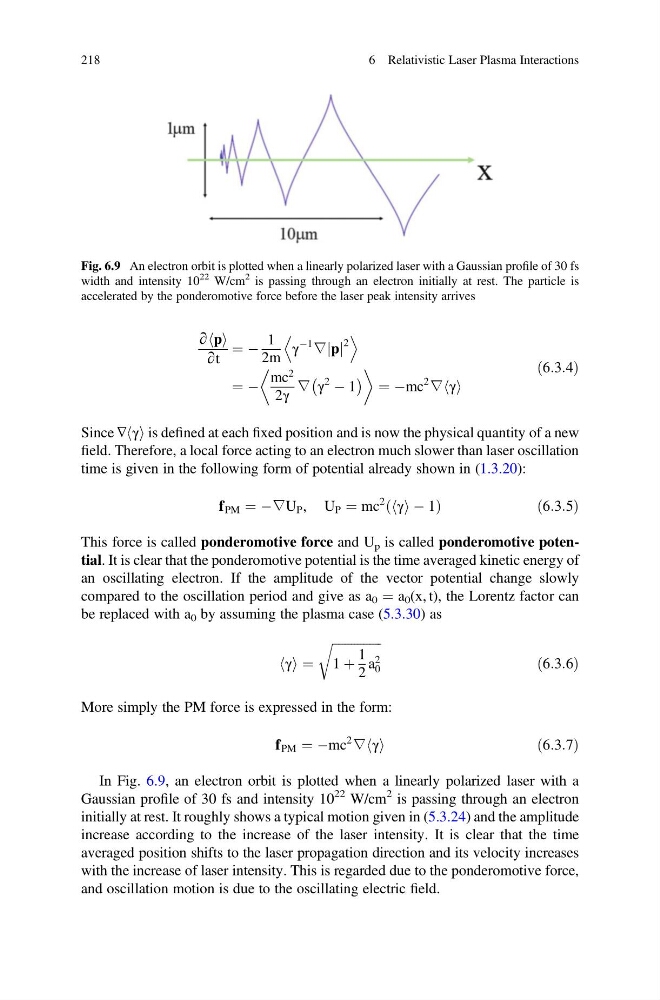
In Fig. 6.9, an electron orbit is plotted when a linearly polarized laser with a
Gaussian profile of 30 fs and intensity 10
22 W/cm
2 is passing through an electron
initially at rest. It roughly shows a typical motion given in (5.3.24) and the amplitude
increase according to the increase of the laser intensity. It is clear that the time
averaged position shifts to the laser propagation direction and its velocity increases
with the increase of laser intensity. This is regarded due to the ponderomotive force,
and oscillation motion is due to the oscillating electric field.
Fig. 6.9 An electron orbit is plotted when a linearly polarized laser with a Gaussian profile of 30 fs
width and intensity 10
22 W/cm
2 is passing through an electron initially at rest. The particle is
accelerated by the ponderomotive force before the laser peak intensity arrives
218
6 Relativistic Laser Plasma Interactions
h i
∂t
¼ À
1
2m
γ
À1
∇ p
j j
2
D
E
¼ À
mc
2
2γ
∇ γ
2
À 1
À
Á
(
)
¼ Àmc
2
∇ γ
h i
ð6:3:4Þ
Since ∇hγi is defined at each fixed position and is now the physical quantity of a new
field. Therefore, a local force acting to an electron much slower than laser oscillation
time is given in the following form of potential already shown in (1.3.20):
f PM ¼ À∇U P , U P ¼ mc
2
γ
h i À 1
ð
Þ
ð6:3:5Þ
This force is called ponderomotive force and U p is called ponderomotive potential. It is clear that the ponderomotive potential is the time averaged kinetic energy of
an oscillating electron. If the amplitude of the vector potential change slowly
compared to the oscillation period and give as a 0 ¼ a 0 (x, t), the Lorentz factor can
be replaced with a 0 by assuming the plasma case (5.3.30) as
γ
h i ¼
ffiffiffiffiffiffiffiffiffiffiffiffiffiffiffi ffi
1 þ
1
2
a 2
0
r
ð6:3:6Þ
More simply the PM force is expressed in the form:
f PM ¼ Àmc
2
∇ γ
h i
ð6:3:7Þ
In Fig. 6.9, an electron orbit is plotted when a linearly polarized laser with a
Gaussian profile of 30 fs and intensity 10
22 W/cm
2 is passing through an electron
initially at rest. It roughly shows a typical motion given in (5.3.24) and the amplitude
increase according to the increase of the laser intensity. It is clear that the time
averaged position shifts to the laser propagation direction and its velocity increases
with the increase of laser intensity. This is regarded due to the ponderomotive force,
and oscillation motion is due to the oscillating electric field.
Fig. 6.9 An electron orbit is plotted when a linearly polarized laser with a Gaussian profile of 30 fs
width and intensity 10
22 W/cm
2 is passing through an electron initially at rest. The particle is
accelerated by the ponderomotive force before the laser peak intensity arrives
218
6 Relativistic Laser Plasma Interactions