

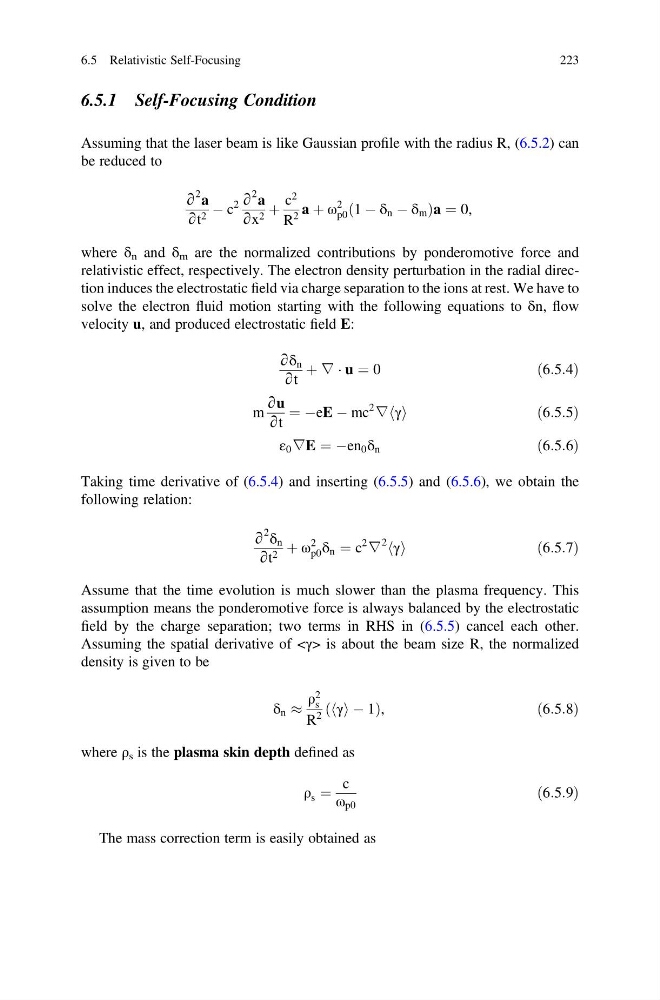
6.5.1 Self-Focusing Condition
Assuming that the laser beam is like Gaussian profile with the radius R, (6.5.2) can
be reduced to
∂
2 a
∂t 2 À c
2 ∂
2 a
∂x 2 þ
c
2
R
2
a þ ω
2
p0 1 À δ n À δ m
ð
Þ a ¼ 0,
where δ n and δ m are the normalized contributions by ponderomotive force and
relativistic effect, respectively. The electron density perturbation in the radial direction induces the electrostatic field via charge separation to the ions at rest. We have to
solve the electron fluid motion starting with the following equations to δn, flow
velocity u, and produced electrostatic field E:
∂δ n
∂t
þ ∇ Á u ¼ 0
ð6:5:4Þ
m
∂u
∂t
¼ ÀeE À mc
2
∇ γ
h i
ð6:5:5Þ
ε 0 ∇E ¼ Àen 0 δ n
ð6:5:6Þ
Taking time derivative of (6.5.4) and inserting (6.5.5) and (6.5.6), we obtain the
following relation:
∂
2 δ n
∂t 2 þ ω
2
p0 δ n ¼ c
2
∇
2 γ
h i
ð6:5:7Þ
Assume that the time evolution is much slower than the plasma frequency. This
assumption means the ponderomotive force is always balanced by the electrostatic
field by the charge separation; two terms in RHS in (6.5.5) cancel each other.
Assuming the spatial derivative of <γ> is about the beam size R, the normalized
density is given to be
δ n %
ρ
2
s
R
2
γ
h i À 1
ð
Þ,
ð6:5:8Þ
where ρ s is the plasma skin depth defined as
ρ s ¼
c
ω p0
ð6:5:9Þ
The mass correction term is easily obtained as
6.5 Relativistic Self-Focusing
223
Assuming that the laser beam is like Gaussian profile with the radius R, (6.5.2) can
be reduced to
∂
2 a
∂t 2 À c
2 ∂
2 a
∂x 2 þ
c
2
R
2
a þ ω
2
p0 1 À δ n À δ m
ð
Þ a ¼ 0,
where δ n and δ m are the normalized contributions by ponderomotive force and
relativistic effect, respectively. The electron density perturbation in the radial direction induces the electrostatic field via charge separation to the ions at rest. We have to
solve the electron fluid motion starting with the following equations to δn, flow
velocity u, and produced electrostatic field E:
∂δ n
∂t
þ ∇ Á u ¼ 0
ð6:5:4Þ
m
∂u
∂t
¼ ÀeE À mc
2
∇ γ
h i
ð6:5:5Þ
ε 0 ∇E ¼ Àen 0 δ n
ð6:5:6Þ
Taking time derivative of (6.5.4) and inserting (6.5.5) and (6.5.6), we obtain the
following relation:
∂
2 δ n
∂t 2 þ ω
2
p0 δ n ¼ c
2
∇
2 γ
h i
ð6:5:7Þ
Assume that the time evolution is much slower than the plasma frequency. This
assumption means the ponderomotive force is always balanced by the electrostatic
field by the charge separation; two terms in RHS in (6.5.5) cancel each other.
Assuming the spatial derivative of <γ> is about the beam size R, the normalized
density is given to be
δ n %
ρ
2
s
R
2
γ
h i À 1
ð
Þ,
ð6:5:8Þ
where ρ s is the plasma skin depth defined as
ρ s ¼
c
ω p0
ð6:5:9Þ
The mass correction term is easily obtained as
6.5 Relativistic Self-Focusing
223