

The paper is based on theoretical and computational study on the nuclear fusion
energy production by spherical capsule implosion driven by the surface pressure
induced by laser heating. It concluded that 10 kJ of laser energy is enough to achieve
ICF by laser implosion. Then, Janus, Siva, and Nova lasers were constructing at
Lawrence Livermore National Laboratory (LLNL) as shown in Fig. 1.4.
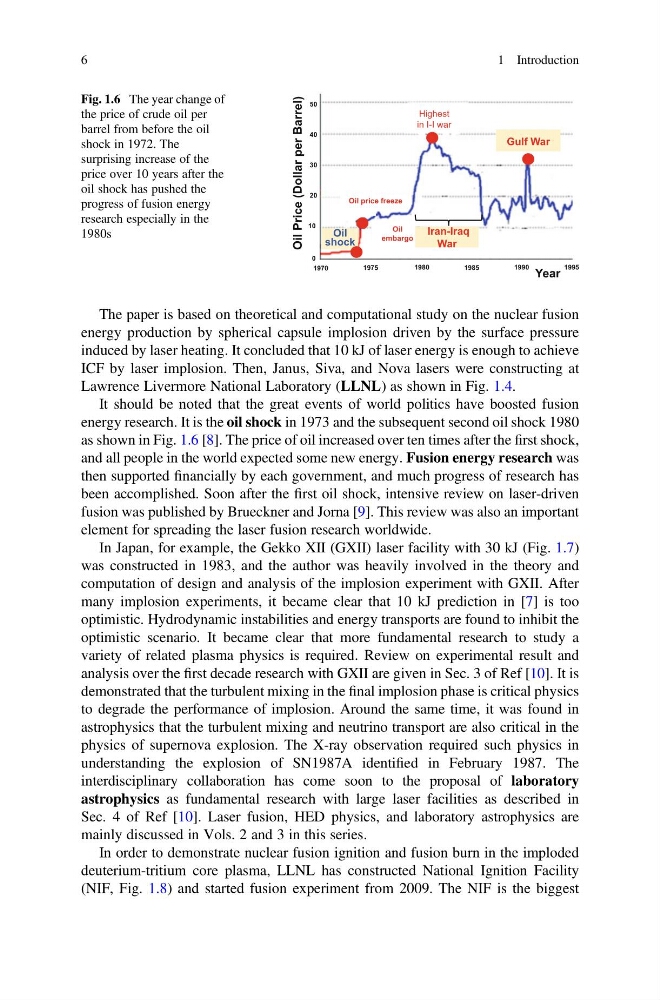
It should be noted that the great events of world politics have boosted fusion
energy research. It is the oil shock in 1973 and the subsequent second oil shock 1980
as shown in Fig. 1.6 [8]. The price of oil increased over ten times after the first shock,
and all people in the world expected some new energy. Fusion energy research was
then supported financially by each government, and much progress of research has
been accomplished. Soon after the first oil shock, intensive review on laser-driven
fusion was published by Brueckner and Jorna [9]. This review was also an important
element for spreading the laser fusion research worldwide.
In Japan, for example, the Gekko XII (GXII) laser facility with 30 kJ (Fig. 1.7)
was constructed in 1983, and the author was heavily involved in the theory and
computation of design and analysis of the implosion experiment with GXII. After
many implosion experiments, it became clear that 10 kJ prediction in [7] is too
optimistic. Hydrodynamic instabilities and energy transports are found to inhibit the
optimistic scenario. It became clear that more fundamental research to study a
variety of related plasma physics is required. Review on experimental result and
analysis over the first decade research with GXII are given in Sec. 3 of Ref [10]. It is
demonstrated that the turbulent mixing in the final implosion phase is critical physics
to degrade the performance of implosion. Around the same time, it was found in
astrophysics that the turbulent mixing and neutrino transport are also critical in the
physics of supernova explosion. The X-ray observation required such physics in
understanding the explosion of SN1987A identified in February 1987. The
interdisciplinary collaboration has come soon to the proposal of laboratory
astrophysics as fundamental research with large laser facilities as described in
Sec. 4 of Ref [10]. Laser fusion, HED physics, and laboratory astrophysics are
mainly discussed in Vols. 2 and 3 in this series.
In order to demonstrate nuclear fusion ignition and fusion burn in the imploded
deuterium-tritium core plasma, LLNL has constructed National Ignition Facility
(NIF, Fig. 1.8) and started fusion experiment from 2009. The NIF is the biggest
1970
1980
1990
1975
1985
1995
10
20
30
40
50
0
Oil Price (Dollar per Barrel)
Year
Oil
shock
Oil price freeze
Gulf War
Oil
embargo
Highest
in I-I war
Iran-Iraq
War
Fig. 1.6 The year change of
the price of crude oil per
barrel from before the oil
shock in 1972. The
surprising increase of the
price over 10 years after the
oil shock has pushed the
progress of fusion energy
research especially in the
1980s
6
1 Introduction
energy production by spherical capsule implosion driven by the surface pressure
induced by laser heating. It concluded that 10 kJ of laser energy is enough to achieve
ICF by laser implosion. Then, Janus, Siva, and Nova lasers were constructing at
Lawrence Livermore National Laboratory (LLNL) as shown in Fig. 1.4.
It should be noted that the great events of world politics have boosted fusion
energy research. It is the oil shock in 1973 and the subsequent second oil shock 1980
as shown in Fig. 1.6 [8]. The price of oil increased over ten times after the first shock,
and all people in the world expected some new energy. Fusion energy research was
then supported financially by each government, and much progress of research has
been accomplished. Soon after the first oil shock, intensive review on laser-driven
fusion was published by Brueckner and Jorna [9]. This review was also an important
element for spreading the laser fusion research worldwide.
In Japan, for example, the Gekko XII (GXII) laser facility with 30 kJ (Fig. 1.7)
was constructed in 1983, and the author was heavily involved in the theory and
computation of design and analysis of the implosion experiment with GXII. After
many implosion experiments, it became clear that 10 kJ prediction in [7] is too
optimistic. Hydrodynamic instabilities and energy transports are found to inhibit the
optimistic scenario. It became clear that more fundamental research to study a
variety of related plasma physics is required. Review on experimental result and
analysis over the first decade research with GXII are given in Sec. 3 of Ref [10]. It is
demonstrated that the turbulent mixing in the final implosion phase is critical physics
to degrade the performance of implosion. Around the same time, it was found in
astrophysics that the turbulent mixing and neutrino transport are also critical in the
physics of supernova explosion. The X-ray observation required such physics in
understanding the explosion of SN1987A identified in February 1987. The
interdisciplinary collaboration has come soon to the proposal of laboratory
astrophysics as fundamental research with large laser facilities as described in
Sec. 4 of Ref [10]. Laser fusion, HED physics, and laboratory astrophysics are
mainly discussed in Vols. 2 and 3 in this series.
In order to demonstrate nuclear fusion ignition and fusion burn in the imploded
deuterium-tritium core plasma, LLNL has constructed National Ignition Facility
(NIF, Fig. 1.8) and started fusion experiment from 2009. The NIF is the biggest
1970
1980
1990
1975
1985
1995
10
20
30
40
50
0
Oil Price (Dollar per Barrel)
Year
Oil
shock
Oil price freeze
Gulf War
Oil
embargo
Highest
in I-I war
Iran-Iraq
War
Fig. 1.6 The year change of
the price of crude oil per
barrel from before the oil
shock in 1972. The
surprising increase of the
price over 10 years after the
oil shock has pushed the
progress of fusion energy
research especially in the
1980s
6
1 Introduction