

been achieved by the use of large-sized glass amplifiers. As a result, the large energy
intense laser has been developed as a large-scale facility.
1.1.2 High-Power Lasers for Nuclear Fusion
The construction of large-scale laser facilities was greatly accelerated by a paper
published in 1972 by Nuckolls et al. [7] on the inertial confinement fusion (ICF)
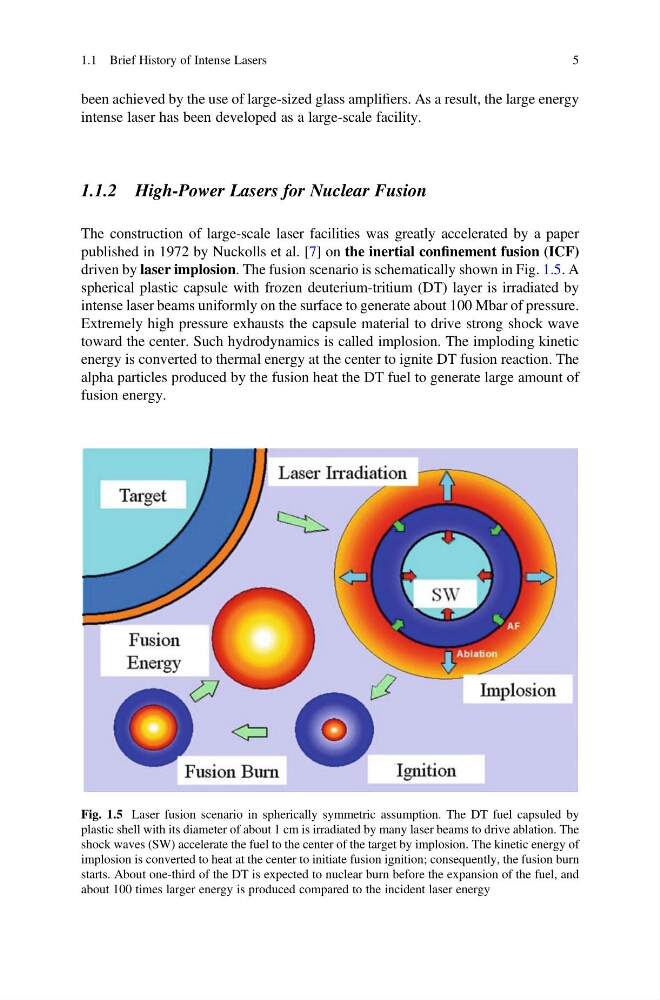
driven by laser implosion. The fusion scenario is schematically shown in Fig. 1.5. A
spherical plastic capsule with frozen deuterium-tritium (DT) layer is irradiated by
intense laser beams uniformly on the surface to generate about 100 Mbar of pressure.
Extremely high pressure exhausts the capsule material to drive strong shock wave
toward the center. Such hydrodynamics is called implosion. The imploding kinetic
energy is converted to thermal energy at the center to ignite DT fusion reaction. The
alpha particles produced by the fusion heat the DT fuel to generate large amount of
fusion energy.
Fig. 1.5 Laser fusion scenario in spherically symmetric assumption. The DT fuel capsuled by
plastic shell with its diameter of about 1 cm is irradiated by many laser beams to drive ablation. The
shock waves (SW) accelerate the fuel to the center of the target by implosion. The kinetic energy of
implosion is converted to heat at the center to initiate fusion ignition; consequently, the fusion burn
starts. About one-third of the DT is expected to nuclear burn before the expansion of the fuel, and
about 100 times larger energy is produced compared to the incident laser energy
1.1 Brief History of Intense Lasers
5
intense laser has been developed as a large-scale facility.
1.1.2 High-Power Lasers for Nuclear Fusion
The construction of large-scale laser facilities was greatly accelerated by a paper
published in 1972 by Nuckolls et al. [7] on the inertial confinement fusion (ICF)
driven by laser implosion. The fusion scenario is schematically shown in Fig. 1.5. A
spherical plastic capsule with frozen deuterium-tritium (DT) layer is irradiated by
intense laser beams uniformly on the surface to generate about 100 Mbar of pressure.
Extremely high pressure exhausts the capsule material to drive strong shock wave
toward the center. Such hydrodynamics is called implosion. The imploding kinetic
energy is converted to thermal energy at the center to ignite DT fusion reaction. The
alpha particles produced by the fusion heat the DT fuel to generate large amount of
fusion energy.
Fig. 1.5 Laser fusion scenario in spherically symmetric assumption. The DT fuel capsuled by
plastic shell with its diameter of about 1 cm is irradiated by many laser beams to drive ablation. The
shock waves (SW) accelerate the fuel to the center of the target by implosion. The kinetic energy of
implosion is converted to heat at the center to initiate fusion ignition; consequently, the fusion burn
starts. About one-third of the DT is expected to nuclear burn before the expansion of the fuel, and
about 100 times larger energy is produced compared to the incident laser energy
1.1 Brief History of Intense Lasers
5