

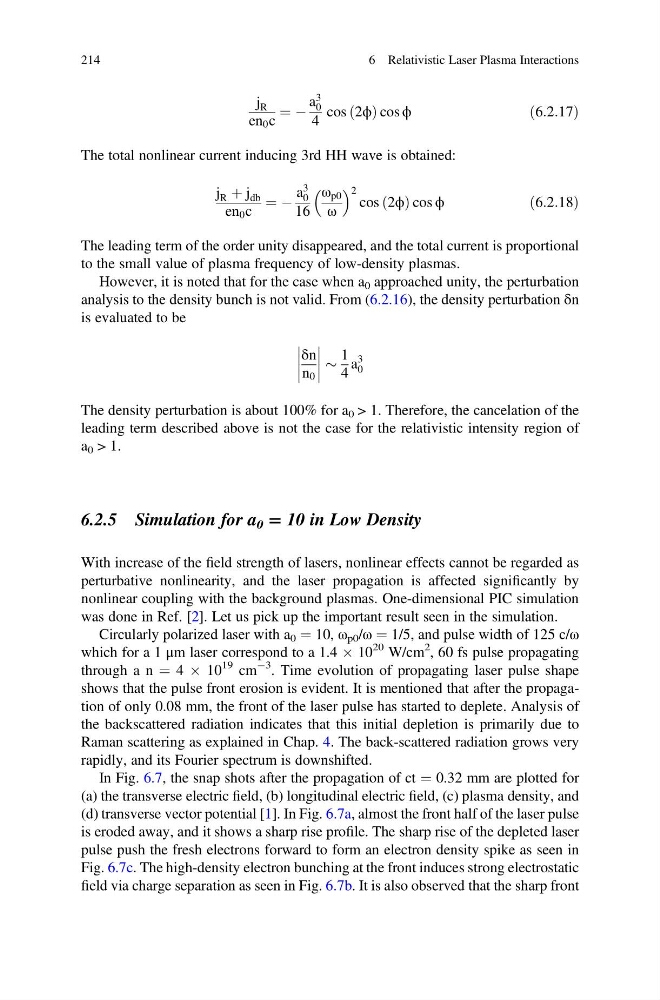
j R
en 0 c
¼ À
a
3
0
4
cos 2ϕ
ð Þcos ϕ
ð6:2:17Þ
The total nonlinear current inducing 3rd HH wave is obtained:
j R þ j db
en 0 c
¼ À
a
3
0
16
ω p0
ω
2
cos 2ϕ
ð Þcos ϕ
ð6:2:18Þ
The leading term of the order unity disappeared, and the total current is proportional
to the small value of plasma frequency of low-density plasmas.
However, it is noted that for the case when a 0 approached unity, the perturbation
analysis to the density bunch is not valid. From (6.2.16), the density perturbation δn
is evaluated to be
δn
n 0
$
1
4
a
3
0
The density perturbation is about 100% for a 0 > 1. Therefore, the cancelation of the
leading term described above is not the case for the relativistic intensity region of
a 0 > 1.
6.2.5 Simulation for a 0 = 10 in Low Density
With increase of the field strength of lasers, nonlinear effects cannot be regarded as
perturbative nonlinearity, and the laser propagation is affected significantly by
nonlinear coupling with the background plasmas. One-dimensional PIC simulation
was done in Ref. [2]. Let us pick up the important result seen in the simulation.
Circularly polarized laser with a 0 ¼ 10, ω p0 /ω ¼ 1/5, and pulse width of 125 c/ω
which for a 1 μm laser correspond to a 1.4 Â 10
20 W/cm
2
, 60 fs pulse propagating
through a n ¼ 4 Â 10
19 cm
À3 . Time evolution of propagating laser pulse shape
shows that the pulse front erosion is evident. It is mentioned that after the propagation of only 0.08 mm, the front of the laser pulse has started to deplete. Analysis of
the backscattered radiation indicates that this initial depletion is primarily due to
Raman scattering as explained in Chap. 4. The back-scattered radiation grows very
rapidly, and its Fourier spectrum is downshifted.
In Fig. 6.7, the snap shots after the propagation of ct ¼ 0.32 mm are plotted for
(a) the transverse electric field, (b) longitudinal electric field, (c) plasma density, and
(d) transverse vector potential [1]. In Fig. 6.7a, almost the front half of the laser pulse
is eroded away, and it shows a sharp rise profile. The sharp rise of the depleted laser
pulse push the fresh electrons forward to form an electron density spike as seen in
Fig. 6.7c. The high-density electron bunching at the front induces strong electrostatic
field via charge separation as seen in Fig. 6.7b. It is also observed that the sharp front
214
6 Relativistic Laser Plasma Interactions
en 0 c
¼ À
a
3
0
4
cos 2ϕ
ð Þcos ϕ
ð6:2:17Þ
The total nonlinear current inducing 3rd HH wave is obtained:
j R þ j db
en 0 c
¼ À
a
3
0
16
ω p0
ω
2
cos 2ϕ
ð Þcos ϕ
ð6:2:18Þ
The leading term of the order unity disappeared, and the total current is proportional
to the small value of plasma frequency of low-density plasmas.
However, it is noted that for the case when a 0 approached unity, the perturbation
analysis to the density bunch is not valid. From (6.2.16), the density perturbation δn
is evaluated to be
δn
n 0
$
1
4
a
3
0
The density perturbation is about 100% for a 0 > 1. Therefore, the cancelation of the
leading term described above is not the case for the relativistic intensity region of
a 0 > 1.
6.2.5 Simulation for a 0 = 10 in Low Density
With increase of the field strength of lasers, nonlinear effects cannot be regarded as
perturbative nonlinearity, and the laser propagation is affected significantly by
nonlinear coupling with the background plasmas. One-dimensional PIC simulation
was done in Ref. [2]. Let us pick up the important result seen in the simulation.
Circularly polarized laser with a 0 ¼ 10, ω p0 /ω ¼ 1/5, and pulse width of 125 c/ω
which for a 1 μm laser correspond to a 1.4 Â 10
20 W/cm
2
, 60 fs pulse propagating
through a n ¼ 4 Â 10
19 cm
À3 . Time evolution of propagating laser pulse shape
shows that the pulse front erosion is evident. It is mentioned that after the propagation of only 0.08 mm, the front of the laser pulse has started to deplete. Analysis of
the backscattered radiation indicates that this initial depletion is primarily due to
Raman scattering as explained in Chap. 4. The back-scattered radiation grows very
rapidly, and its Fourier spectrum is downshifted.
In Fig. 6.7, the snap shots after the propagation of ct ¼ 0.32 mm are plotted for
(a) the transverse electric field, (b) longitudinal electric field, (c) plasma density, and
(d) transverse vector potential [1]. In Fig. 6.7a, almost the front half of the laser pulse
is eroded away, and it shows a sharp rise profile. The sharp rise of the depleted laser
pulse push the fresh electrons forward to form an electron density spike as seen in
Fig. 6.7c. The high-density electron bunching at the front induces strong electrostatic
field via charge separation as seen in Fig. 6.7b. It is also observed that the sharp front
214
6 Relativistic Laser Plasma Interactions