

d
2
b p x
dt
2
þ
ω
2
p0
γ
b p x ¼
d
dt
2c
γ
∂
∂x
a
2
ð6:2:11Þ
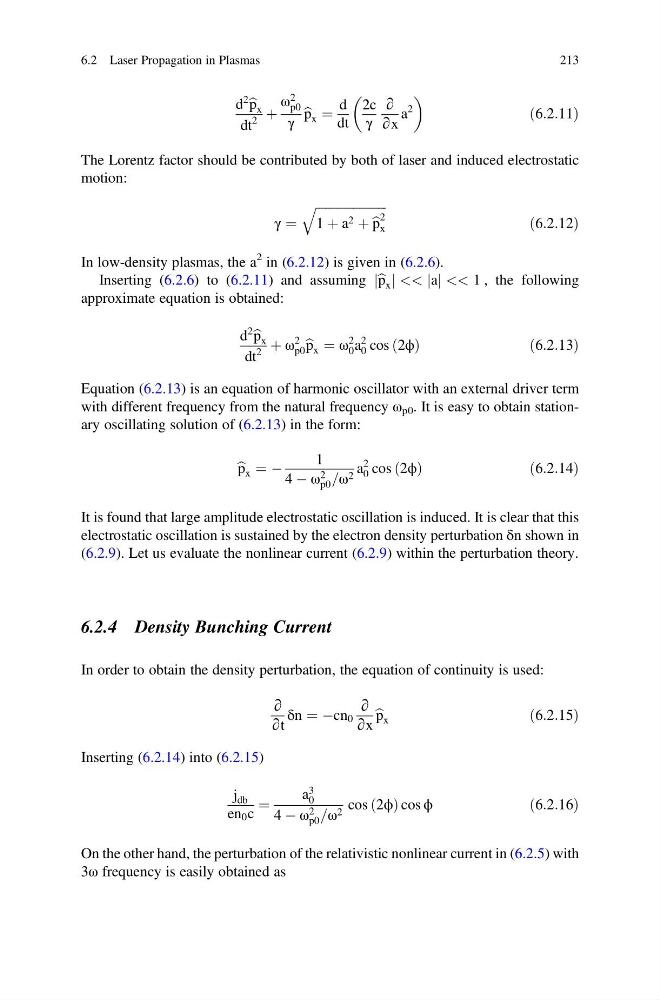
The Lorentz factor should be contributed by both of laser and induced electrostatic
motion:
γ ¼
ffiffiffiffiffiffiffiffiffiffiffiffiffiffiffiffiffiffiffiffiffiffi ffi
1 þ a 2 þ b p
2
x
q
ð6:2:12Þ
In low-density plasmas, the a
2 in (6.2.12) is given in (6.2.6).
Inserting (6.2.6) to (6.2.11) and assuming b p x
j j << a
j j << 1 , the following
approximate equation is obtained:
d
2
b p x
dt
2
þ ω
2
p0 b p x ¼ ω
2
0 a
2
0 cos 2ϕ
ð Þ
ð6:2:13Þ
Equation (6.2.13) is an equation of harmonic oscillator with an external driver term
with different frequency from the natural frequency ω p0 . It is easy to obtain stationary oscillating solution of (6.2.13) in the form:
b p x ¼ À
1
4 À ω 2
p0 =ω 2 a
2
0 cos 2ϕ
ð Þ
ð6:2:14Þ
It is found that large amplitude electrostatic oscillation is induced. It is clear that this
electrostatic oscillation is sustained by the electron density perturbation δn shown in
(6.2.9). Let us evaluate the nonlinear current (6.2.9) within the perturbation theory.
6.2.4 Density Bunching Current
In order to obtain the density perturbation, the equation of continuity is used:
∂
∂t
δn ¼ Àcn 0
∂
∂x
b p x
ð6:2:15Þ
Inserting (6.2.14) into (6.2.15)
j db
en 0 c
¼
a
3
0
4 À ω 2
p0 =ω 2 cos 2ϕ
ð Þcos ϕ
ð6:2:16Þ
On the other hand, the perturbation of the relativistic nonlinear current in (6.2.5) with
3ω frequency is easily obtained as
6.2 Laser Propagation in Plasmas
213
2
b p x
dt
2
þ
ω
2
p0
γ
b p x ¼
d
dt
2c
γ
∂
∂x
a
2
ð6:2:11Þ
The Lorentz factor should be contributed by both of laser and induced electrostatic
motion:
γ ¼
ffiffiffiffiffiffiffiffiffiffiffiffiffiffiffiffiffiffiffiffiffiffi ffi
1 þ a 2 þ b p
2
x
q
ð6:2:12Þ
In low-density plasmas, the a
2 in (6.2.12) is given in (6.2.6).
Inserting (6.2.6) to (6.2.11) and assuming b p x
j j << a
j j << 1 , the following
approximate equation is obtained:
d
2
b p x
dt
2
þ ω
2
p0 b p x ¼ ω
2
0 a
2
0 cos 2ϕ
ð Þ
ð6:2:13Þ
Equation (6.2.13) is an equation of harmonic oscillator with an external driver term
with different frequency from the natural frequency ω p0 . It is easy to obtain stationary oscillating solution of (6.2.13) in the form:
b p x ¼ À
1
4 À ω 2
p0 =ω 2 a
2
0 cos 2ϕ
ð Þ
ð6:2:14Þ
It is found that large amplitude electrostatic oscillation is induced. It is clear that this
electrostatic oscillation is sustained by the electron density perturbation δn shown in
(6.2.9). Let us evaluate the nonlinear current (6.2.9) within the perturbation theory.
6.2.4 Density Bunching Current
In order to obtain the density perturbation, the equation of continuity is used:
∂
∂t
δn ¼ Àcn 0
∂
∂x
b p x
ð6:2:15Þ
Inserting (6.2.14) into (6.2.15)
j db
en 0 c
¼
a
3
0
4 À ω 2
p0 =ω 2 cos 2ϕ
ð Þcos ϕ
ð6:2:16Þ
On the other hand, the perturbation of the relativistic nonlinear current in (6.2.5) with
3ω frequency is easily obtained as
6.2 Laser Propagation in Plasmas
213