

E ¼ A x, t
ð Þexp Àin ω 0 t À k 0 x
ð
Þ
½
,
n¼ 1, 3, 5, Á Á Á
Are shown to be
E ω, k
ð
Þ ¼
ZZ
dxdtA x, t
ð Þexp Ài Ωt À Kx
½
f
g
Ω ¼ ω À nω 0
ð
Þ
K ¼ k À nk 0
ð
Þ
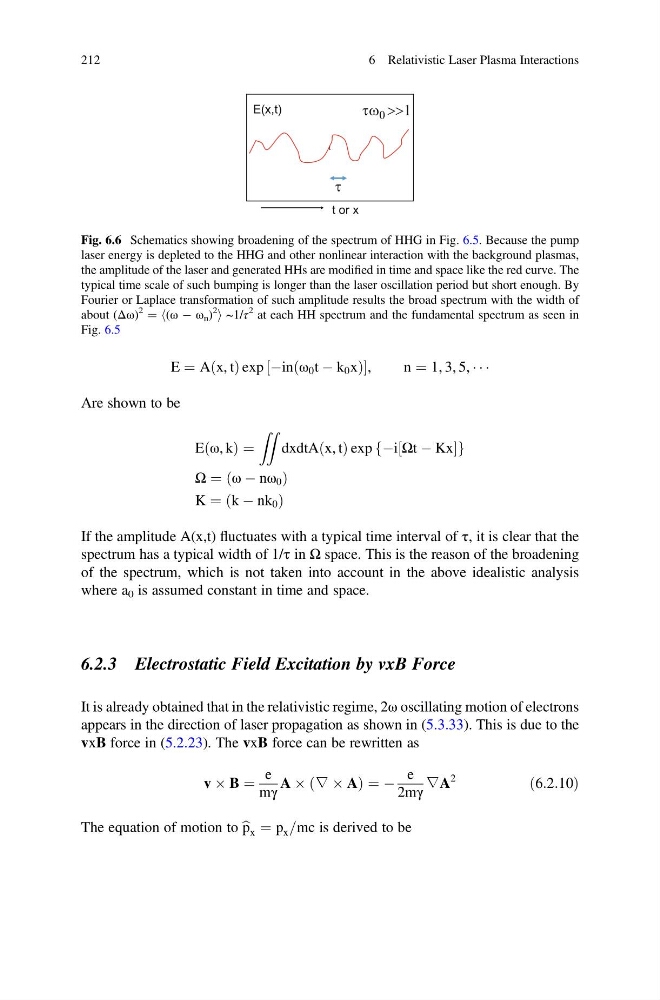
If the amplitude A(x,t) fluctuates with a typical time interval of τ, it is clear that the
spectrum has a typical width of 1/τ in Ω space. This is the reason of the broadening
of the spectrum, which is not taken into account in the above idealistic analysis
where a 0 is assumed constant in time and space.
6.2.3 Electrostatic Field Excitation by vxB Force
It is already obtained that in the relativistic regime, 2ω oscillating motion of electrons
appears in the direction of laser propagation as shown in (5.3.33). This is due to the
vxB force in (5.2.23). The vxB force can be rewritten as
v  B ¼
e
mγ
A Â ∇ Â A
ð
޼e
2mγ
∇A
2
ð6:2:10Þ
The equation of motion to b p x ¼ p x =mc is derived to be
t
t or x
E(x,t)
t
tw 0 >>1
Fig. 6.6 Schematics showing broadening of the spectrum of HHG in Fig. 6.5. Because the pump
laser energy is depleted to the HHG and other nonlinear interaction with the background plasmas,
the amplitude of the laser and generated HHs are modified in time and space like the red curve. The
typical time scale of such bumping is longer than the laser oscillation period but short enough. By
Fourier or Laplace transformation of such amplitude results the broad spectrum with the width of
about (Δω)
2 ¼ h(ω À ω n )
2
i ~1/τ
2 at each HH spectrum and the fundamental spectrum as seen in
Fig. 6.5
212
6 Relativistic Laser Plasma Interactions
ð Þexp Àin ω 0 t À k 0 x
ð
Þ
½
,
n¼ 1, 3, 5, Á Á Á
Are shown to be
E ω, k
ð
Þ ¼
ZZ
dxdtA x, t
ð Þexp Ài Ωt À Kx
½
f
g
Ω ¼ ω À nω 0
ð
Þ
K ¼ k À nk 0
ð
Þ
If the amplitude A(x,t) fluctuates with a typical time interval of τ, it is clear that the
spectrum has a typical width of 1/τ in Ω space. This is the reason of the broadening
of the spectrum, which is not taken into account in the above idealistic analysis
where a 0 is assumed constant in time and space.
6.2.3 Electrostatic Field Excitation by vxB Force
It is already obtained that in the relativistic regime, 2ω oscillating motion of electrons
appears in the direction of laser propagation as shown in (5.3.33). This is due to the
vxB force in (5.2.23). The vxB force can be rewritten as
v  B ¼
e
mγ
A Â ∇ Â A
ð
޼e
2mγ
∇A
2
ð6:2:10Þ
The equation of motion to b p x ¼ p x =mc is derived to be
t
t or x
E(x,t)
t
tw 0 >>1
Fig. 6.6 Schematics showing broadening of the spectrum of HHG in Fig. 6.5. Because the pump
laser energy is depleted to the HHG and other nonlinear interaction with the background plasmas,
the amplitude of the laser and generated HHs are modified in time and space like the red curve. The
typical time scale of such bumping is longer than the laser oscillation period but short enough. By
Fourier or Laplace transformation of such amplitude results the broad spectrum with the width of
about (Δω)
2 ¼ h(ω À ω n )
2
i ~1/τ
2 at each HH spectrum and the fundamental spectrum as seen in
Fig. 6.5
212
6 Relativistic Laser Plasma Interactions