

a
2
¼
a
2
0
2
1 þ cos 2 ωt À kx
ð
Þ
f
g
½
ð 6:2:6Þ
The current term in (5.2.8) including the relativistic effect is proportional to
j
R
/
cos ϕ
1 þ η cos 2ϕ
/ cos ϕ
X
n¼0
B 2n cos 2nϕ
ð
Þ,
ð6:2:7Þ
where η is a function of a
2
0 , ϕ ¼ ωt À kx, and the B 2n is Fourier component calculated
by
B 2n ¼
1
π
Z π
0
cos 2ϕ
1 þ η cos 2ϕ
dϕ
ð6:2:8Þ
Note that B 0 ¼ <1/γ>, and this term provides the relativistic transparency. The
Fourier components n ¼ 1, 2, 3, . . . are easily found that they provides nonlinear
currents oscillating with the frequencies of 3ω, 5 ω, 7ω, . . . Higher harmonics of the
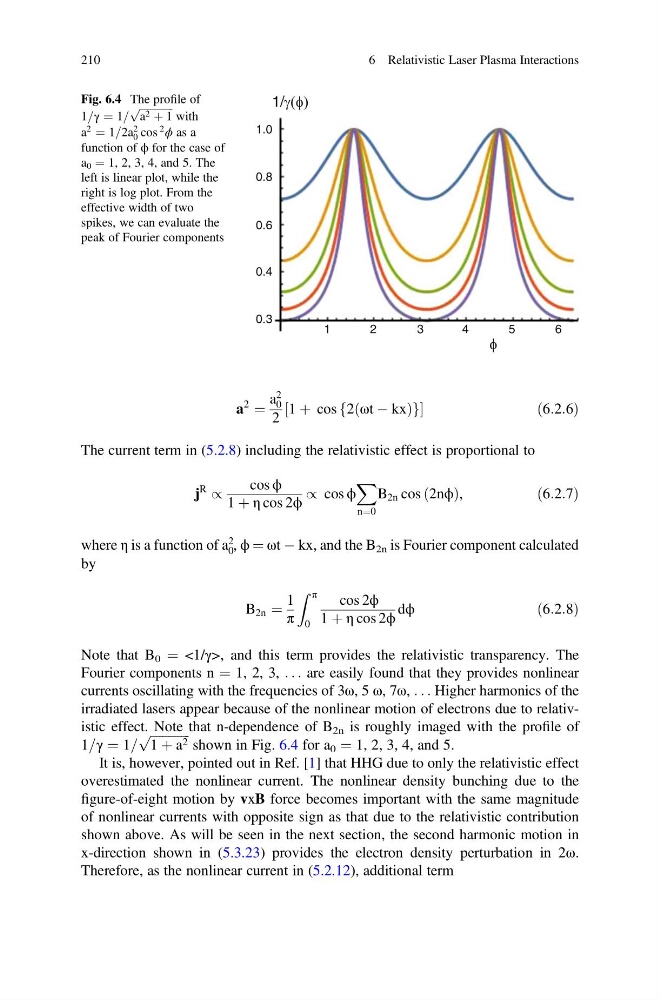
irradiated lasers appear because of the nonlinear motion of electrons due to relativistic effect. Note that n-dependence of B 2n is roughly imaged with the profile of
1=γ ¼ 1=
ffiffiffiffiffiffiffiffiffiffiffiffi ffi
1 þ a 2
p
shown in Fig. 6.4 for a 0 ¼ 1, 2, 3, 4, and 5.
It is, however, pointed out in Ref. [1] that HHG due to only the relativistic effect
overestimated the nonlinear current. The nonlinear density bunching due to the
figure-of-eight motion by vxB force becomes important with the same magnitude
of nonlinear currents with opposite sign as that due to the relativistic contribution
shown above. As will be seen in the next section, the second harmonic motion in
x-direction shown in (5.3.23) provides the electron density perturbation in 2ω.
Therefore, as the nonlinear current in (5.2.12), additional term
1.0
1/g(f)
f
0.8
0.6
0.4
0.3
1
2
3
4
5
6
Fig. 6.4 The profile of
1=γ ¼ 1=
ffiffiffiffiffiffiffiffiffiffiffiffi ffi
a 2 þ 1
p
with
a
2 ¼ 1=2a
2
0 cos
2 ϕ as a
function of ϕ for the case of
a 0 ¼ 1, 2, 3, 4, and 5. The
left is linear plot, while the
right is log plot. From the
effective width of two
spikes, we can evaluate the
peak of Fourier components
210
6 Relativistic Laser Plasma Interactions
2
¼
a
2
0
2
1 þ cos 2 ωt À kx
ð
Þ
f
g
½
ð 6:2:6Þ
The current term in (5.2.8) including the relativistic effect is proportional to
j
R
/
cos ϕ
1 þ η cos 2ϕ
/ cos ϕ
X
n¼0
B 2n cos 2nϕ
ð
Þ,
ð6:2:7Þ
where η is a function of a
2
0 , ϕ ¼ ωt À kx, and the B 2n is Fourier component calculated
by
B 2n ¼
1
π
Z π
0
cos 2ϕ
1 þ η cos 2ϕ
dϕ
ð6:2:8Þ
Note that B 0 ¼ <1/γ>, and this term provides the relativistic transparency. The
Fourier components n ¼ 1, 2, 3, . . . are easily found that they provides nonlinear
currents oscillating with the frequencies of 3ω, 5 ω, 7ω, . . . Higher harmonics of the
irradiated lasers appear because of the nonlinear motion of electrons due to relativistic effect. Note that n-dependence of B 2n is roughly imaged with the profile of
1=γ ¼ 1=
ffiffiffiffiffiffiffiffiffiffiffiffi ffi
1 þ a 2
p
shown in Fig. 6.4 for a 0 ¼ 1, 2, 3, 4, and 5.
It is, however, pointed out in Ref. [1] that HHG due to only the relativistic effect
overestimated the nonlinear current. The nonlinear density bunching due to the
figure-of-eight motion by vxB force becomes important with the same magnitude
of nonlinear currents with opposite sign as that due to the relativistic contribution
shown above. As will be seen in the next section, the second harmonic motion in
x-direction shown in (5.3.23) provides the electron density perturbation in 2ω.
Therefore, as the nonlinear current in (5.2.12), additional term
1.0
1/g(f)
f
0.8
0.6
0.4
0.3
1
2
3
4
5
6
Fig. 6.4 The profile of
1=γ ¼ 1=
ffiffiffiffiffiffiffiffiffiffiffiffi ffi
a 2 þ 1
p
with
a
2 ¼ 1=2a
2
0 cos
2 ϕ as a
function of ϕ for the case of
a 0 ¼ 1, 2, 3, 4, and 5. The
left is linear plot, while the
right is log plot. From the
effective width of two
spikes, we can evaluate the
peak of Fourier components
210
6 Relativistic Laser Plasma Interactions