

targets, laser can propagate through thanks to the relativistic effect at higher laser
intensities available experimentally these days.
In the case of linearly polarization, it is shown that the average Lorentz factor
defined in (5.3.23) is applicable to the relativistic transparency.
6.2.2 Higher Harmonic Generation (HHG)
In linearly polarized case, not only the relativistic change of plasma frequency but
also higher harmonic generation (HHG) is derived as follows. Since the electron
motion is given in (5.3.33), the electron current in the perpendicular direction is
easily obtained from (5.3.14):
j
ε 0
¼ À
ω
2
p0
γ t
ð Þ
A
ð6:2:5Þ
The time-varying Lorentz factor is given in (5.3.15a). The Lorentz factor is only a
function of a
2 :
electrostatic
field
(a)
(b)
laser pulse
electrons
ions
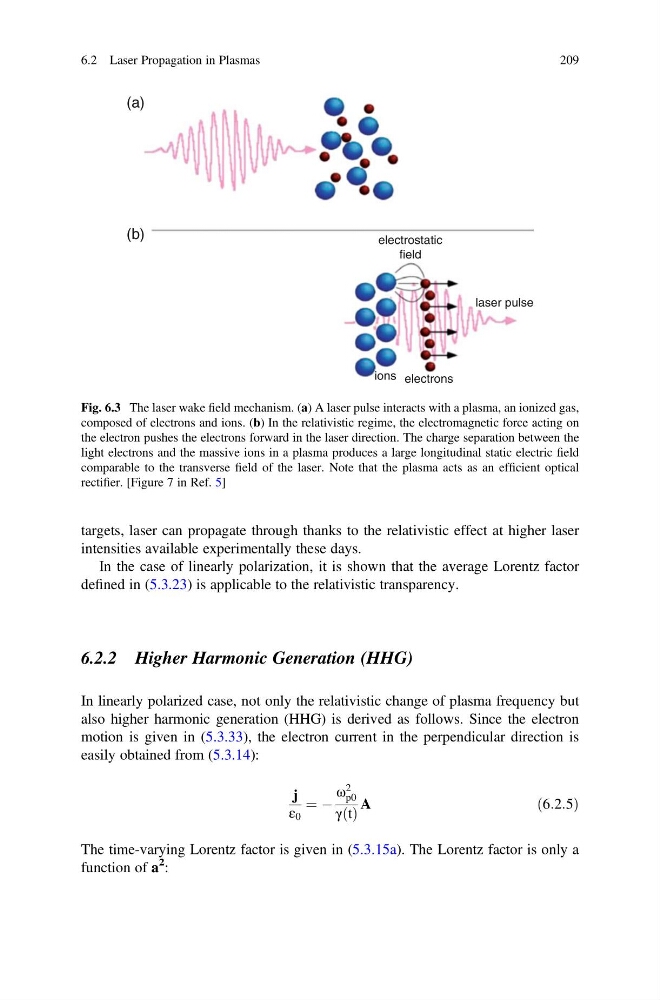
Fig. 6.3 The laser wake field mechanism. (a) A laser pulse interacts with a plasma, an ionized gas,
composed of electrons and ions. (b) In the relativistic regime, the electromagnetic force acting on
the electron pushes the electrons forward in the laser direction. The charge separation between the
light electrons and the massive ions in a plasma produces a large longitudinal static electric field
comparable to the transverse field of the laser. Note that the plasma acts as an efficient optical
rectifier. [Figure 7 in Ref. 5]
6.2 Laser Propagation in Plasmas
209
intensities available experimentally these days.
In the case of linearly polarization, it is shown that the average Lorentz factor
defined in (5.3.23) is applicable to the relativistic transparency.
6.2.2 Higher Harmonic Generation (HHG)
In linearly polarized case, not only the relativistic change of plasma frequency but
also higher harmonic generation (HHG) is derived as follows. Since the electron
motion is given in (5.3.33), the electron current in the perpendicular direction is
easily obtained from (5.3.14):
j
ε 0
¼ À
ω
2
p0
γ t
ð Þ
A
ð6:2:5Þ
The time-varying Lorentz factor is given in (5.3.15a). The Lorentz factor is only a
function of a
2 :
electrostatic
field
(a)
(b)
laser pulse
electrons
ions
Fig. 6.3 The laser wake field mechanism. (a) A laser pulse interacts with a plasma, an ionized gas,
composed of electrons and ions. (b) In the relativistic regime, the electromagnetic force acting on
the electron pushes the electrons forward in the laser direction. The charge separation between the
light electrons and the massive ions in a plasma produces a large longitudinal static electric field
comparable to the transverse field of the laser. Note that the plasma acts as an efficient optical
rectifier. [Figure 7 in Ref. 5]
6.2 Laser Propagation in Plasmas
209