

e
dE es
dt
¼ ω pe0
2 v x
ð6:1:9Þ
Assume that Lorentz force by laser field gives abrupt increase of the momentum
in x-direction as shown in (5.3.27). Taking the time derivative of (6.1.7) and use
(6.1.9) to eliminate E es , the following model equation is obtained for the momentum
due to the electrostatic wave in the x-direction p es (t, x 0 ):
d
2 p es
dt
2
¼ À
ω p0
2
γ
p es þ p em δ t À x 0 =c
ð
Þ
ð 6:1:10Þ
In (6.1.10), x 0 is the initial coordinate of each electron layer in the slab plasma,
so-called Lagrangian coordinate, and it is independent of the time t. In (6.1.10) the
electron plasma frequency in relativistic regime is defined as
ω
2
p0
R ¼
e
2 n 0
ε 0 m γ
ð Þ
¼
1
γ
ω
2
p0
NR
,
ð6:1:11Þ
where “R” and “NR” mean relativistic and non-relativistic, respectively. This is the
effect of relativistic mass correction. It is very important that the plasma frequency
is reduced by Lorentz factor γ due to the relativistic effect in strong laser field.
Although (6.1.11) is in general a nonlinear differential equation difficult to solve
exactly, it is easily solved in the case of circularly polarized laser with a constant
γ ¼ γ 0 . Then, (6.1.10) is easily solved to find the solution:
p es t, x
ð Þ ¼
0
p em cos
ω p0
ffiffiffiffi ffi
γ 0
p t À x=v g
À
Á
&
'
8
<
:
x > v g t
À
Á
x < v g t
À
Á
ð6:1:12Þ
In order to make the evaluation more realistic, we have replaced the speed of light c
in (6.1.10) to the group velocity of laser pulse in plasmas v g , which is less than the
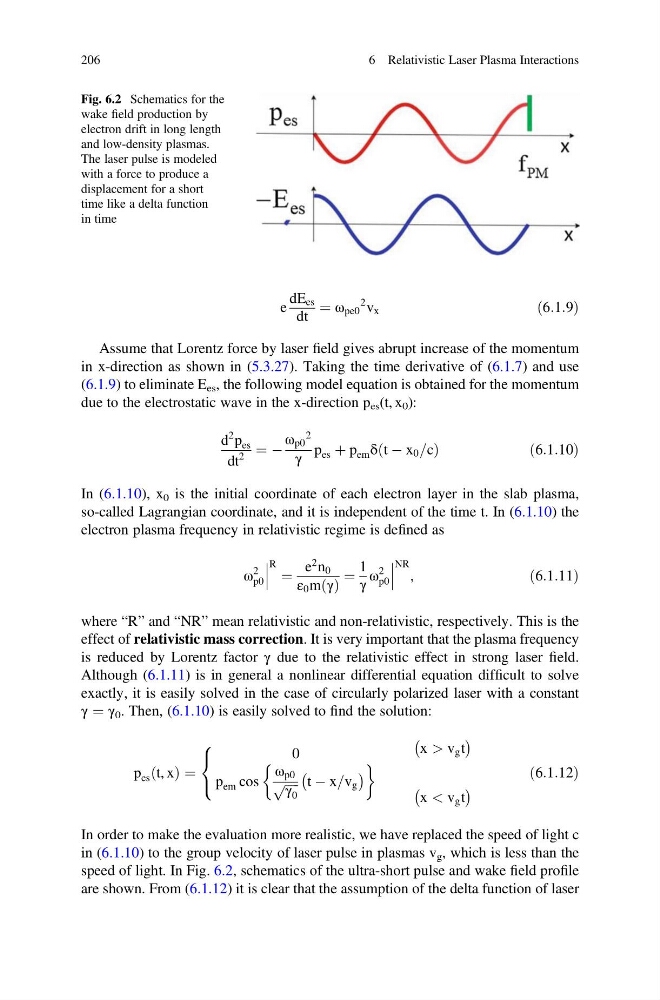
speed of light. In Fig. 6.2, schematics of the ultra-short pulse and wake field profile
are shown. From (6.1.12) it is clear that the assumption of the delta function of laser
Fig. 6.2 Schematics for the
wake field production by
electron drift in long length
and low-density plasmas.
The laser pulse is modeled
with a force to produce a
displacement for a short
time like a delta function
in time
206
6 Relativistic Laser Plasma Interactions
dE es
dt
¼ ω pe0
2 v x
ð6:1:9Þ
Assume that Lorentz force by laser field gives abrupt increase of the momentum
in x-direction as shown in (5.3.27). Taking the time derivative of (6.1.7) and use
(6.1.9) to eliminate E es , the following model equation is obtained for the momentum
due to the electrostatic wave in the x-direction p es (t, x 0 ):
d
2 p es
dt
2
¼ À
ω p0
2
γ
p es þ p em δ t À x 0 =c
ð
Þ
ð 6:1:10Þ
In (6.1.10), x 0 is the initial coordinate of each electron layer in the slab plasma,
so-called Lagrangian coordinate, and it is independent of the time t. In (6.1.10) the
electron plasma frequency in relativistic regime is defined as
ω
2
p0
R ¼
e
2 n 0
ε 0 m γ
ð Þ
¼
1
γ
ω
2
p0
NR
,
ð6:1:11Þ
where “R” and “NR” mean relativistic and non-relativistic, respectively. This is the
effect of relativistic mass correction. It is very important that the plasma frequency
is reduced by Lorentz factor γ due to the relativistic effect in strong laser field.
Although (6.1.11) is in general a nonlinear differential equation difficult to solve
exactly, it is easily solved in the case of circularly polarized laser with a constant
γ ¼ γ 0 . Then, (6.1.10) is easily solved to find the solution:
p es t, x
ð Þ ¼
0
p em cos
ω p0
ffiffiffiffi ffi
γ 0
p t À x=v g
À
Á
&
'
8
<
:
x > v g t
À
Á
x < v g t
À
Á
ð6:1:12Þ
In order to make the evaluation more realistic, we have replaced the speed of light c
in (6.1.10) to the group velocity of laser pulse in plasmas v g , which is less than the
speed of light. In Fig. 6.2, schematics of the ultra-short pulse and wake field profile
are shown. From (6.1.12) it is clear that the assumption of the delta function of laser
Fig. 6.2 Schematics for the
wake field production by
electron drift in long length
and low-density plasmas.
The laser pulse is modeled
with a force to produce a
displacement for a short
time like a delta function
in time
206
6 Relativistic Laser Plasma Interactions