

pulse is a good approximation if the wavelength of the wake plasma wave is longer
than the pulse duration, namely, the density is low enough.
From (6.1.12), it is clear that the laser energy is used to generate the wake field.
This is equivalent to laser absorption by plasmas. The energy densities of laser field
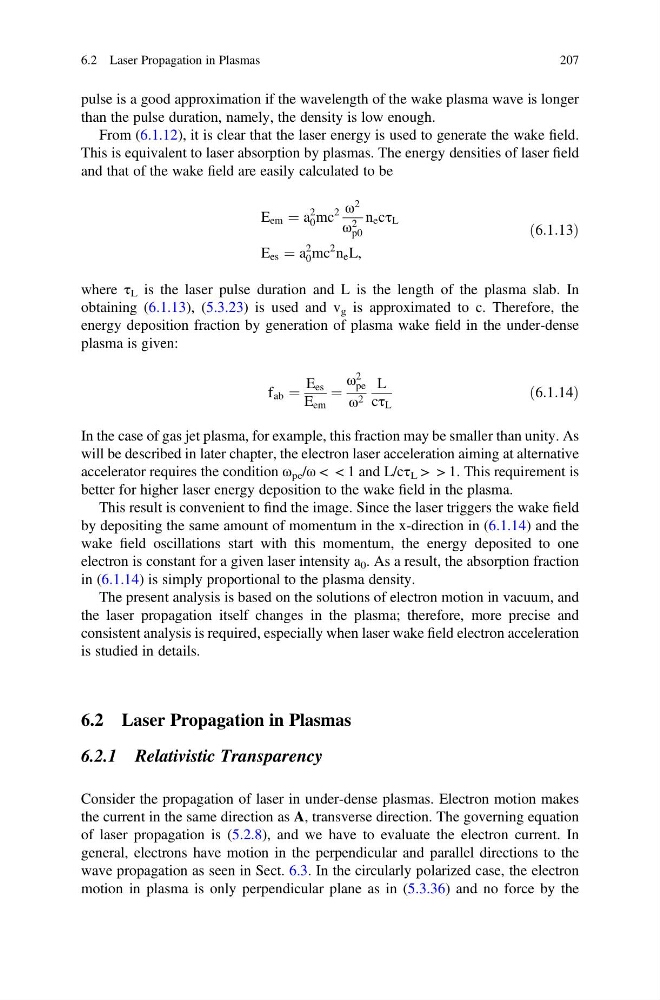
and that of the wake field are easily calculated to be
E em ¼ a
2
0 mc
2 ω
2
ω 2
p0
n e cτ L
E es ¼ a
2
0 mc
2 n e L,
ð6:1:13Þ
where τ L is the laser pulse duration and L is the length of the plasma slab. In
obtaining (6.1.13), (5.3.23) is used and v g is approximated to c. Therefore, the
energy deposition fraction by generation of plasma wake field in the under-dense
plasma is given:
f ab ¼
E es
E em
¼
ω
2
pe
ω 2
L
cτ L
ð6:1:14Þ
In the case of gas jet plasma, for example, this fraction may be smaller than unity. As
will be described in later chapter, the electron laser acceleration aiming at alternative
accelerator requires the condition ω pe /ω < < 1 and L/cτ L > > 1. This requirement is
better for higher laser energy deposition to the wake field in the plasma.
This result is convenient to find the image. Since the laser triggers the wake field
by depositing the same amount of momentum in the x-direction in (6.1.14) and the
wake field oscillations start with this momentum, the energy deposited to one
electron is constant for a given laser intensity a 0 . As a result, the absorption fraction
in (6.1.14) is simply proportional to the plasma density.
The present analysis is based on the solutions of electron motion in vacuum, and
the laser propagation itself changes in the plasma; therefore, more precise and
consistent analysis is required, especially when laser wake field electron acceleration
is studied in details.
6.2 Laser Propagation in Plasmas
6.2.1 Relativistic Transparency
Consider the propagation of laser in under-dense plasmas. Electron motion makes
the current in the same direction as A, transverse direction. The governing equation
of laser propagation is (5.2.8), and we have to evaluate the electron current. In
general, electrons have motion in the perpendicular and parallel directions to the
wave propagation as seen in Sect. 6.3. In the circularly polarized case, the electron
motion in plasma is only perpendicular plane as in (5.3.36) and no force by the
6.2 Laser Propagation in Plasmas
207
than the pulse duration, namely, the density is low enough.
From (6.1.12), it is clear that the laser energy is used to generate the wake field.
This is equivalent to laser absorption by plasmas. The energy densities of laser field
and that of the wake field are easily calculated to be
E em ¼ a
2
0 mc
2 ω
2
ω 2
p0
n e cτ L
E es ¼ a
2
0 mc
2 n e L,
ð6:1:13Þ
where τ L is the laser pulse duration and L is the length of the plasma slab. In
obtaining (6.1.13), (5.3.23) is used and v g is approximated to c. Therefore, the
energy deposition fraction by generation of plasma wake field in the under-dense
plasma is given:
f ab ¼
E es
E em
¼
ω
2
pe
ω 2
L
cτ L
ð6:1:14Þ
In the case of gas jet plasma, for example, this fraction may be smaller than unity. As
will be described in later chapter, the electron laser acceleration aiming at alternative
accelerator requires the condition ω pe /ω < < 1 and L/cτ L > > 1. This requirement is
better for higher laser energy deposition to the wake field in the plasma.
This result is convenient to find the image. Since the laser triggers the wake field
by depositing the same amount of momentum in the x-direction in (6.1.14) and the
wake field oscillations start with this momentum, the energy deposited to one
electron is constant for a given laser intensity a 0 . As a result, the absorption fraction
in (6.1.14) is simply proportional to the plasma density.
The present analysis is based on the solutions of electron motion in vacuum, and
the laser propagation itself changes in the plasma; therefore, more precise and
consistent analysis is required, especially when laser wake field electron acceleration
is studied in details.
6.2 Laser Propagation in Plasmas
6.2.1 Relativistic Transparency
Consider the propagation of laser in under-dense plasmas. Electron motion makes
the current in the same direction as A, transverse direction. The governing equation
of laser propagation is (5.2.8), and we have to evaluate the electron current. In
general, electrons have motion in the perpendicular and parallel directions to the
wave propagation as seen in Sect. 6.3. In the circularly polarized case, the electron
motion in plasma is only perpendicular plane as in (5.3.36) and no force by the
6.2 Laser Propagation in Plasmas
207