

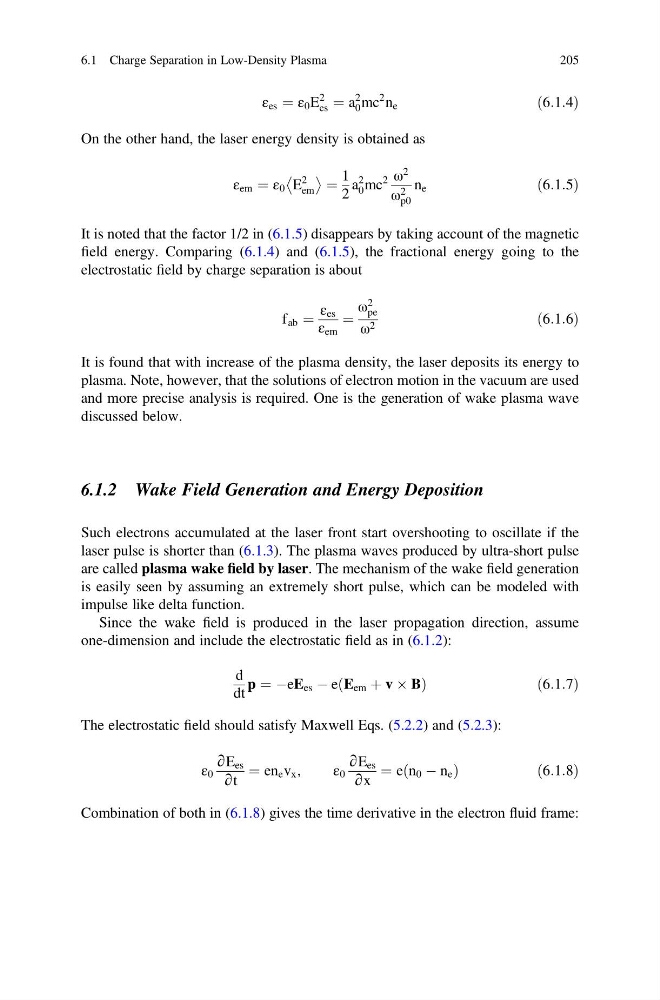
ε es ¼ ε 0 E
2
es ¼ a
2
0 mc
2 n e
ð6:1:4Þ
On the other hand, the laser energy density is obtained as
ε em ¼ ε 0 E
2
em
¼
1
2
a
2
0 mc
2 ω
2
ω 2
p0
n e
ð6:1:5Þ
It is noted that the factor 1/2 in (6.1.5) disappears by taking account of the magnetic
field energy. Comparing (6.1.4) and (6.1.5), the fractional energy going to the
electrostatic field by charge separation is about
f ab ¼
ε es
ε em
¼
ω
2
pe
ω 2
ð6:1:6Þ
It is found that with increase of the plasma density, the laser deposits its energy to
plasma. Note, however, that the solutions of electron motion in the vacuum are used
and more precise analysis is required. One is the generation of wake plasma wave
discussed below.
6.1.2 Wake Field Generation and Energy Deposition
Such electrons accumulated at the laser front start overshooting to oscillate if the
laser pulse is shorter than (6.1.3). The plasma waves produced by ultra-short pulse
are called plasma wake field by laser. The mechanism of the wake field generation
is easily seen by assuming an extremely short pulse, which can be modeled with
impulse like delta function.
Since the wake field is produced in the laser propagation direction, assume
one-dimension and include the electrostatic field as in (6.1.2):
d
dt
p ¼ ÀeE es À e E em þ v  B
ð
Þ
ð 6:1:7Þ
The electrostatic field should satisfy Maxwell Eqs. (5.2.2) and (5.2.3):
ε 0
∂E es
∂t
¼ en e v x ,
ε 0
∂E es
∂x
¼ e n 0 À n e
ð
Þ
ð6:1:8Þ
Combination of both in (6.1.8) gives the time derivative in the electron fluid frame:
6.1 Charge Separation in Low-Density Plasma
205
2
es ¼ a
2
0 mc
2 n e
ð6:1:4Þ
On the other hand, the laser energy density is obtained as
ε em ¼ ε 0 E
2
em
¼
1
2
a
2
0 mc
2 ω
2
ω 2
p0
n e
ð6:1:5Þ
It is noted that the factor 1/2 in (6.1.5) disappears by taking account of the magnetic
field energy. Comparing (6.1.4) and (6.1.5), the fractional energy going to the
electrostatic field by charge separation is about
f ab ¼
ε es
ε em
¼
ω
2
pe
ω 2
ð6:1:6Þ
It is found that with increase of the plasma density, the laser deposits its energy to
plasma. Note, however, that the solutions of electron motion in the vacuum are used
and more precise analysis is required. One is the generation of wake plasma wave
discussed below.
6.1.2 Wake Field Generation and Energy Deposition
Such electrons accumulated at the laser front start overshooting to oscillate if the
laser pulse is shorter than (6.1.3). The plasma waves produced by ultra-short pulse
are called plasma wake field by laser. The mechanism of the wake field generation
is easily seen by assuming an extremely short pulse, which can be modeled with
impulse like delta function.
Since the wake field is produced in the laser propagation direction, assume
one-dimension and include the electrostatic field as in (6.1.2):
d
dt
p ¼ ÀeE es À e E em þ v  B
ð
Þ
ð 6:1:7Þ
The electrostatic field should satisfy Maxwell Eqs. (5.2.2) and (5.2.3):
ε 0
∂E es
∂t
¼ en e v x ,
ε 0
∂E es
∂x
¼ e n 0 À n e
ð
Þ
ð6:1:8Þ
Combination of both in (6.1.8) gives the time derivative in the electron fluid frame:
6.1 Charge Separation in Low-Density Plasma
205