

d
dt
p x ¼ ÀeE es
ð6:1:1Þ
The electric field by the charge separation is enhanced with time as
E es $
en 0
ε 0
ct
ð6:1:2Þ
The electrons obtained the drift velocity by laser are decelerated and stop moving.
This time can be calculated with (6.1.1) and (6.1.2) to be
ωt ¼ a 0
ω
ω p0
ð6:1:3Þ
Insert parameters, for example, laser intensity 10
22 W/cm
2 (10
20 W/cm
2 ) and ω/
ω pe ¼ 10; the value of (6.1.3) is ωt ¼ 10
3 which corresponds to 500 fs (50 fs), which
is comparable to standard pulse durations. However, when lasers are irradiated to
high-density plasmas or to solid targets, the plasma density is high enough so that the
plasma frequency is of the order of laser frequency, ω p0 ¼ O(ω). The establishment
of the electrostatic field by charge separation is taken place very soon after ωt ~1.
Therefore, the drift motion of free electron derived in (5.3.27) is not realistic, and
electron motion is reasonable to describe with no drift motion shown in (5.3.33) with
condition (5.3.29).
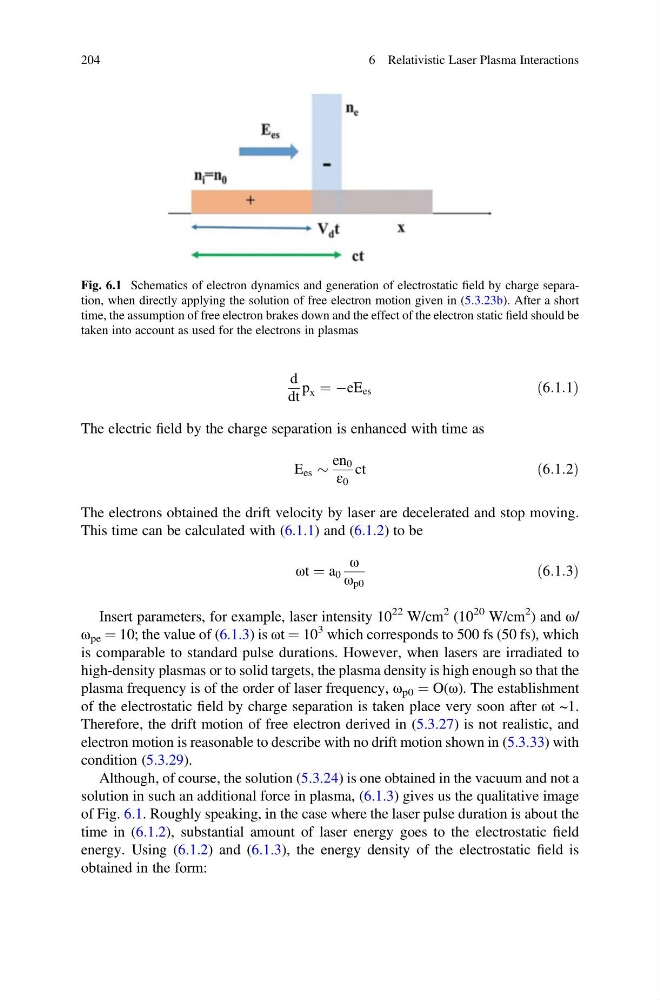
Although, of course, the solution (5.3.24) is one obtained in the vacuum and not a
solution in such an additional force in plasma, (6.1.3) gives us the qualitative image
of Fig. 6.1. Roughly speaking, in the case where the laser pulse duration is about the
time in (6.1.2), substantial amount of laser energy goes to the electrostatic field
energy. Using (6.1.2) and (6.1.3), the energy density of the electrostatic field is
obtained in the form:
Fig. 6.1 Schematics of electron dynamics and generation of electrostatic field by charge separation, when directly applying the solution of free electron motion given in (5.3.23b). After a short
time, the assumption of free electron brakes down and the effect of the electron static field should be
taken into account as used for the electrons in plasmas
204
6 Relativistic Laser Plasma Interactions
dt
p x ¼ ÀeE es
ð6:1:1Þ
The electric field by the charge separation is enhanced with time as
E es $
en 0
ε 0
ct
ð6:1:2Þ
The electrons obtained the drift velocity by laser are decelerated and stop moving.
This time can be calculated with (6.1.1) and (6.1.2) to be
ωt ¼ a 0
ω
ω p0
ð6:1:3Þ
Insert parameters, for example, laser intensity 10
22 W/cm
2 (10
20 W/cm
2 ) and ω/
ω pe ¼ 10; the value of (6.1.3) is ωt ¼ 10
3 which corresponds to 500 fs (50 fs), which
is comparable to standard pulse durations. However, when lasers are irradiated to
high-density plasmas or to solid targets, the plasma density is high enough so that the
plasma frequency is of the order of laser frequency, ω p0 ¼ O(ω). The establishment
of the electrostatic field by charge separation is taken place very soon after ωt ~1.
Therefore, the drift motion of free electron derived in (5.3.27) is not realistic, and
electron motion is reasonable to describe with no drift motion shown in (5.3.33) with
condition (5.3.29).
Although, of course, the solution (5.3.24) is one obtained in the vacuum and not a
solution in such an additional force in plasma, (6.1.3) gives us the qualitative image
of Fig. 6.1. Roughly speaking, in the case where the laser pulse duration is about the
time in (6.1.2), substantial amount of laser energy goes to the electrostatic field
energy. Using (6.1.2) and (6.1.3), the energy density of the electrostatic field is
obtained in the form:
Fig. 6.1 Schematics of electron dynamics and generation of electrostatic field by charge separation, when directly applying the solution of free electron motion given in (5.3.23b). After a short
time, the assumption of free electron brakes down and the effect of the electron static field should be
taken into account as used for the electrons in plasmas
204
6 Relativistic Laser Plasma Interactions