

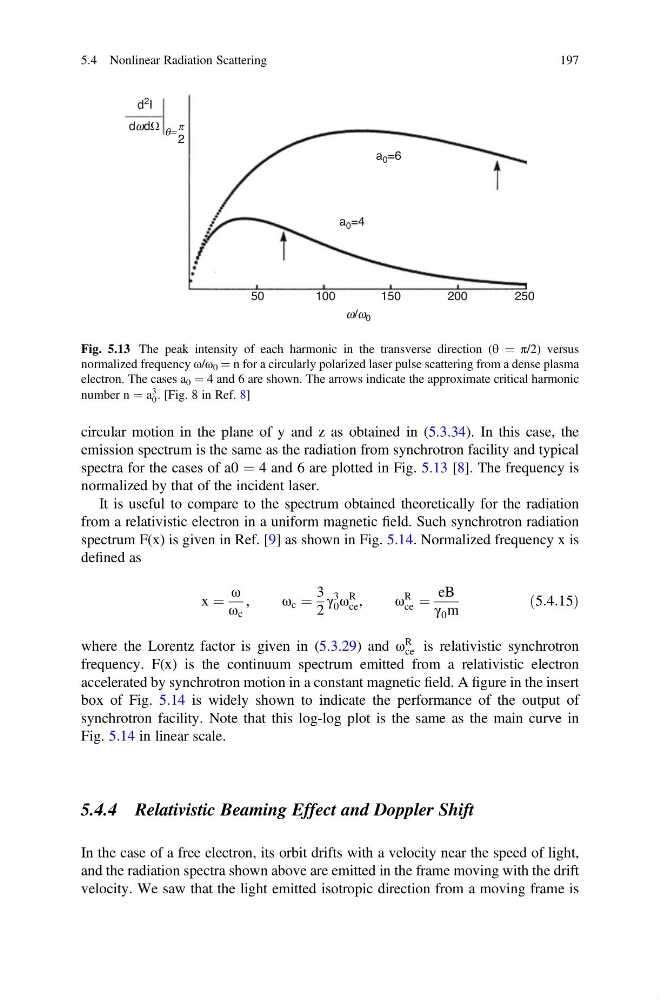
circular motion in the plane of y and z as obtained in (5.3.34). In this case, the
emission spectrum is the same as the radiation from synchrotron facility and typical
spectra for the cases of a0 ¼ 4 and 6 are plotted in Fig. 5.13 [8]. The frequency is
normalized by that of the incident laser.
It is useful to compare to the spectrum obtained theoretically for the radiation
from a relativistic electron in a uniform magnetic field. Such synchrotron radiation
spectrum F(x) is given in Ref. [9] as shown in Fig. 5.14. Normalized frequency x is
defined as
x ¼
ω
ω c
,
ω c ¼
3
2
γ
3
0 ω
R
ce ,
ω
R
ce ¼
eB
γ 0 m
ð5:4:15Þ
where the Lorentz factor is given in (5.3.29) and ω
R
ce is relativistic synchrotron
frequency. F(x) is the continuum spectrum emitted from a relativistic electron
accelerated by synchrotron motion in a constant magnetic field. A figure in the insert
box of Fig. 5.14 is widely shown to indicate the performance of the output of
synchrotron facility. Note that this log-log plot is the same as the main curve in
Fig. 5.14 in linear scale.
5.4.4 Relativistic Beaming Effect and Doppler Shift
In the case of a free electron, its orbit drifts with a velocity near the speed of light,
and the radiation spectra shown above are emitted in the frame moving with the drift
velocity. We saw that the light emitted isotropic direction from a moving frame is
50
100
a 0 =4
a 0 =6
150
200
250
d 2 I
dωdΩ
2
ω/ω 0
θ=
π
Fig. 5.13 The peak intensity of each harmonic in the transverse direction (θ ¼ π/2) versus
normalized frequency ω/ω 0 ¼ n for a circularly polarized laser pulse scattering from a dense plasma
electron. The cases a 0 ¼ 4 and 6 are shown. The arrows indicate the approximate critical harmonic
number n ¼ a
3
0 . [Fig. 8 in Ref. 8]
5.4 Nonlinear Radiation Scattering
197
emission spectrum is the same as the radiation from synchrotron facility and typical
spectra for the cases of a0 ¼ 4 and 6 are plotted in Fig. 5.13 [8]. The frequency is
normalized by that of the incident laser.
It is useful to compare to the spectrum obtained theoretically for the radiation
from a relativistic electron in a uniform magnetic field. Such synchrotron radiation
spectrum F(x) is given in Ref. [9] as shown in Fig. 5.14. Normalized frequency x is
defined as
x ¼
ω
ω c
,
ω c ¼
3
2
γ
3
0 ω
R
ce ,
ω
R
ce ¼
eB
γ 0 m
ð5:4:15Þ
where the Lorentz factor is given in (5.3.29) and ω
R
ce is relativistic synchrotron
frequency. F(x) is the continuum spectrum emitted from a relativistic electron
accelerated by synchrotron motion in a constant magnetic field. A figure in the insert
box of Fig. 5.14 is widely shown to indicate the performance of the output of
synchrotron facility. Note that this log-log plot is the same as the main curve in
Fig. 5.14 in linear scale.
5.4.4 Relativistic Beaming Effect and Doppler Shift
In the case of a free electron, its orbit drifts with a velocity near the speed of light,
and the radiation spectra shown above are emitted in the frame moving with the drift
velocity. We saw that the light emitted isotropic direction from a moving frame is
50
100
a 0 =4
a 0 =6
150
200
250
d 2 I
dωdΩ
2
ω/ω 0
θ=
π
Fig. 5.13 The peak intensity of each harmonic in the transverse direction (θ ¼ π/2) versus
normalized frequency ω/ω 0 ¼ n for a circularly polarized laser pulse scattering from a dense plasma
electron. The cases a 0 ¼ 4 and 6 are shown. The arrows indicate the approximate critical harmonic
number n ¼ a
3
0 . [Fig. 8 in Ref. 8]
5.4 Nonlinear Radiation Scattering
197