

intensity is in the y-direction, and the maximum intensity is shifted to the higher
harmonics components.
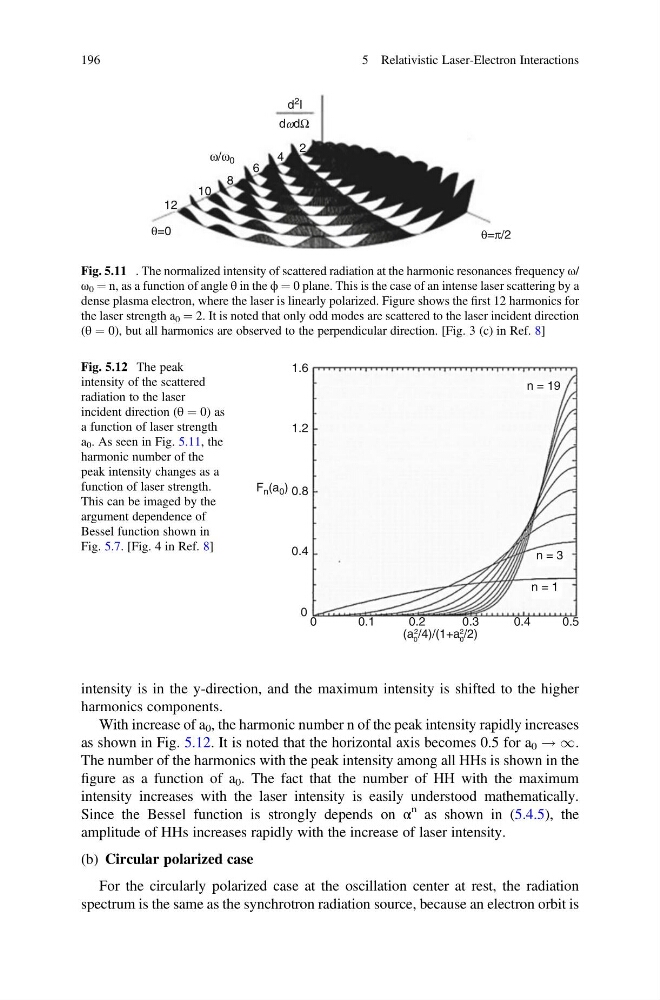
With increase of a 0 , the harmonic number n of the peak intensity rapidly increases
as shown in Fig. 5.12. It is noted that the horizontal axis becomes 0.5 for a 0 ! 1.
The number of the harmonics with the peak intensity among all HHs is shown in the
figure as a function of a 0 . The fact that the number of HH with the maximum
intensity increases with the laser intensity is easily understood mathematically.
Since the Bessel function is strongly depends on α
n as shown in (5.4.5), the
amplitude of HHs increases rapidly with the increase of laser intensity.
(b) Circular polarized case
For the circularly polarized case at the oscillation center at rest, the radiation
spectrum is the same as the synchrotron radiation source, because an electron orbit is
2
d 2 I
dwdΩ
ω/ω 0
θ=0
θ=π/2
4
6
8
10
12
Fig. 5.11 . The normalized intensity of scattered radiation at the harmonic resonances frequency ω/
ω 0 ¼ n, as a function of angle θ in the ϕ ¼ 0 plane. This is the case of an intense laser scattering by a
dense plasma electron, where the laser is linearly polarized. Figure shows the first 12 harmonics for
the laser strength a 0 ¼ 2. It is noted that only odd modes are scattered to the laser incident direction
(θ ¼ 0), but all harmonics are observed to the perpendicular direction. [Fig. 3 (c) in Ref. 8]
1.6
1.2
0.8
F n (a 0 )
0.4
0
0
0.1
0.2
0.3
(a 0
2 /4)/(1+a 0
2
/2)
0.4
0.5
n = 3
n = 1
n = 19
Fig. 5.12 The peak
intensity of the scattered
radiation to the laser
incident direction (θ ¼ 0) as
a function of laser strength
a 0 . As seen in Fig. 5.11, the
harmonic number of the
peak intensity changes as a
function of laser strength.
This can be imaged by the
argument dependence of
Bessel function shown in
Fig. 5.7. [Fig. 4 in Ref. 8]
196
5 Relativistic Laser-Electron Interactions
harmonics components.
With increase of a 0 , the harmonic number n of the peak intensity rapidly increases
as shown in Fig. 5.12. It is noted that the horizontal axis becomes 0.5 for a 0 ! 1.
The number of the harmonics with the peak intensity among all HHs is shown in the
figure as a function of a 0 . The fact that the number of HH with the maximum
intensity increases with the laser intensity is easily understood mathematically.
Since the Bessel function is strongly depends on α
n as shown in (5.4.5), the
amplitude of HHs increases rapidly with the increase of laser intensity.
(b) Circular polarized case
For the circularly polarized case at the oscillation center at rest, the radiation
spectrum is the same as the synchrotron radiation source, because an electron orbit is
2
d 2 I
dwdΩ
ω/ω 0
θ=0
θ=π/2
4
6
8
10
12
Fig. 5.11 . The normalized intensity of scattered radiation at the harmonic resonances frequency ω/
ω 0 ¼ n, as a function of angle θ in the ϕ ¼ 0 plane. This is the case of an intense laser scattering by a
dense plasma electron, where the laser is linearly polarized. Figure shows the first 12 harmonics for
the laser strength a 0 ¼ 2. It is noted that only odd modes are scattered to the laser incident direction
(θ ¼ 0), but all harmonics are observed to the perpendicular direction. [Fig. 3 (c) in Ref. 8]
1.6
1.2
0.8
F n (a 0 )
0.4
0
0
0.1
0.2
0.3
(a 0
2 /4)/(1+a 0
2
/2)
0.4
0.5
n = 3
n = 1
n = 19
Fig. 5.12 The peak
intensity of the scattered
radiation to the laser
incident direction (θ ¼ 0) as
a function of laser strength
a 0 . As seen in Fig. 5.11, the
harmonic number of the
peak intensity changes as a
function of laser strength.
This can be imaged by the
argument dependence of
Bessel function shown in
Fig. 5.7. [Fig. 4 in Ref. 8]
196
5 Relativistic Laser-Electron Interactions