

(a) Linear polarization case
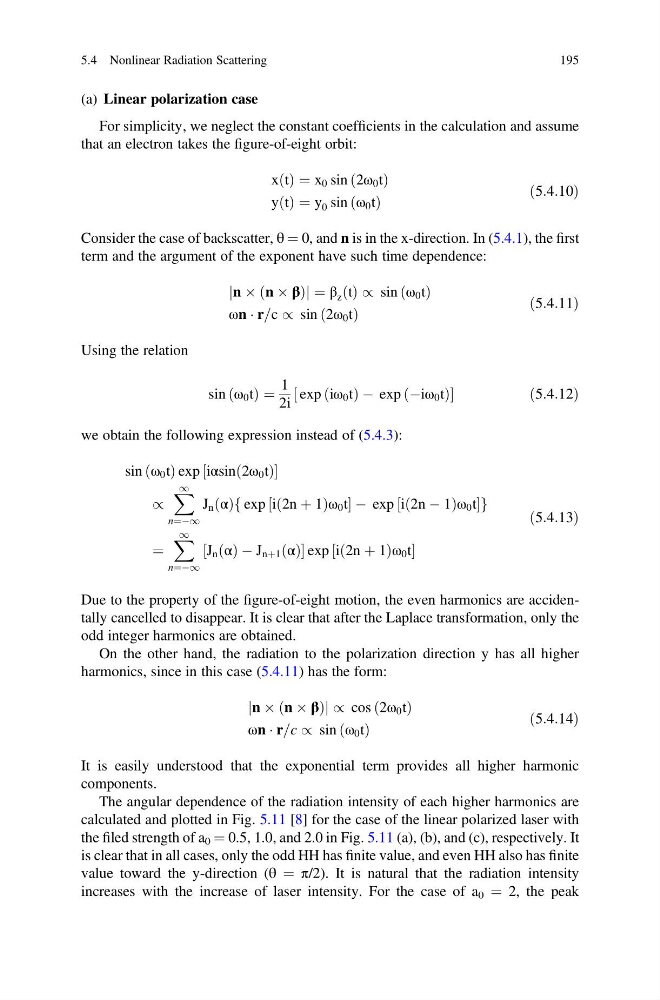
For simplicity, we neglect the constant coefficients in the calculation and assume
that an electron takes the figure-of-eight orbit:
x t
ð Þ ¼ x 0 sin 2ω 0 t
ð
Þ
y t
ð Þ ¼ y 0 sin ω 0 t
ð Þ
ð5:4:10Þ
Consider the case of backscatter, θ ¼ 0, and n is in the x-direction. In (5.4.1), the first
term and the argument of the exponent have such time dependence:
n  n  β
ð
Þ
j
j¼ β z t
ð Þ / sin ω 0 t
ð Þ
ωn Á r=c / sin 2ω 0 t
ð
Þ
ð5:4:11Þ
Using the relation
sin ω 0 t
ð Þ ¼
1
2i
exp iω 0 t
ð
ÞÀ exp Àiω 0 t
ð
Þ
½
ð 5:4:12Þ
we obtain the following expression instead of (5.4.3):
sin ω 0 t
ð Þexp iαsin 2ω 0 t
ð
Þ
½
/
X 1
n¼À1
J n α
ð Þ exp i 2n þ 1
ð
Þω 0 t
½
Àexp i 2n À 1
ð
Þω 0 t
½
f
g
¼
X 1
n¼À1
J n α
ð Þ À J nþ1 α
ð Þ
½
exp i 2n þ 1
ð
Þω 0 t
½
ð5:4:13Þ
Due to the property of the figure-of-eight motion, the even harmonics are accidentally cancelled to disappear. It is clear that after the Laplace transformation, only the
odd integer harmonics are obtained.
On the other hand, the radiation to the polarization direction y has all higher
harmonics, since in this case (5.4.11) has the form:
n  n  β
ð
Þ
j
j/ cos 2ω 0 t
ð
Þ
ωn Á r=c / sin ω 0 t
ð Þ
ð5:4:14Þ
It is easily understood that the exponential term provides all higher harmonic
components.
The angular dependence of the radiation intensity of each higher harmonics are
calculated and plotted in Fig. 5.11 [8] for the case of the linear polarized laser with
the filed strength of a 0 ¼ 0.5, 1.0, and 2.0 in Fig. 5.11 (a), (b), and (c), respectively. It
is clear that in all cases, only the odd HH has finite value, and even HH also has finite
value toward the y-direction (θ ¼ π/2). It is natural that the radiation intensity
increases with the increase of laser intensity. For the case of a 0 ¼ 2, the peak
5.4 Nonlinear Radiation Scattering
195
For simplicity, we neglect the constant coefficients in the calculation and assume
that an electron takes the figure-of-eight orbit:
x t
ð Þ ¼ x 0 sin 2ω 0 t
ð
Þ
y t
ð Þ ¼ y 0 sin ω 0 t
ð Þ
ð5:4:10Þ
Consider the case of backscatter, θ ¼ 0, and n is in the x-direction. In (5.4.1), the first
term and the argument of the exponent have such time dependence:
n  n  β
ð
Þ
j
j¼ β z t
ð Þ / sin ω 0 t
ð Þ
ωn Á r=c / sin 2ω 0 t
ð
Þ
ð5:4:11Þ
Using the relation
sin ω 0 t
ð Þ ¼
1
2i
exp iω 0 t
ð
ÞÀ exp Àiω 0 t
ð
Þ
½
ð 5:4:12Þ
we obtain the following expression instead of (5.4.3):
sin ω 0 t
ð Þexp iαsin 2ω 0 t
ð
Þ
½
/
X 1
n¼À1
J n α
ð Þ exp i 2n þ 1
ð
Þω 0 t
½
Àexp i 2n À 1
ð
Þω 0 t
½
f
g
¼
X 1
n¼À1
J n α
ð Þ À J nþ1 α
ð Þ
½
exp i 2n þ 1
ð
Þω 0 t
½
ð5:4:13Þ
Due to the property of the figure-of-eight motion, the even harmonics are accidentally cancelled to disappear. It is clear that after the Laplace transformation, only the
odd integer harmonics are obtained.
On the other hand, the radiation to the polarization direction y has all higher
harmonics, since in this case (5.4.11) has the form:
n  n  β
ð
Þ
j
j/ cos 2ω 0 t
ð
Þ
ωn Á r=c / sin ω 0 t
ð Þ
ð5:4:14Þ
It is easily understood that the exponential term provides all higher harmonic
components.
The angular dependence of the radiation intensity of each higher harmonics are
calculated and plotted in Fig. 5.11 [8] for the case of the linear polarized laser with
the filed strength of a 0 ¼ 0.5, 1.0, and 2.0 in Fig. 5.11 (a), (b), and (c), respectively. It
is clear that in all cases, only the odd HH has finite value, and even HH also has finite
value toward the y-direction (θ ¼ π/2). It is natural that the radiation intensity
increases with the increase of laser intensity. For the case of a 0 ¼ 2, the peak
5.4 Nonlinear Radiation Scattering
195